

10:31:02 AM | 5/29/2025

As the world strongly transitions toward renewable energy sources to reduce greenhouse gas emissions and combat climate change, developing efficient energy storage solutions has become more critical than ever. In Vietnam, LS ELECTRIC Vietnam has taken the lead in deploying and supplying advanced energy storage systems (ESS), thus playing a vital role in the country’s energy transition.
Overview of the ESS System
LS ELECTRIC Vietnam’s Energy Storage System (ESS) is an integrated architecture that stores electricity from the power grid or renewable energy sources and discharges it when needed. Its core functions include charging, discharging, monitoring, control and power quality management. This system helps reduce grid load during peak hours, enhances grid stability, and supports optimal energy management.
The overall architecture of an LS ELECTRIC Vietnam ESS system comprises three main components: Power devices, battery, and control and monitoring software system (PMS, BMS and PCS). In particular, the power devices act as the “entry port” connecting the ESS system to the grid, including transformer (adjusting voltage levels for charging/discharging), circuit breaker and switches (providing protection and isolating faults), protection relays (automatically disconnecting the system in case of abnormal current flows). These components ensure safe, stable and efficient charging-discharging processes between the grid and the battery storage system, and vice versa.
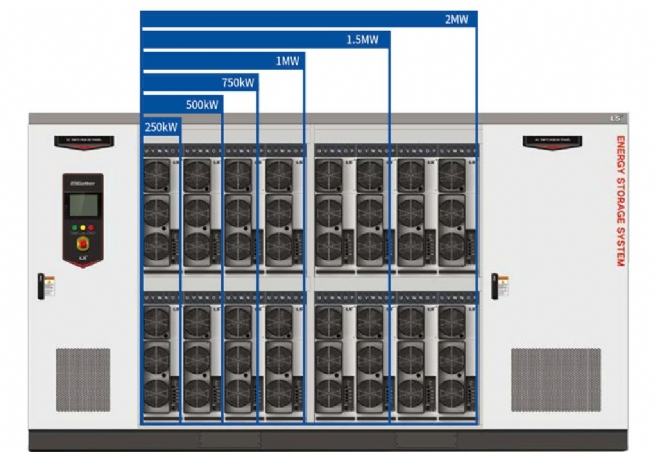
LS ELECTRIC Vietnam ESS Energy Storage System
The “Heart” of the System: Power Conditioning System
The Power Conditioning System (PCS) is often referred to as the “heart” of the ESS system. It is a bidirectional AC-DC converter that enables Charging (Converting alternating current (AC) from the grid into direct current (DC) for battery storage) and Discharging (Converting DC from the batteries into AC to supply loads or feed back into the grid.
Additionally, PCS performs voltage regulation and noise filtering and ensures the output power quality meets technical standards. For that reason, PCS works as an “intelligent intermediary station” between the storage sources and the overall power system.
Storage battery & smart management system
Storage batteries, also called lithium-ion batteries, are typically chosen for their high energy density, long life span (10-15 years), and fast, stable discharge capability. These batteries store electricity from the grid or renewable sources during charging and supply energy to loads or return power to the grid during discharging.
The Battery Management System (BMS) ensures safe and efficient battery operation. BMS monitors voltage, current, temperature and charge/discharge cycles of each cell; automatically disconnects in case of anomalies; and balances cell voltages to prolong battery life. With LS ELECTRIC Vietnam’s solutions, BMS features a centralized battery management system integrated with overall control software platforms.
PMS - The “brain” of the entire system
The Power Management System (PMS) serves as the central control unit that coordinates, monitors and optimizes all ESS operations. PMS capabilities include real-time monitoring; communication with SCADA or EMS systems; load forecasting and data analytics; and scheduling and coordination of charge/discharge cycles.
Developed by LS ELECTRIC Vietnam, PMS features a user-friendly interface with remote access via computers or mobile devices, affording both businesses and professional operators.
Real-world applications in Vietnam and the world
Since 2008, LS ELECTRIC has successfully implemented 164 ESS projects across 24 countries in diverse sectors including steel industry (SEAH), water treatment plants (Hwameong), solar power (Youngam PV+ESS) and frequency and voltage regulation projects in the United Kingdom and South Korea. Notably, projects on Jeju Marado Island and Deokjeokdo Island have demonstrated ESS effectiveness in replacing diesel-fueled generators with renewable energy and storage systems.
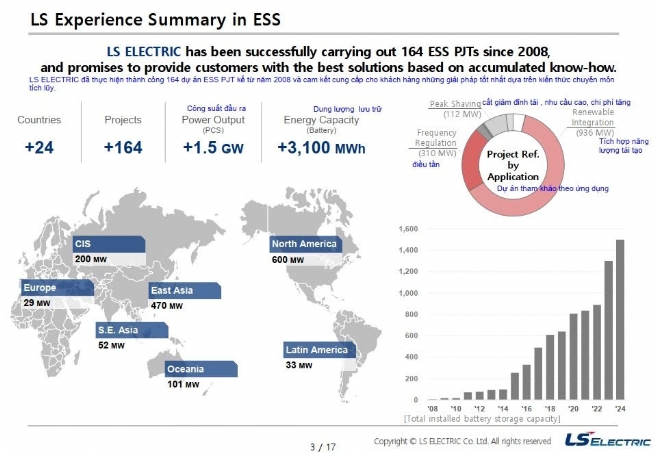
Partners highly appreciate ESS for its superior features to enhance efficiency and system stability, particularly the capacity to store surplus renewable energy for use when needed, stabilize the grid, and regulate frequency and voltage. For businesses, ESS systems help reduce electricity bills by storing cheaper electricity during off-peak hours and supplying it during peak hours. Specially, ESS also functions as a reliable backup power source, ensuring uninterrupted operation for critical infrastructure such as data centers and production lines in the event of power outages or system failures.
In Vietnam, the adoption of ESS technologies is gaining momentum. LS ELECTRIC Vietnam offers storage solutions ranging from a few hundred kWh to several MWh, tailored to the needs of industrial plants, commercial centers, hospitals, offices and renewable energy projects with a high demand for large-scale storage.
Notable projects include the smart energy plant in Yen Phong Industrial Park (Bac Ninh province) where LS ELECTRIC Vietnam deployed a grid-connected ESS system for energy-efficient operation and the PECC2 project that integrates emergency power generation to ensure uninterrupted electricity supply during unexpected events like grid outages or system failures.
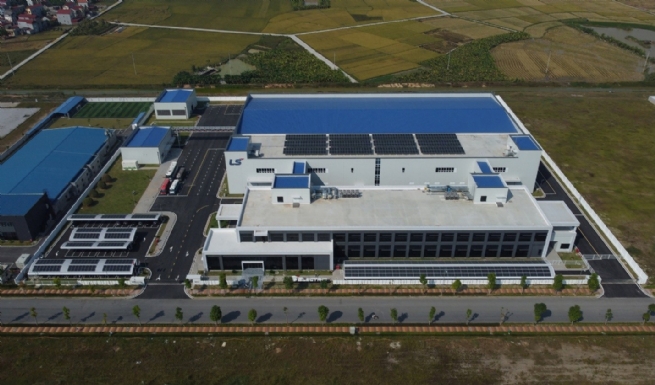
The first smart energy-applied plant in Northern Vietnam by LS ELECTRIC Vietnam in Expanded Yen Phong Industrial Park
Toward a smart energy future
LS ELECTRIC Vietnam’s ESS systems are more than just a technical solution but also a key to open a smart, flexible, and sustainable energy future. With an integrated design, advanced technologies, scalable architecture and tangible economic benefits, ESS not only helps businesses reduce costs but also contributes to the country's efforts to enhance carbon emission reductions, environmental protection and energy security.
Source: Vietnam Business Forum


 Vietnamese





