

9:18:40 AM | 10/16/2025

According to Da Nang Statistics, in the first nine months of 2025, the city’s fisheries sector not only met its planned targets for capture and aquaculture production but also gradually restructured toward sustainable, modern, and efficient development.
In the first nine months of 2025, fisheries activities in Da Nang City remained stable and achieved the set targets and plans, making an important contribution to maintaining the growth rate of the agriculture, forestry, and fisheries sector.
The city’s total aquatic production was estimated at 140.5 thousand tons, up 2.7% year-on-year. Of this, fish accounted for over 96 thousand tons (+3.2%), shrimp nearly 20.4 thousand tons (+3.3%), and other aquatic products about 24.2 thousand tons (+0.4%). In September 2025 alone, total aquatic production was approximately 16.6 thousand tons, down 1.1% from the same period last year.
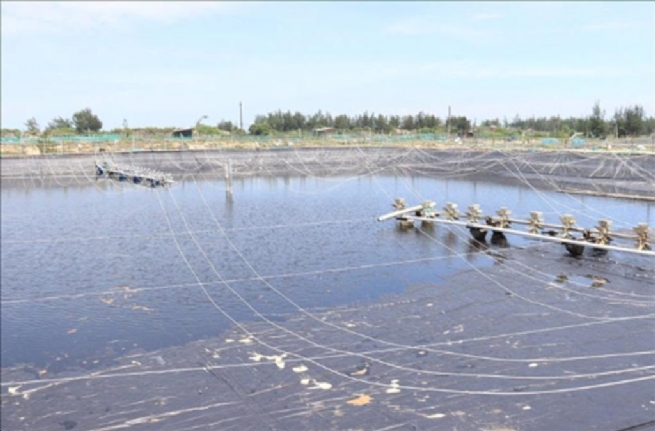
Expanding farming areas and diversifying aquaculture methods help enhance production value and increase local farmers’ income. Photo: Lan Anh
Regarding aquaculture, production remained stable, farmed species developed normally, and no disease outbreaks were reported. In September 2025, aquaculture output was estimated at 5.4 thousand tons, up 3.7% compared to the same period last year. Cumulatively, in the first nine months of 2025, aquaculture production was estimated at over 27 thousand tons, an increase of 3.2% year-on-year. The total aquaculture area reached nearly 5.3 thousand hectares, up 2.6% from the same period in 2024; of which fish farming areas accounted for over 2.3 thousand hectares, up 2%. The main farming methods were intensive and semi-intensive systems (accounting for over 48.9%), mostly applied to brackish-water shrimp farming. In addition, by taking advantage of natural ponds, lakes, and reservoirs, local farmers adopted extensive and improved extensive farming methods, combining partial harvesting and restocking, which help maintain diverse production systems suited to the specific conditions of each farming area.
In the fisheries exploitation sector, Da Nang continues to implement central and local policies and mechanisms to support and encourage fishermen to venture offshore, promote distant-water fishing, and gradually reduce nearshore fishing activities, which are less efficient and negatively impact marine resources. The adjustment of the fishing fleet structure toward modernization and a focus on offshore vessels not only improves production efficiency but also contributes to addressing the “yellow card” imposed on Vietnam’s seafood industry. The local authorities are also implementing policies to assist coastal fishermen in shifting to more sustainable and profitable livelihoods, thereby limiting destructive fishing practices and helping protect and restore aquatic resources.
As of now, the city has 4,469 fishing and fishing logistics vessels with a total engine capacity of 766.2 thousand HP, averaging 171.4 HP per vessel, down 5.6 HP compared to the same period last year. Of these, 4,405 vessels are engaged in marine fishing, including 1,021 offshore vessels (23.2%), 868 midshore vessels (19.7%), and 2,516 nearshore vessels (57.1%). The main fishing gears include surface gillnets (1,394 vessels, 31.6%), single trawls (432 vessels, 9.8%), bottom gillnets (492 vessels, 11.2%), handline fishing (451 vessels, 10.2%), and other gears (980 vessels, 22.2%).
In September 2025, capture fisheries output was estimated at over 11 thousand tons, down 3.3% (–383 tons) compared to the same period last year. Cumulatively, in the first nine months of 2025, capture production reached 113.4 thousand tons, up 2.6% year-on-year, including marine capture at 106 thousand tons (+2.7%, accounting for 93.5% of total capture) and inland capture at nearly 7.4 thousand tons (+0.9%).
Overall, Da Nang’s fisheries sector in the first nine months of 2025 has not only achieved its production targets but also continued its transition toward sustainability, modernization, and efficiency. Efforts to promote offshore fishing in parallel with resource regeneration, along with expanding farming areas and diversifying aquaculture methods, have helped enhance production value and fishermen’s income. The fisheries sector continues to play an important role in Da Nang’s agricultural structure, ensuring social welfare and making a practical contribution to the city’s socio-economic growth goals.
Source: VASEP
 April 24–25, 2026
 Kinh Bac Cultural Center, Bac Ninh Province


 Vietnamese





