

1:43:14 PM | 12/18/2025

Bac Ninh is entering a new period of acceleration, aiming to develop an airport city in Gia Binh. The project will expand international connectivity and drive breakthrough economic and urban development. With modern infrastructure and strong potential in industry, services, and cultural tourism, the province expects not only to upgrade its urban profile but also to create strong momentum for investment attraction, turning its development goals into reality in the near future.
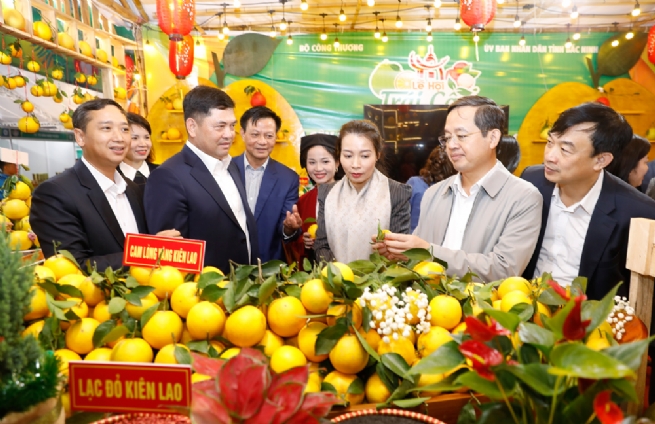
Bac Ninh provincial leaders visit the fruit and OCOP product exhibition area at the Fruit Festival 2025
Breakthrough from an expanded development space
The year 2025 marks a historic turning point as Bac Ninh begins reorganizing and expanding its administrative boundaries, forming a new Bac Ninh province with a larger population, broader space, and stronger economic capacity. The new administrative structure of 99 communes and wards, a two-tier local government model, and expanded regional connectivity create an unprecedented development foundation for the 2025-2030 period. This new posture opens a strategic planning phase based on a completely different development space: wider, more synchronized, and rich in opportunities for regional linkages.
The First Congress of the Bac Ninh Provincial Party Committee for the 2025- 2030 term sets a core objective: to make Bac Ninh a centrally governed city before 2030 and a green, modern city by 2045 that carries the cultural identity of the Kinh Bac region. This vision positions the province on a transformative development path, shifting its growth model toward sustainability and high technology.
Speaking at the congress on September 30, 2025, Nguyen Duy Ngoc, then Chairman of the Party Central Committee’s Inspection Commission, stressed that the merger of Bac Giang and Bac Ninh creates new development opportunities as well as strategic geo-economic and geopolitical advantages. The newly merged province now holds a critical strategic position as the northeastern gateway to Hanoi and a key link between the northern midlands and mountainous region and the economic triangle of Hanoi-Hai Phong-Quang Ninh. These advantages give Bac Ninh the conditions for breakthrough development, expanding its development space, unlocking its full potential, and becoming a strong and sustainable growth engine. The province is also expected to evolve into one of the country’s major economic and industrial hubs, laying the groundwork for Bac Ninh to meet the criteria of a centrally governed city.
After 28 years since the separation of the former Ha Bac province, this restructuring is seen as a necessary step to restore the “strategic space” of a region that historically held a central position in the Kinh Bac cultural area. The new Bac Ninh focuses on organizing development space based on a cluster city model, a system of economic corridors, and multiple growth centers connected with Gia Binh International Airport and regional transport networks. Development following the transit-oriented development model (TOD) will shape a modern urban landscape and create an efficient spatial structure, opening the prospect of forming an “airport city” and even the future “Song Cau urban miracle.”
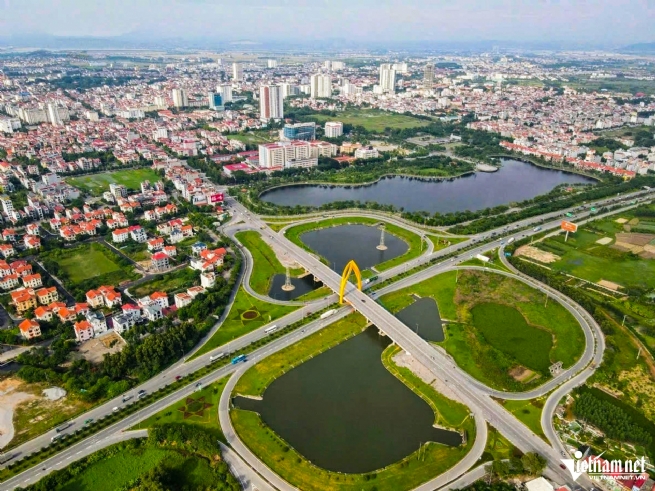
Bac Ninh is steadily advancing toward its goal of becoming a centrally governed city before 2030
Building a new growth model
As one of Vietnam’s earliest industrial provinces, Bac Ninh is now moving into a period of deeper economic restructuring. In 2025, development is based on three main pillars: high tech industry, modern services, and high-tech agriculture.
In industry, Bac Ninh has set clear targets. The province aims to become Vietnam’s leading electronics hub and expand key sectors such as manufacturing, digital devices, semiconductors, clean energy, new materials, and supporting industries. The industrial ecosystem is shifting toward greener, smarter, and more energy efficient operations, with a higher rate of localization. The province is focusing on selective investment attraction, prioritizing projects that create strong spillover effects, offer high added value, and support green growth and the national digital transformation strategy.
In services, Bac Ninh aims to develop high quality trade and services, especially regional logistics, finance, technical education, and technology transfer. The development of Gia Binh Airport and enhanced interregional infrastructure is expected to elevate Bac Ninh as a new logistics center of the Capital Region and support supply chain restructuring.
Agriculture is transitioning from traditional production to high tech, organic, and smart agriculture linked to advanced new rural development. Bac Ninh is prioritizing high-quality raw material zones, agricultural logistics centers, and stronger connections with processing industries to create high and sustainable added value.
These pillars are supported by a unified system of urban development, economic infrastructure, and digital infrastructure, ensuring balanced growth across urban, industrial, and rural areas.
Improving business environment - a driving force for development
In the new development context, the investment-business environment remains the “frontline” where Bac Ninh seeks to create breakthroughs. The province affirms that improving competitiveness and enhancing the investment climate is not merely an administrative task but a core driver of growth amid the ongoing merger and restructuring process.
Accordingly, the province focuses on substantive administrative procedure reform, emphasizing accountability and measuring success by business satisfaction. The one-stop mechanism, digital government, and online public services are being strengthened, resulting in clear improvements in processing speed, transparency, and compliance cost reduction.
Regarding investment infrastructure, the province is expanding and restructuring industrial parks and high-tech zones toward green and smart models that meet international standards. At the same time, Bac Ninh is developing digital infrastructure, shared data platforms, smart operation centers, and advancing digital government, digital economy, and digital society.
Bac Ninh particularly identifies the private sector as an important economic engine. The province aims to build a strong local business community capable of participating in global value chains and to support small and medium-sized enterprises through digital transformation, technological innovation, and market expansion.
In parallel, the province continues to attract FDI but with a selective approach, prioritizing strategic investors in high-tech industries, semiconductors, modern logistics, and clean energy. This orientation aims to elevate growth quality and contribute to the high-tech industrial ecosystem of the Hanoi Capital Region.
The year 2025 marks a strategically important phase for Bac Ninh. It is both fulfilling regular development tasks and beginning to shape a new growth model, a new development space, and a new position. With significant opportunities created by the administrative merger, clear orientations set by the Provincial Party Congress Resolution, and a multidimensional system of growth drivers ranging from industry, services, and agriculture to enterprises and digital infrastructure, Bac Ninh is steadily advancing toward its goal of becoming a centrally governed city before 2030 and ultimately a green, smart, and prosperous urban center by 2045.n
By Ngo Khuyen, Vietnam Business Forum
 April 24–25, 2026
 Kinh Bac Cultural Center, Bac Ninh Province


 Vietnamese





