11:24:51 AM | 9/1/2026

With 3,531 products rated three stars or higher, Hanoi is shifting its One Commune One Product (OCOP) Program from expanding the number of products to improving quality and reaching wider markets. Export opportunities will open only when traditional craft products meet quality standards, have sufficient supply capacity, and satisfy the requirements of modern distribution systems.
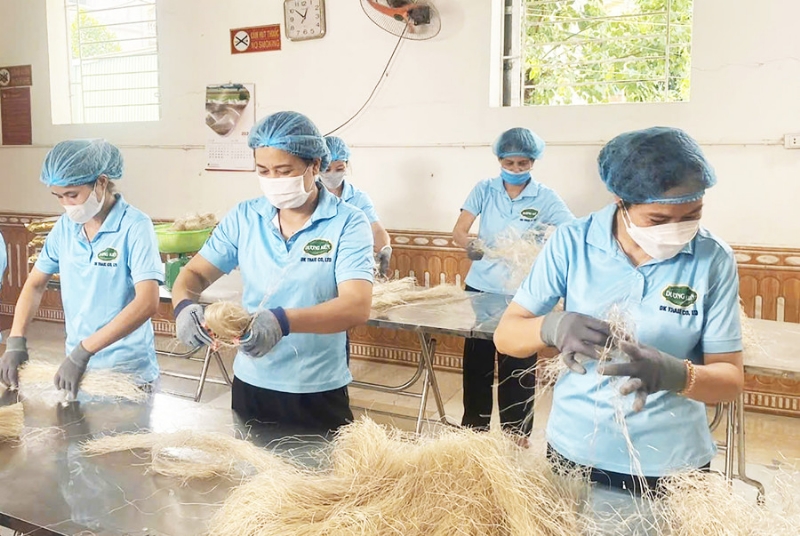
Workers package premium Duong Kien arrowroot vermicelli at a standardized, enclosed production facility
Building stronger distribution channels
In mid-August, vermicelli, tea, honey, ceramics, and other regional specialties were displayed in a modern retail setting at AEON Mall Long Bien. This was the second edition of the 2026 Trade Promotion Fair for Agricultural and OCOP Products, following the first edition at AEON Mall Ha Dong. Nearly 80 organizations, businesses, and OCOP producers from 23 provinces and cities brought nearly 1,000 product lines.
For many producers, the greater opportunity lies beyond sales at the fair: meeting purchasing teams, observing customer responses, and testing their products against the requirements of modern retail channels. A product may attract customers for a few days, but to become a regular supplier, its quality must be consistent, legal documents complete, prices competitive, and supply uninterrupted.
After more than seven years of implementation, Hanoi has 3,531 OCOP products rated three stars or higher, the most in the country. With a broad product base now in place, the next focus is on staying competitive in the market and retaining more added value for producers.
The city’s 2026 plan targets 300 additional products rated three stars or higher, including at least 20 potential five-star products proposed for national-level assessment. It also aims to develop 8-10 additional product introduction and sales outlets and five creative design and OCOP promotion centers linked to tourism and traditional craft villages. OCOP is thus being integrated into a broader value chain covering design, commerce, and cultural experiences.
Driving innovation
In So Village, Hung Dao Commune, Duong Kien arrowroot vermicelli shows how a traditional craft can become an export product. Once heavily dependent on weather conditions, the company has invested in a closed production line and tighter control of raw materials and processing. The facility now produces about one ton of vermicelli a day, rising to 3-4 tons during peak periods, with products reaching markets in Japan, Taiwan (China), and South Korea.
In Bat Trang, Tan Thinh Ceramics Production and Business Cooperative has taken a different approach: product differentiation. Twenty members, including artisans and skilled craftspeople, work under a common brand while developing their individual strengths. Its Suoi Ngoc glazed ceramic collection, rated five-star OCOP, has reached markets in Germany, France, Japan, and South Korea. Its competitiveness comes not only from firing techniques and glaze quality, but also from its ability to convey Vietnamese aesthetics and cultural stories in a form suited to contemporary life.
The two stories, one from food and the other from handicrafts, show the essence of OCOP: classification is a step toward standardization, not the final goal. The new criteria issued in 2026 also assess product quality, community strength, marketing capacity, and access to global markets within the same framework. Five-star products are considered to have met the conditions for export, but securing contracts and maintaining market presence still depend on each producer’s capabilities.
Expanding into export markets
The core of the OCOP Program is not simply giving products a title, but standardizing the entire process from production and processing to brand building and market development. Meeting standards for quality, food safety, traceability, and brand identity has helped many Hanoi OCOP products enter domestic and international supply chains.
Most OCOP producers are still small businesses, cooperatives, or household producers. They have traditional skills and distinctive products but often lack dedicated staff for market development, international standards, and logistics. When orders grow quickly, weaknesses in raw material supply, working capital, warehousing, and management can quickly emerge. To enter foreign markets, products must meet requirements for safety, traceability, intellectual property, environmental standards, and specific standards in target markets.
Experts say that as international economic integration deepens, OCOP is becoming an effective support system for businesses and cooperatives. Through the program, producers receive support not only in brand building and packaging design, but also in trade connections, trade promotion activities, and digital tools for product promotion and sales.
Nguyen Dinh Hoa, Deputy Director of the Hanoi Department of Agriculture and Environment, said that to help OCOP products reach international markets, the city will continue to strengthen supply-demand connections, organize product promotion events linked to regional culture, and support businesses in participating in domestic and international fairs and exhibitions. The city will also continue developing a network of OCOP product introduction and sales outlets, while establishing creative design and promotion centers for OCOP products and traditional craft villages linked to tourism. These hubs will help connect products with consumers, distributors, and international partners.
Hanoi is also prioritizing support for potential five-star products, deep-processed products, traditional craft village products, and items with strong export potential to increase their value and competitiveness in global markets. Continued investment in OCOP products, with a focus on quality standards, brand building, and export market expansion, will help Hanoi better tap the potential of its rural areas and bring its distinctive products to wider markets.
|
This special section is presented in collaboration with the Hanoi Coordination Office for National Target Program |
By Do Ngoc, Vietnam Business Forum