9:04:04 PM | 10/29/2026

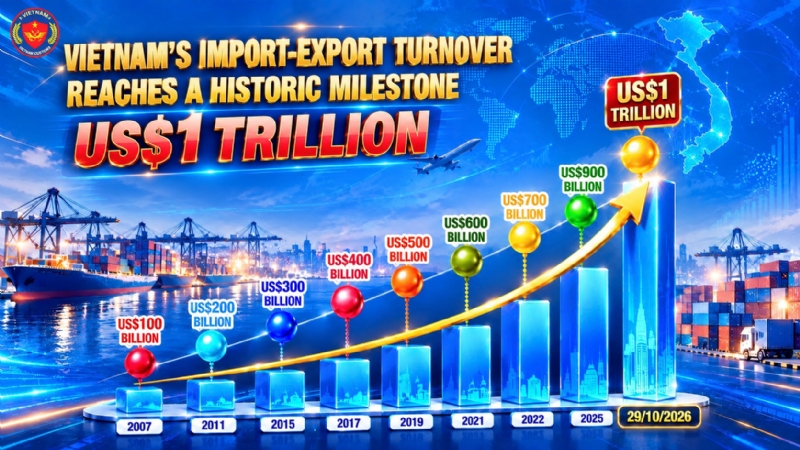
According to the Customs Department under the Ministry of Finance, Vietnam’s merchandise import-export turnover officially reached US$1 trillion as of October 29, 2026. Of this total, exports amounted to US$493.64 billion, up 27.2% year on year, while imports reached US$507.66 billion, an increase of 37.6%.
This achievement comes amid global trade disruptions driven by geopolitical conflicts, rising energy prices and escalating production costs. Given its high degree of economic openness, Vietnam is directly exposed to external fluctuations, yet it has maintained positive momentum in trade growth.
The Customs Department forecasts that export turnover for the full year 2026 will increase by more than 25%, exceeding the Government’s target of 15–16%. This is an encouraging signal for production and business activities, indicating that enterprises are improving their ability to tap into markets and sustain orders.
The US$1 trillion milestone marks a new stage in the development of Vietnam’s trade sector, nearly two decades after the country joined the World Trade Organization (WTO). From US$100 billion in 2007, import-export turnover rose to US$500 billion in 2019, reached US$929.92 billion in 2025 and crossed the US$1 trillion threshold on October 29, 2026.
During the 2016–2025 period, cumulative import-export turnover reached US$6.12 trillion, averaging US$612 billion annually. In 2025 alone, turnover totalled US$929.92 billion, 2.65 times the US$351.38 billion recorded in 2016. The average annual growth rate over this period was 11%.
Vietnam currently ranks 18th globally in exports and 20th in imports, placing second in ASEAN after Singapore. The expansion of trade reflects the Vietnamese economy’s increasingly deep integration into international markets, while creating additional opportunities for businesses to expand production, develop markets and participate in global supply chains.
A key driver has been the expansion of external economic relations and the effective utilisation of free trade agreements (FTAs). As of October 29, 2026, Vietnam maintained trade relations with 237 countries and territories, including 36 export markets and 31 import markets, each with turnover exceeding US$1 billion.
Exports to several FTA partner markets continued to grow strongly, with shipments to Japan increasing by 18.6%, South Korea by 19.1%, Canada by 14.4% and Mexico by 42.5%. China and the United States remained Vietnam’s largest trading partners.
Among Vietnam’s major product categories, computers, electronic products and components; telephones and components; and machinery, equipment, tools and spare parts continued to play important roles. Combined import-export turnover for these three categories reached US$532 billion, accounting for 54% of the country’s total and representing a 49% increase year on year.
However, the trade structure also reveals a significant disparity in scale between foreign-invested enterprises (FIEs) and domestic businesses. As of October 29, 2026, FIEs recorded import-export turnover of US$778 billion, accounting for 77.5% of the national total and increasing by 37% year on year. Meanwhile, domestic enterprises generated approximately US$223 billion, up 16%.
These figures show that the FIE sector remains a major driver of merchandise trade, while highlighting the need to strengthen domestic enterprises’ capabilities. To capitalise more effectively on the opportunities offered by economic integration, Vietnamese businesses need to enhance their technological capacity, improve product quality, develop supporting industries and deepen their integration into the supply chains of multinational corporations.
Alongside market expansion, administrative reform and customs modernisation are important factors in promoting import-export activities.
According to the Customs Department, the Ministry of Finance has directed the implementation of comprehensive reform measures, ranging from streamlining the organisational structure and improving institutional and policy frameworks to strengthening risk management and digitising operational procedures. These efforts aim to provide services to businesses anytime, anywhere and across multiple platforms.
The coordinated deployment of information technology systems helps simplify procedures, improve transparency and reduce compliance costs. For import-export businesses, these factors directly affect customs clearance times, logistics costs, delivery schedules and their ability to fulfil contracts with overseas partners.
As trade turnover approaches the US$1 trillion scale, regulatory authorities must not only handle growing volumes of goods but also ensure that procedures remain seamless, transparent and business-friendly. Substantive reforms will enable enterprises to better manage production schedules, goods flows and supply chains, thereby strengthening their competitiveness.
Alongside trade facilitation, efforts to combat smuggling, trade fraud, origin fraud and intellectual property infringement continue to be intensified. These measures help protect law-abiding businesses from unfair competition while safeguarding the reputation of Vietnamese goods in international markets.
Amid continued volatility in global trade, sustaining growth will require Vietnam to further improve its business environment, enhance the effectiveness of customs procedural reforms and help enterprises make better use of FTAs. In particular, strengthening domestic businesses and increasing domestic value-added content will be key to translating the scale of import-export activity into tangible competitiveness and laying the foundation for sustainable growth.
By Le Hien, Vietnam Business Forum