

12:14:32 PM | 4/4/2025

In order to raise awareness of "green" transformation for people and craft village establishments and enterprises, the Hanoi Department of Industry and Trade has organized the construction of many sustainable production and consumption connection chains for product manufacturing industries in craft villages such as lacquerware, rattan and bamboo weaving, etc.
Gaining many benefits from the economy to the environment
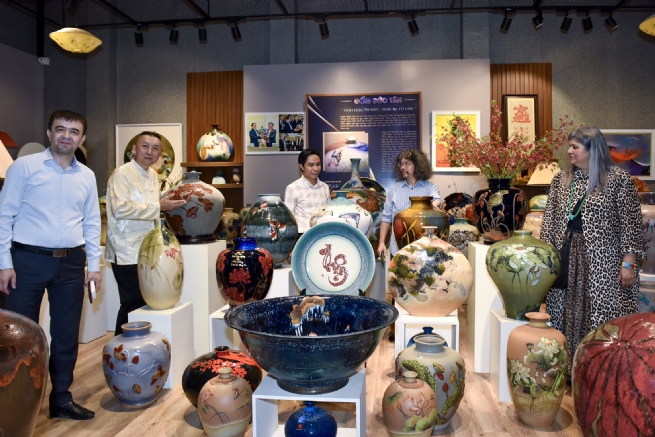
To promote cleaner production in ceramic villages, the Hanoi Department of Industry and Trade has implemented a program to build a network of linkages, cooperation in production and sustainable consumption in the ceramic industry in Kim Lan (Gia Lam district, Hanoi).
In previous years, due to the characteristics of ceramic production, which required the use of manual kilns, the situation of air pollution, water environment, soil, noise pollution, and solid waste was very difficult, significantly affecting the quality of life of people as well as the appearance of the craft village.
By participating in the program, establishments benefit from incentive mechanisms, support for technological innovation, and are regularly disseminated and updated with green and sustainable production standards, helping to increase product value and minimize environmental impacts.
Thanks to "greening", some rattan and bamboo weaving enterprises in Phu Vinh craft village (Phu Nghia commune, Chuong My district) have gained many benefits from the economy to the environment. Before applying cleaner production, enterprises lost up to 10% of fresh rattan in the boiling, soaking, and purchasing stages. Chemicals were lost a lot because the rattan boiling and soaking system was made of cement without heating.
However, when implementing cleaner production, the amount of lost raw materials decreased sharply, enterprises did not incur much cost, especially reducing emissions to the environment.
Previously, every day, Bat Trang craft village (Gia Lam district) consumed about 800 tons of coal and emitted toxic gases into the environment: CO, SO2, H2S, silica dust, solid waste... To solve the problem of sustainable development, businesses and production facilities in Bat Trang craft village have actively participated in converting ceramic firing technology from traditional coal and gas kilns to modern gas kilns.
To date, Bat Trang has nearly 1,000 households using liquefied gas ceramic kilns, contributing to reducing a large amount of waste compared to coal kilns. Improved gas kiln technology not only ensures a greener craft village environment but also helps facilities and businesses reduce energy consumption and increase economic efficiency.
Building many sustainable production and consumption chains
According to environmental experts, environmental issues have long been a difficult problem, and in craft villages, it is even more complicated and difficult because most craft villages are small-scale and household-based, so developing and preserving craft village values in conjunction with environmental protection is not easy to implement.
However, in the current trend, if you want handicraft and fine art products to go far, green and clean production is an inevitable solution.
To do this, it is necessary to develop mechanisms and policies to encourage economic sectors to participate in investing in wastewater treatment activities in craft villages; promote research, application of techniques, transfer of clean technology, wastewater treatment technology to small-scale production facilities in the direction of simple, stable operation, cost savings and effective treatment of water pollution.
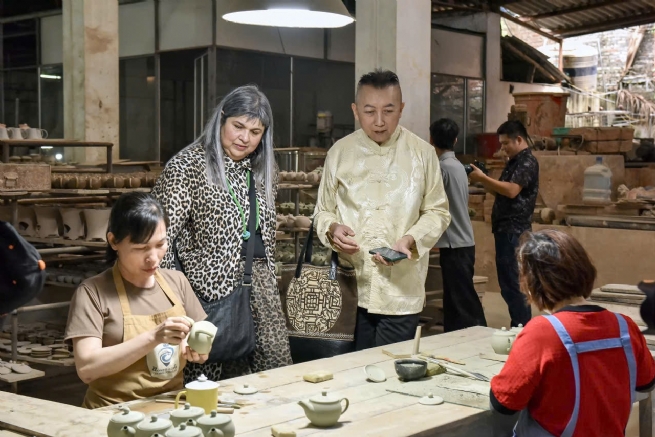
In order to raise awareness of "green" transformation for people and craft village establishments and enterprises, the Hanoi Department of Industry and Trade has also organized the construction of many sustainable production and consumption connection chains for product manufacturing industries in craft villages, such as: lacquerware industry, rattan and bamboo weaving industry, wood processing and wood products, agricultural processing industry...
In order for programs and projects to support the application of green and clean technology in production to be effective, the Center for Industrial Promotion and Industrial Development Consulting (Hanoi Department of Industry and Trade) has conducted surveys and carefully selected beneficiaries and feasible projects.
In particular, priority is given to projects with large scale and influence, in order to encourage rural industrial production establishments to invest in new production lines and equipment, expand production scale, innovate and apply scientific and technological advances, improve production capacity, product quality and protect the environment.
In addition, the unit regularly organizes training on cleaner production, sustainable consumption, introduces and popularizes high-performance, energy-saving equipment, reduces pollution, and gradually eliminates low-performance equipment through energy audits at facilities and craft village enterprises; strengthens propaganda, mobilization, and technical guidance to help facilities develop and implement green, clean production solutions, and use electricity economically and effectively.
The leaders of the Department of Industry and Trade said that it is necessary to plan craft village spaces associated with environmental protection, plan to integrate tourism activities with craft production; plan to concentrate on the model of small and medium-sized industrial parks in rural areas...
Accordingly, the planning content includes re-planning production space, planning and building waste treatment systems; developing incentive and support policies in craft villages such as tax and fee reductions for establishments that perform well in environmental protection and establishments that invest in environmental protection or capital support for environmental improvement projects through the establishment of an environmental protection fund.
With the goal of ensuring that by 2030, 100% of craft villages in the city are recognized, fully meeting the conditions for environmental protection; thoroughly overcoming the environmental pollution of craft villages, the Hanoi Department of Industry and Trade will continue to coordinate with relevant units to implement activities, programs and projects to support and encourage establishments and craft village enterprises to apply modern production technology, improve product quality, and link sustainably to effectively use resources, minimize waste generation, promote a circular economy and sustainable development. In addition, continue to promote the organization of specialized fairs and exhibitions to promote and introduce green and energy-saving product brands; prioritize support for small and medium-sized enterprises that employ a lot of labor, enterprises that invest in technology, and have environmentally friendly products...
Source: Vietnam Business Forum





 Vietnamese





