11:09:31 AM | 9/15/2026

The green transition is increasingly becoming a pillar of industrial competitiveness. The Carbon Border Adjustment Mechanism (CBAM), Environmental, Social and Governance (ESG) requirements and emissions-reduction pressures are having a growing direct impact on global supply chains. According to David Tuan Anh Nguyen, Executive Director of the Nordic Chamber of Commerce in Vietnam (NordCham Vietnam), the biggest challenge is no longer ambition but execution.
On the occasion of the Green Industries Summit 2026, co-hosted by NordCham Vietnam and the Vietnam Chamber of Commerce and Industry (VCCI), Vietnam Business Forum interviewed NordCham Executive Director David Tuan Anh Nguyen about the key bottlenecks in the green transition, the role of digitalization, and the need to build green industrial ecosystems in Vietnam.
Vietnam faces the twin challenge of strengthening industrial competitiveness while reducing emissions, as CBAM and ESG standards have an increasingly direct impact on supply chains. In NordCham's view, what are the most significant bottlenecks to green manufacturing for Vietnamese and FDI companies?
The biggest bottleneck is no longer ambition. It is execution.
Vietnamese and FDI companies increasingly understand that green manufacturing is becoming a condition for competing in global supply chains. But turning ambition into investment requires reliable clean energy, clearer standards, better emissions data, access to finance and, above all, a predictable policy environment.
For smaller Vietnamese companies, the challenge is even greater. They may understand what international customers are asking for, but lack the capital, technology or expertise to move at the same pace.
This is where larger manufacturers and FDI companies can play an important role by bringing local suppliers into the transition through technology, standards and knowledge-sharing.
We can already see this in the Nordic business community. LEGO’s Vietnam factory is integrating rooftop solar, battery storage and direct renewable power procurement, while Jotun Vietnam has moved towards 100% renewable electricity. These are examples of sustainability being built into the operating model, rather than treated as a separate initiative.
The green transition should therefore not be seen simply as a cost of doing business. It is part of building the next generation of industrial competitiveness.
With the theme of “Green Industries 4.0,” combining the green transition with digitalization, AI and automation, from NordCham's perspective, what role is digital transformation playing in helping businesses cut costs, raise productivity and meet sustainability requirements? Which technologies are likely to deliver the clearest impact?
We increasingly see the green and digital transitions as two sides of the same industrial transformation.
The starting point is data. If a factory does not know precisely how much energy, material or water it is using, it is difficult to improve.
Digital technologies provide that visibility. AI, automation, robotics, smart energy management and data analytics can then help companies reduce waste, improve productivity and make production more flexible.
The strongest business cases are where productivity and sustainability reinforce each other. Predictive maintenance can reduce downtime and material waste. Intelligent energy management can lower consumption. Automation can make production more precise and consistent.
Nordic companies are already demonstrating this approach. Tetra Pak Vietnam, for example, is combining smart manufacturing with resource efficiency, while Pandora’s new Vietnamese manufacturing facility is designed around renewable energy and digital manufacturing solutions.
 |
Vietnam has a particular opportunity because many new industrial facilities are being built today. Digitalization, automation and energy efficiency can be designed into factories from the beginning.
That is the real meaning of “Green Industries 4.0”: not simply making existing factories greener, but rethinking how the factory itself should operate.
The Nordic experience tends to emphasize coordination among enterprises, industrial parks, energy suppliers, financial institutions and government agencies. Drawing on the practical experience of Nordic businesses in Vietnam, which models of collaboration should be promoted to build green industrial ecosystems rather than isolated projects?
A green factory cannot exist in isolation. It depends on the ecosystem around it.
A company can improve its own energy efficiency or install renewable energy, but bigger gains come when it is connected to an industrial park with efficient infrastructure, reliable clean energy, sustainable logistics and suppliers moving in the same direction.
This is where Vietnam can move from individual projects to green industrial ecosystems.
Industrial parks can become platforms for shared solutions in energy, water, waste, logistics and resource efficiency. Large manufacturers can also work more closely with Vietnamese suppliers to help them meet the standards required by global supply chains.
The Nordic experience offers practical examples. LEGO’s renewable energy agreement with VSIP demonstrates how an industrial park can become part of the clean-energy solution, while ABB and Swedish textile company Syre are exploring how automation, electrification and digital technologies can support textile-to-textile recycling in Vietnam.
And the ecosystem goes beyond business. Universities, vocational institutions and financial institutions all have roles to play, while the government provides the framework that allows these actors to coordinate.
Our role should not simply be to bring a technology into Vietnam. It should be to help connect technology, finance, skills, industry and policy so that the solution can actually scale.
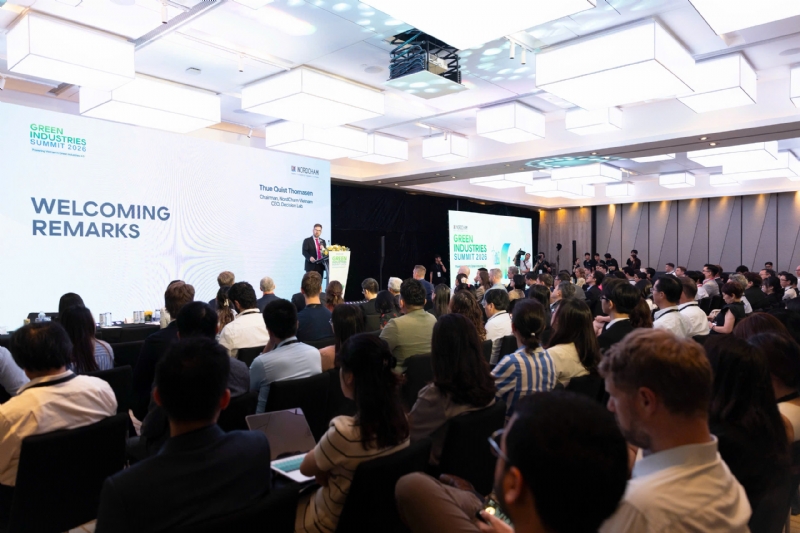
Overview of the Green Industries Summit 2026
From the perspective of the Nordic business community, what changes does NordCham hope to see in policy, energy infrastructure, the carbon market and the investment environment? And in which areas could Nordic businesses contribute more strongly to that process?
For companies making green investments, predictability is perhaps the most important factor.
A company building a factory or investing in new energy and production technology is making a decision that can shape its operations for decades. Businesses therefore need a clear direction on energy policy, reliable and increasingly green electricity, transparent rules for renewable energy and carbon management, and a carbon market that provides a credible investment signal.
This is not simply a request from business to government. Nordic companies also have an important role to play. Our members bring experience in renewable energy, energy efficiency, circular economy, industrial automation, green manufacturing, water technology and sustainable logistics. Jotun, Tetra Pak, LEGO, Pandora, Vestas and ABB are examples of Nordic companies bringing different parts of this expertise into Vietnam.
We should also not underestimate the importance of people. The factories of the future will require engineers, technicians and managers who understand both digital technologies and sustainability.
Vietnam has already set the direction. The next challenge is to make that direction investable, scalable and practical.
And that is where I see NordCham’s role: connecting Nordic companies with Vietnamese partners, technology with investment, and policy with implementation.
Thank you very much!
By Thu Huyen, Vietnam Business Forum