11:21:48 AM | 9/15/2026

Toyota Vietnam’s continued investment of more than US$283 million in its plant demonstrates Phu Tho Province’s growing appeal as a destination for large-scale investment, particularly from global corporations.
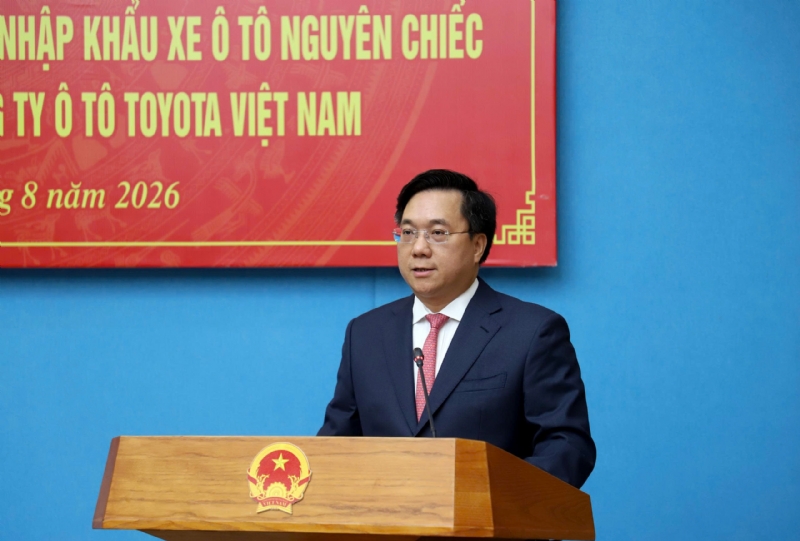
Phu Tho Provincial People’s Committee Chairman Tran Duy Dong addresses the event
In addition to expanding automobile production capacity and preparing for electrified vehicle models, Toyota’s project helps strengthen Phu Tho’s position on the northern industrial map, creating opportunities to develop a supporting industry ecosystem and high-tech supply chains.
From Local Advantages to Large-Scale Investment Destination
On August 28, 2026, Toyota Motor Vietnam Co., Ltd officially received the decision on the adjustment of its investment policy issued by the Phu Tho Provincial People’s Committee, along with the 12th amended investment registration certificate issued by the Phu Tho Department of Finance.
This marks a significant milestone not only for Toyota Vietnam but also for Phu Tho as it pursues a strategy of attracting large-scale investment projects with advanced technology and strong spillover potential.
Under the adjustment, the project, “Assembly and Production of All Types of Automobiles and Automotive Parts, Provision of Warranty and Repair Services, and Import of Completely Built-Up Automobiles in the Vietnamese Market,” has been supplemented to include the assembly and production of various types of automobiles and automotive parts, including electrified vehicle models.
The project has total investment capital of more than US$283 million, covers 28.6 ha of land, and has a registered production and assembly capacity of about 52,000 vehicles per year. It is one of the largest industrial projects in terms of scale and also reflects the Japanese company’s continued confidence in Phu Tho’s investment environment and manufacturing potential.
Notably, the new investment is not simply aimed at expanding capacity. Toyota Motor Vietnam plans to build a paint shop and press shop, with construction scheduled to begin in May 2027 and operations to start in 2029. The facilities are designed to modernize technology, increase automation, improve product quality and enhance energy efficiency. They will provide the foundation for Toyota to produce new CKD models in Vietnam, including hybrid electric vehicles.
From an investment attraction perspective, the continued expansion of an existing project by a global corporation is significant. Reinvestment decisions are often based on a company’s long-term assessment of the market, production environment, human resources, infrastructure and local supply-chain connectivity. Phu Tho Provincial People’s Committee Chairman Tran Duy Dong said that, for Phu Tho, this provides a basis for further pursuing its strategy of selective investment attraction, focusing on technology projects and large-scale manufacturing projects capable of generating high added value.
Amid increasingly intense competition among localities for foreign direct investment (FDI), retaining large FDI enterprises and encouraging them to expand their investments is as important as, or even more important than, attracting new projects. Toyota is a representative example of this process. Since receiving its first investment license in 1995, the company has gradually expanded its operations in Vietnam. The continued adjustment of the project, additional investment in production lines and preparations for the next generation of electrified vehicles show that the investment relationship between the company and the locality is deepening.
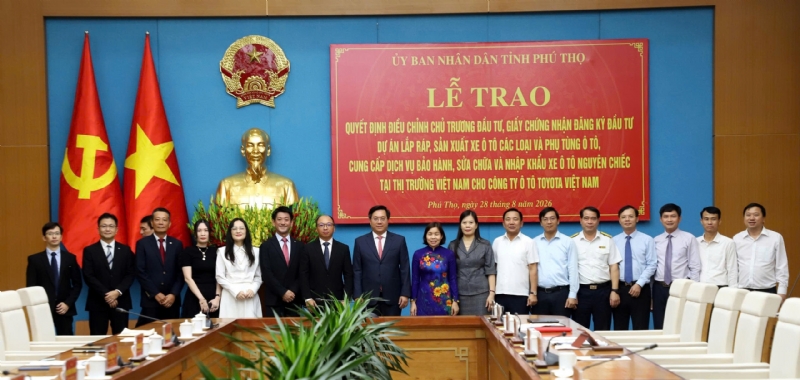
Toyota Motor Vietnam receives the decision approving the adjustment of its investment policy from the Phu Tho Provincial People’s Committee, August 28
Building Momentum for Northern Industrial Ecosystem
A locality’s appeal to global corporations is measured not only by the amount of registered capital, but also by its ability to build a production ecosystem around major projects. With Toyota’s project, this impact is expected to be particularly clear in the automotive supporting industry. Expanding production, particularly toward electrified vehicle models, will increase demand for components, parts, materials, technology, logistics and technical personnel.
Speaking at the ceremony, Osamu Hirata, General Director of Toyota Motor Vietnam, said the project would have an impact beyond the company itself. By maintaining its supplier network and promoting localization, Toyota expects to help strengthen the automotive supporting industry, create jobs, promote technology transfer and increase tax revenues.
This is the spillover value Phu Tho can expect from attracting and retaining large-scale investors. When a global corporation expands its operations, domestic suppliers gain greater opportunities to meet international technical requirements, management standards and production processes. If effectively leveraged, this could help Vietnamese companies improve their capabilities and gradually participate more deeply in global supply chains.
The presence of lead companies can attract Tier 1 and Tier 2 suppliers and industrial service companies. This helps form an interconnected production network, creating more jobs and increasing local revenues.
For Phu Tho, the challenge is not only to continue attracting more FDI projects but, more importantly, to improve the quality of investment capital, increase the share of projects using modern technology and strengthen linkages with domestic enterprises.
Toyota’s continued investment also comes as the company develops additional facilities in Vietnam. In March 2026, Toyota broke ground on a new office complex at its headquarters, while also developing a training center, an office complex and new production lines. These investments demonstrate Toyota’s long-term commitment to Vietnam. For Phu Tho, they also provide an opportunity to further strengthen its position in the production networks of multinational corporations.
Over more than three decades of operations in Vietnam, Toyota has produced more than 700,000 vehicles, sold 1 million vehicles and recorded 20 million service visits, while maintaining stable contributions to the state budget.
From an investment project by a Japanese company, Toyota has become an important part of Vietnam’s automobile industry. For Phu Tho, the continued expansion of the project signals that the locality is gaining further advantages in the competition to attract global corporations.
In the new phase, Phu Tho’s advantages will lie not only in securing more large-scale capital projects, but also in its ability to turn the presence of global corporations into a “pulling force” for supporting industries, high-quality human resources and the local business ecosystem. If successful, each major FDI project will not only bring additional investment capital, but also help strengthen Phu Tho’s position in global manufacturing value chains.
By Huong Hau, Vietnam Business Forum