10:29:55 AM | 9/18/2026

Innovation is rapidly shifting from a policy direction to a direct driver of growth. With 968 science and technology enterprises and a series of new achievements in digital technology and technology transfer, Vietnam faces a greater requirement: turning knowledge and technology resources into higher productivity, products and tangible business competitiveness.
Innovation Must Deliver Business Results
If innovation was previously viewed mainly through research, initiatives or the development of new technologies, the focus today has shifted to a more substantive measure: Does technology create economic value? Does it improve business productivity? And are products competitive enough in the market?
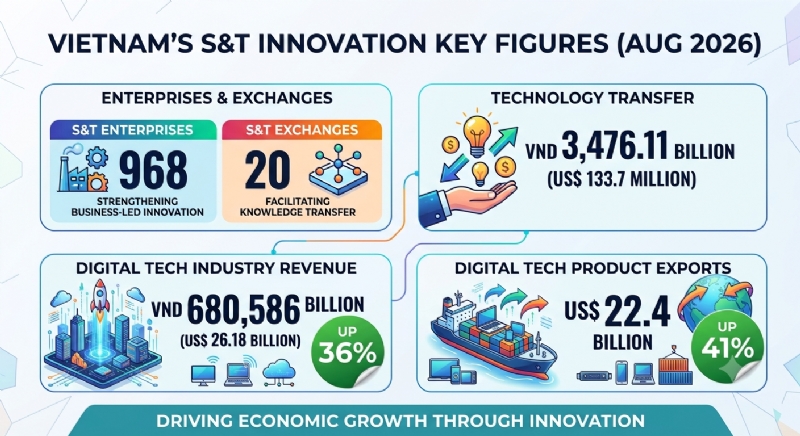
The latest figures from the Ministry of Science and Technology show that this process is undergoing a significant shift. By the end of August 2026, Vietnam had 968 science and technology enterprises and 20 science and technology exchanges. In August alone, the value of technology transfer contracts reached VND3,476.11 billion (US$133.7 million). These figures show that science, technology and innovation activities are becoming increasingly connected with the market and business sector.
In a rapidly developing field such as the digital technology industry, the value created further demonstrates the power of technology to drive growth. In August, digital technology industry revenue was estimated at VND680,586 billion (US$26.18 billion), up 36% from the same period in 2025; exports of digital technology products and goods reached about US$22.4 billion, up 41%.
These figures not only reflect the expansion of an industrial sector but also show that technology is becoming increasingly integrated into production and business activities. From AI, data and automation to digital platforms, technology is becoming a tool for businesses to reduce costs, shorten production times, improve quality and expand markets.
At the recent 2026 national quality and productivity forum, the Ministry of Science and Technology continued to place productivity at the center, with science, technology, innovation, digital transformation and AI identified as important resources for improving productivity. This is particularly significant for the business community. As competition increasingly depends on technology, businesses that are slow to innovate risk not only missing growth opportunities but also falling further behind leading companies.
Therefore, innovation cannot be assessed solely by the number of research projects, seminars, competitions or ideas generated. The ultimate measures must be the number of products brought to market, productivity gains, the ability to master technology, revenue from new products and markets, and businesses' ability to strengthen their competitiveness. This is also why businesses are being placed at the center of the innovation ecosystem. The government creates institutions and an enabling environment; research institutes and universities provide knowledge, technology and talent; while businesses must turn knowledge into products, services and economic value.
Focusing Support on Businesses and Key Problems
A significant shift in the current implementation of innovation policy is the need to focus resources rather than spread them thinly, using the practical needs of businesses and the economy as the starting point.
At a working session with Dong Nai City leaders on September 4, 2026, Minister of Science and Technology Vu Hai Quan underscored the approach of “selecting businesses for support, choosing major problems for investment.” Accordingly, Dong Nai is being guided to select about 10 businesses with genuine needs and a willingness to innovate for support in technology application and transfer, production process improvement, and enhancing productivity, quality and operational efficiency.
This approach shows that innovation support policies are moving in a more targeted direction. Instead of providing support through broad campaigns, resources should be directed toward businesses capable of adopting technology, with clear needs and the ability to deliver measurable results.
Dong Nai was also asked to select 5-10 major problems for scientists, research institutes, universities and businesses to work on together. For problems with a major impact on socio-economic development, concentrating resources “thoroughly and effectively” is expected to generate specific products and results that can then be replicated.
This can be viewed as an appropriate direction for improving the quality of innovation in the new period: using practical problems as the starting point, businesses as the center, and science and technology as tools for solving them.
In particular, as resources for science, technology and innovation continue to expand, the challenge is no longer simply to “have more resources” but to use them as effectively as possible. A research project that cannot find a business to adopt it, a technology that is not tested in a real-world environment, or a product that cannot find a market will struggle to create an impact commensurate with the resources invested.
Therefore, establishing real-world testing environments, sandbox mechanisms and business-research institute-university linkage models is becoming increasingly important. In Dong Nai, the Ministry of Science and Technology is also considering a “living lab” model linked to the Long Thanh airport area, focusing on fields such as smart logistics, AI, drones, autonomous vehicles and digital solutions.
The country's 20 science and technology exchanges are opening another channel for connecting technology supply and demand. This is an important platform for ensuring that research results do not remain in laboratories but can reach businesses that can adopt, invest in, refine and commercialize them.
This reality also requires businesses themselves to change their mindset. Innovation does not necessarily have to begin with expensive technologies or large-scale projects. For many businesses, it could mean digitizing a process, applying AI to management, automating a production stage, using data to optimize the supply chain or investing in new technology to improve product quality. More importantly, businesses need to view innovation as an investment in competitiveness rather than simply a task undertaken when government support programs are available.
From a policy perspective, this approach can also help the innovation ecosystem shift from “many activities” to “many results.” When each support program targets a specific business, a specific problem and a specific output, investment efficiency becomes easier to measure and successful models can be replicated.
With nearly 1,000 science and technology enterprises, an expanding system of technology exchanges and strong growth in the digital technology industry, Vietnam is better positioned to turn innovation into a tangible driver of growth.
By Le Hien, Vietnam Business Forum