

10:42:35 PM | 9/15/2015

As China follows Japan’s economic model and becomes more costly for manufacturing, Chinese firms are looking to neighbouring countries to site their manufacturing facilities, according to The Institute of Chartered Accountants in England and Wales (ICAEW)’s latest Economic Insight report. This presents Vietnam with an opportunity to move up the value chain by becoming a global hub for low-value production.
“Economic Insight: South East Asia” is produced by Centre for Economics and Business Research Ltd (CEBR), ICAEW’s partner and economic forecaster. Commissioned by ICAEW, the report provides its 144,000 members with a current snapshot of the region’s economic performance. It undertakes a quarterly review of South East Asian economies, with a focus on Indonesia, Malaysia, the Philippines, Singapore, Thailand and Vietnam.
Vietnam is already a hub for manufacturing and currently follows behind only Singapore in size of Chinese investments. With huge growth potential, a young population and generally lower wage costs, the country will benefit from the infrastructure development that will follow the competition for influence in the region between China and other major economies. This will take the form of the unlocking of Chinese-led capital by way of the China-ASEAN Investment Cooperation Fund (CAF) and the Asian Infrastructure Investment Bank (AIIB). The Japan-dominated Asian Development Bank (ADB) also recently announced a US$110bn plan to invest in Asian infrastructure projects. Most importantly, Vietnam will need to invest significantly in increasing the capacity of much-needed supporting industries through effectively engaging with the US and Japan.
Countries like Vietnam, Indonesia and the Philippines should be able to access much-needed funds to invest in infrastructure, energy and natural resource exploitation. This will be particularly helpful as these large emerging economies get capital needed to link up far flung provinces and towns. As a result economies of scale are generated enabling disparate areas to be linked into the greater production mechanism that is driving ASEAN growth.
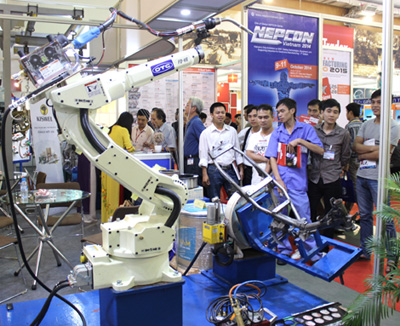
In order to access investment funds more effectively, become a global manufacturing hub and move up the value chain, Vietnam – in the long-run – will need to be proactive in shortlisting its FDI projects in accordance with the government development strategy and orientation.
Mark Billington, Regional Director, ICAEW South East Asia said: “While Vietnam has the competitive advantage of low-wage labour, it is not sustainable. It is therefore becoming essential to invest in skilled labour training and education. Aside from these, Vietnam should also consider focusing more on its environment infrastructure initiatives, especially in transportation and services.”
Scott Corfe, ICAEW Economic Advisor and Cebr Associate Director, said: “ASEAN is showing how rather than harming themselves through competition, structurally similar economies can complement each other and create cross-border networks. Each country can specialise to its full extent, with supply chains spreading across East Asia – so raw material extraction, processing, parts manufacture and assembly are all taking place in different locations. This means that the maximum gains from trade are being realised.”
Just as ASEAN economies are following a path of development, from low-value low-wage production to high-value manufacturing and services, the Chinese economy has broadly followed the Japanese model particularly as wages have become uncompetitive for low-value production. Chinese companies, like the Japanese ones before them, use neighbouring countries as production bases, exporting manufactured parts for relatively lower-value assembly.
The excess industrial capacity in China is however leading to the country exporting large (and increasing) quantities of consumer goods to ASEAN.
Mark Billington, Regional Director, ICAEW South East Asia, said: “China’s consumers are not buying proportionally more of the country’s vast output even as they grow richer. With an excess of industrial capacity, China needs overseas markets to support domestic production; ASEAN is a key destination for its products. The long-term effects of this new model of economic development remain to be seen. However the export of Chinese-made goods has had a deflationary impact on an international scale and is likely to be more so with the lower yuan. China is South East Asia’s largest trading partner and one of the largest investors in the region.”
With continued ASEAN integration and the importance of the region to the world’s four largest economies, Vietnam is well positioned to attract multinationals looking to capitalise on the opportunities located in South East Asia.
Other findings in the report include Indonesia’s slow economic reform, results of the Philippines’ cautious fiscal policy, Singapore’s growth forecast revised downwards, and warming US-Vietnam ties positive for the economy.
The Trans-Pacific Partnership (TPP) promises to improve Vietnamese access to the US clothing and footwear markets in exchange for reducing the state’s role in the economy. The deal will also likely allow US companies to export arms to Vietnam and lead to its recognition by the US as a market economy.
ICAEW is a world leading professional membership organisation that promotes, develops and supports over 144,000 chartered accountants worldwide, and also a founder member of Chartered Accountants Worldwide and the Global Accounting Alliance.
Nam Pham


 Vietnamese





