

11:25:36 PM | 4/21/2016

Key discussions in the roundtable focus on the most important issues associated with Vietnam’s intellectual property (IP) commitments as part of TPP.
The event was attended by senior officials and representatives of eight different member ministries and line agencies of the government inter-ministerial IPR Task Forces (Program 168), international organizations and business associations, local business societies and a wide variety of industrial property agencies. The business forum shared presentations and discussions on various concerns related to intellectual property within TPP, industrial property enforcement, computer software ownership enforcement, and takeaways from international experts.
In his opening remarks to the business forum, Mr. Tran Minh Dung, Chief Inspector, MOST, said: “Intellectual property rights ( IPRs) have become an integral part and a vital, make-or-break driver for the wellbeing of businesses. IPRs are not simply businesses’ intangible assets that are created and accumulated continuingly and without time and space boundaries, but also a legal instrument that protects and assists companies to start their business undertakings in global markets, and both in a physical business environment and an electronic business (digital) environment.
Protection and enforcement of intellectual property rights are an imperative for both businesses and nations at a macro scale. Keeping this in mind, the Vietnamese government and the country’s entire intellectual property right registration and enforcement system are making steps to improve and take to new heights the efficacy of intellectual property right protection and enforcement in Vietnam”, Mr. Tran Minh Dung underscored.
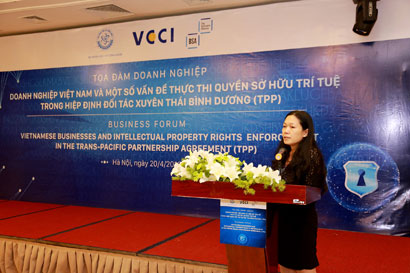
As a standing member of Vietnam TPP negotiating team, Ms. Nguyen Thi Thanh Ha, Legal and Compliance Manager, Intellectual Property Authority, MOST, gave very detailed opening notes on the country’s commitments for IPR protection and enforcement within TPP, to help the local business community to understand what intellectual property commitments Vietnam has made, in order to adopt the right pathways in this regard.
Also in this morning forum, Mr. Tran Van Minh, Deputy Chief Inspector, Ministry of Culture-Sports-Tourism, shared his views on IPR enforcement and protection in respect of computer software. “The ministry Inspectorate, in cooperation with the Ministry of Public Security, has handled and resolved 100% of received ownership-related grievances from computer software owners. Between 2006 and 2015, spot checks took place at 541 companies all over the country, with 27,602 computers scrutinized, and computer software copying without the owners’ consent found. The ministry Inspectorate released statements for civil offences and 499 rulings for administrative penalization, collecting VND 8,613,000,000 of fine money in total to the state revenue”, said Minh.
“TPP gives special attention to intellectual property right protection, with great emphasis on intellectual property right enforcement, where it requires extension of copyright protective period to 70 years and calls for even penal actions as part of enforcement efforts. This will pose serious challenges to Vietnamese businesses in trying to better comply with IP provisions. In respect of computer software, in recent years, despite some significant improvements, computer software piracy is still common.
That puts the business community in a position to be more careful with the issue of intellectual property, be more prepared in terms of finances, human resources and technical capacity in TPP integration, to make sure that we can avoid potential legal troubles and litigations”, Minh stressed.
Economic Counsellor, U.S Embassy in Hanoi, Mr. John Hill discussed the substantial opportunities and benefits that TPP can offer the local business community and the country’s economy as a whole. Mr. John Hill believes that TPP will provide Vietnam with tangible benefits, including:
• Tariff reductions will deliver the most immediate benefits, especially as Vietnam gains better access to the U.S. market.
• TPP aims to zero out 18,000 tariff lines, which is huge.
• In apparel and footwear, which are strong export sectors for Vietnam, those rates range up to 32 percent in the U.S.
• Other export sectors will benefit as well, such as the seafood industry, which will see reductions of import taxes on shrimp, squid, and tuna.
• Models run by prominent think tanks predict that Vietnam will see the biggest relative performance boost by 2030, such as 8.1-9.8 percent GNP growth (Peterson Institute and World Bank, respectively), compared to 0.4-0.5% of U.S; 30 percent growth in exports (both Peterson Institute and World Bank), compared to 8-9% of U.S.; and 13 percent income growth (Peterson Institute).
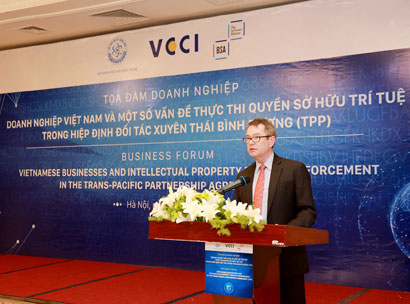
“But frankly, even more important than the immediate trade-based benefits of TPP is its framework of standards and behavior that will, long term, shape Vietnam’s economic trajectory”, Mr. John Hill emphasized at the roundtable.
Over the years, despite significant improvement in terms of computer software piracy, the actual piracy rate among Vietnamese firms remains very high. When TPP goes live, the need for much stricter intellectual property compliance will create great pressure on local businesses, compelling them to comply whether they like it or not, once they enter this world’s largest free trade playground.
Building on the many years of cooperation with relevant Vietnamese governmental bodies, Mr. Roland Chan, Senior Director for Compliance Programs, Asia Pacific, BSA | The Software Alliance, shared a few notes on the risks that local companies might face, including cybersecurity concerns in a world that is now hyperlinked to the internet. In response to a question about how businesses should be aware of the potential troubles that they may face using unlicensed software in TPP, Mr. Roland Chan pointed out that first of all, it may be a legal question. Under the current Vietnamese law, using unlicensed software constitutes a breach of IP protection laws, including for computer software.
“As an equally important concern, studies have shown that there is a close correlation between the use of unlicensed software and malware intrusions. Ensuring the legal use of properly licensed software is a key first step an organization can take to improve information security. As a next step, by implementing an effective Software Asset Management (SAM) solution in place, businesses can take full control of their software inventory and reduce risk significantly.”, Mr. Roland Chan said.
“One month campaign commemorating World Intellectual Property Day towards integration”, through its many practical education activities, has showcased strong efforts by MOST and other relevant ministries and line agencies in achieving the goal of bolstering effective IP right enforcement. This business roundtable is an instrumental part in the agenda, providing very useful information to help achieve the set objective of heightening awareness on the role and importance of IP rights in social development; pressing ahead the establishment, application, development and enforcement of IP rights; making sure that IP rights become a useful tool to promote science and technology development, and socioeconomic development as a whole; and building awareness in the entire society to fulfill the country’s IP international commitments.
Hoa Pham


 Vietnamese





