

9:21:57 AM | 8/3/2016

In view of increasing environmental disasters and widespread food safety problems in Vietnam, the Institute of Chartered Accountants in England and Wales (ICAEW) late July organized a professional workshop: "Accounting for sustainability" in order to give perspective to businesses and suggest the right direction when making long-term development plans.
This workshop was part of a series of thought leadership activitieswhich have received strong supportfrom Vietnam’s Ministry of Finance, UK Trade and Investment (UKTI) and other prestigious organizations.
Richard Spencer, Head of Sustainability, ICAEW,highlighted that the role of the accounting practice is becoming increasingly crucial in painting a realistic picture of the current challenges regarding sustainable development. He also pointed out that the measurement and monitoring skills central to accountancy can helplay thefoundation for the most realistic and appropriate sustainable solutions.
“The role of accounting is to capture, report and communicate accurate, reliable and trustworthy information for decision making” said Richard Spencer.
According to Richard Spencer, the accounting profession is present in all business areas including the public sector. ICAEW emphasised that the accounting profession must contribute to the realisation of global goals on sustainable development in order to serve the interests of the community.Spencer elaborated on the implications of sustainability on businesses and stressed that companies focusing on sustainability and compatibility with the environment would increasingly be sought after, and integrating natural capital into their decision making will be considered one of the top criteria for evaluation.
He also noted that The Guardian had recently endorsed this view, publishing an article entitled "Is Accounting the last hope for a global ecosystem?".
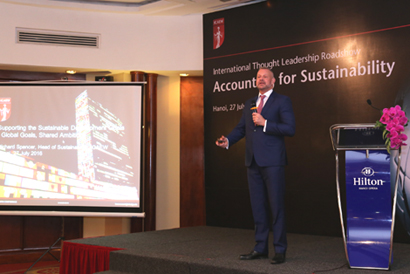
Speaking about the ICAEW sustainability policy, Richard Spencer said, "We are conscious of its position and leadership role, and are committed to doing everything possible to promote sustainability, incorporating it into everything we do and calling on organisations and individuals to do the same. Most importantly, we ensure that sustainability is a core focus of activities including capacity building and the continuous professional development of staff and members".
"The global objectives of sustainable development which we have just discussed today, especially in the current context of Vietnam, cannot be delayed any further. Everyone has heard about the name Formosa. The most practical thing we could do, as international organizations, individual country, every business, is to allocate sufficient resources and budget for sustainable development objectives. For those who practice accounting, financial statements need to be accurate, transparent, and clear, to demonstrate and analyze impacts on sustainable development. As for the State, it is necessary to quickly apply the regulations and guidance on this issue is based on international standards and platforms, as well as there are specific guidelines that can lead to practical action. And we only have a single way forward which is to work together to address the outstanding shortcomings." Mr Dang Thai Hung - Representative of the Ministry of Finance appreciated the efforts of the ICAEW in advocating for sustainable development globally and in Vietnam.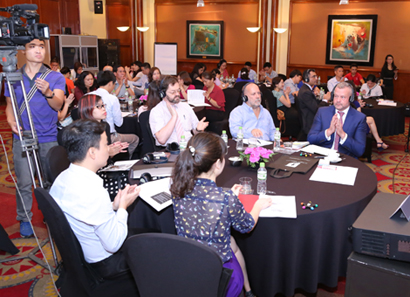 ICAEW’s workshop provided multiple suggestionson how top management can re-think sustainability for the businesses and organisations.
Dong Thuy
ICAEW’s workshop provided multiple suggestionson how top management can re-think sustainability for the businesses and organisations.
Dong Thuy
 April 24–25, 2026
 Kinh Bac Cultural Center, Bac Ninh Province


 Vietnamese





