

10:04:04 AM | 3/9/2020

Switching from coal to gas in energy planning plays an important role in ensuring energy security, increasing the reliability of the power system and reducing greenhouse gas emissions in Vietnam. However, liquefied natural gas (LNG) plants should not be considered an alternative to all planned or proposed coal-fired power plants.
The second edition of Made in Vietnam Energy Plan (MVEP 2.0) by the Power and Energy Working Group - Vietnam Business Forum has proposed a strategy to balance and integrate the supply from electricity generation by LNG into the power development strategy of using renewable energy.
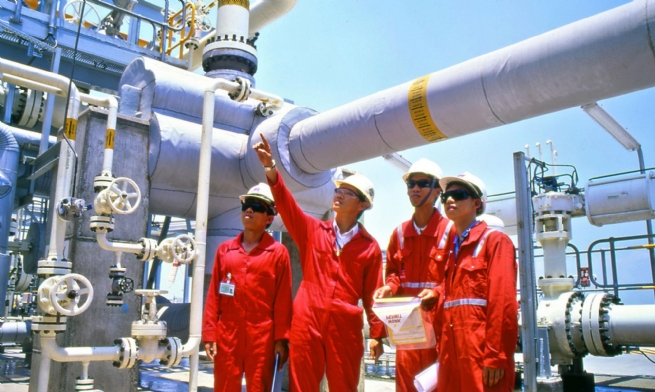
It is possible to replace planned coal-fired power plants
Vietnam's gas reserves, mainly in offshore areas within the country's exclusive economic zone, are estimated at 202 billion m3. The power industry consumes about 80% of the annual output (reaching 9.8 billion m3 in 2017), while the consumption rate of fertilizer production and industry are at 10%. According to MVEP 2.0, while developing domestic resources is a top priority of the Vietnamese Government and the oil and gas industry, the actual use in electricity production is much slower than expected, partly due to conflicts in the East Sea, increasing drilling costs in deep waters and complex geological areas, and leading to investor fatigue. Meanwhile, the demand for electricity increases while the supply capacity of the power industry is limited, especially in the Southeast region.
Replacing coal with natural gas in thermal power plants will help improve public health and protect the environment through reducing air pollution. Compared to other fossil fuels, the combustion of natural gas produces negligible amounts of sulfur, mercury and fine particulates. Combined cycle generators using natural gas with the ability to increase or decrease 600 MW within 10 minutes can support the integration of wind and solar energy. Natural gas also plays an important role in meeting peak electricity demand and supplying fuel to combined thermal power plants twice as efficient as those only producing power.
VMEP 2.0 states that, with some advantages such as abundant offshore gas reserves, the ability to import with beneficial terms in the near future, taking precedence over coal, minimizing the impact on public health and the environment, and the ability to limit the effects of climate change, LNG should be considered an appropriate alternative fuel source to coal. Because gas is used as a base load, as well as helping to respond quickly to changes in demand or renewable energy supply, it is an effective competitive resource to account for a high proportion in Vietnam's energy sector. The 7th power master plan has planned the construction of 10 gas thermal power plants, including six combined cycle power plants with a total capacity of about 24.2 GW, located in the Central and Southeast region and Mekong Delta region. Investors' interest indicates the possibility that natural gas-fired power plants will be proposed to replace planned coal-fired power plants.
Demand for imports
To address Vietnam's energy needs while waiting to address the energy shortage issue, VMEP 2.0 says that it is necessary to quickly develop renewable energy sources and modes. In the future, storage batteries and hydropower could help solve problems arising from the disruption of these energy sources. However, the generation capacity with the ability to maintain the grid's voltage and frequency before climatic conditions and different demand situations needs to be met with lower carbon energy sources than coal, the energy selected by the 7th power master plan. This demand can be met with imported natural gas.
Asia has great demand for natural gas. By 2035, nearly 50% of global natural gas demand by power generation and industry will come from Asia. As a result, the global power market is moving in this direction, and development plans increasing the use of LNG as a fuel for gas-fired thermal power projects. By 2022, it is expected that the global capacity of LNG will increase by 132 billion m3 annually, of which 70% of this new capacity will belong to American and Australian companies. In the period from now until 2022, the United States is expected to continue to increase its market share in the world's total liquefied gas capacity with an increase of 70 billion m3 annually.
However, natural gas is not a panacea. Management is still limited to drilling, mining and pipeline transportation activities that can lead to methane leakage, a greenhouse gas 86 times stronger than CO2 when maintaining heat in 20 years. The amount of methane leak can reach 1-9% of total emissions throughout the life cycle of a gas-fired power plant. Many technologies have been developed to reduce the amount of methane leaking; however, to implement these technologies, appropriate policy and investment actions are needed in both exporting and importing countries.
Safe gas extraction and filling station network
In order for LNG to become a source of raw materials for power plants, according to VMEP 2.0, it is necessary to build a network of liquefied gas extraction and filling stations. A recent report completed at the request of the International Finance Corporation (IMF) shows that Vietnam's coastline has many suitable locations to build extraction and filling stations as well as Floating Storage Regasification Unit (FSRU) and installing LNG receiving stations both offshore and onshore. It is essential to conduct a financial feasibility study based on geographical conditions, expected scale and maximum capacity to determine whether Vietnam will use FSRUs and how to use them. The value of FSRU lies in its ability to quickly deploy, especially in operating gas-fired power plants.
In the recent plan of Vietnam, oil and gas industry has proposed to build 6 LNG focal stations. As of early 2019, 10 LNG focal stations have been proposed to be built. A station (Thi Vai) is under construction. The construction of storage facilities will facilitate the use of LNG transported by truck to various industries other than the power one. Replacing liquefied petroleum gas (LPG) with directly supplied LNG will save cost to end users in the long term.
By Anh Mai, Vietnam Business Forum






 Vietnamese





