

12:48:21 PM | 4/3/2020

The Covid-19 pandemic has unsurprisingly produced a negative impact on foreign direct investment (FDI) flows into Vietnam. FDI inflows to Vietnam in the first quarter of 2020 decreased in both projects and registered value. However, according to experts, this is also an opportunity for Vietnam to restructure the market and have policies to entice investors intending to narrow production in neighboring countries and invest in Vietnam.
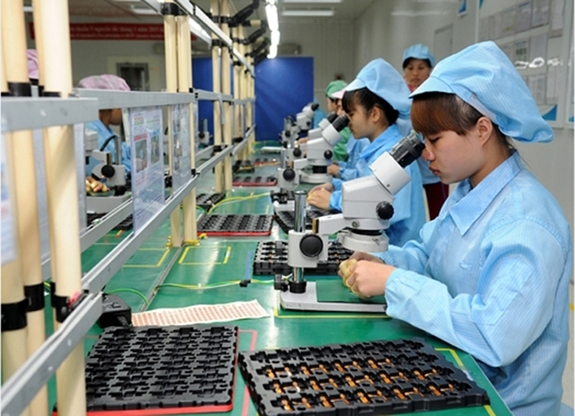
The complicated outbreak of Covid-19 respiratory disease is greatly affecting foreign investors’ travelling as well as their decisions on fresh investments and expansion investments, thus reducing foreign investment in both projects and registered value in the first quarter of 2020. Besides, many FDI enterprises are facing numerous hardships such as expertise shortage, imported input shortage, stalled production and shrinking consumer market. Difficulties have multiplied for large-scale enterprises that are exporting to epidemic regions.
Specifically, according to data from the Foreign Investment Agency (FIA), as of March 20, 2020, the FDI value (both fresh and added) totaled US$8.55 billion, down 21.9% from the same period of 2019. Of the sum, the greenfield value accounted for US$5.5 billion, up 44.8% year on year. This was a positive point. However, this growth was mainly driven by the US$4 billion Bac Lieu LNG Power Project licensed in the quarter.
In addition, foreign investors spent nearly US$2 billion to make 2,523 share purchase deals, down 65.5% in value but up 52.6% in deals from the corresponding period of 2019. According to FIA, although the number of capital contribution and share purchase deals increased strongly in the March quarter, the average value of a deal was quite small, just US$780,000 (much smaller than the average deal size of US$3.4 million in the first quarter of 2019).
By industry, foreign investors invested in 18 industries, of which the electricity industry led with over US$4 billion, accounting for 47.5% of the total registered value. The manufacturing and processing industry ranked second with US$2.72 billion, accounting for 31.9%, followed by retail industry with US$682 million and the real estate industry with US$264 million.
By partner, 87 countries and territories invested in Vietnam in the January-March period. Singapore took the lead with US$4.54 billion, accounting for 53.1% of the total FDI value in Vietnam. Japan ranked second with US$846.7 million, accounting for 9.9%, followed by China with US$815.6 million, accounting for 9.3%.
Apart from Bac Lieu LNG Power Plant, other big FDI projects licensed in the quarter included US$300 million Jinyu Radian Tire Manufacturing Plant Project (Vietnam), Radian Tire Manufacturing Project (China) in Tay Ninh province and Sews-components Vietnam Factory Project (Japan).
According to experts, although the number of fresh and expanded projects respectively decreased 5% and 17.2%, this was only a short-term status. In the long term, Vietnam will still be a bright spot of FDI attraction in the region.
Vietnam has already joined many new-generation free trade agreements (FTA)s, including the EU - Vietnam Free Trade Agreement (EVFTA), which have created important platforms for foreign investment flows into Vietnam. Besides input and labor resources, Vietnam is also offering a lot of incentives for FDI. Furthermore, its advantages such as good epidemic prevention and stable politics are also plus points and Covid-19 pandemic impacts on FDI are just short term.
Besides, experts anticipated that Vietnam would see a decline in FDI flows in the second quarter and possibly to the third quarter if the Covid-19 pandemic continues to evolve complicatedly. This is an opportunity for Vietnam to restructure and rethink the market, especially supporting industries and manufacturing industries. It is high time for Vietnam to develop its own supporting industries or to join hands with other countries that signed new-generation FTAs, such as CPTPP or EVFTA, to increase their investment in Vietnam and enhance the value added to take advantage of export opportunities to those markets. Investment promotion agencies should proactively work with foreign investors who have planned to invest in Vietnam to discuss, orient and unify preliminary investment procedures.
In the context of the Covid-19 pandemic influence, FIA proposed some remedies like applying special entry to Vietnam for foreign investors with negative Covid-19 tests, who will work in independent, self-isolated areas guaranteed and supervised by local authorities. Besides, the agency proposed extending work permits for foreign experts and technicians working at foreign-invested enterprises, applying quick customs clearance procedures for imported inputs and goods, or extending the execution schedule for projects troubled by the epidemic.
Moreover, according to FIA, central and local authorities should stop all inspections into FDI companies during the epidemic period, helping them focus on restoring manufacturing and business activities impacted by the epidemic, except for cases with signs or suspicion of law violations. Last but not the least, they should consider and resolve requests for project implementation extension from projects troubled by the contagion and reduce the time needed to complete administrative procedures concerning investment projects.
By Thu Ha, Vietnam Business Forum





 Vietnamese





