10:55:29 AM | 8/7/2020

After seafood and steel, wood products are within the target of global trade lawsuits.
Recommendations to businesses
According to the Trade Remedies Authority of Vietnam (TRAV) under the Ministry of Industry and Trade, the United States Department of Commerce (DOC) recently initiated an anti-dumping and anti-subsidy probe into Chinese-alleged plywood products imported from Vietnam. These are hardwood plywood, decorative plywood and some veneer-coated plywood.
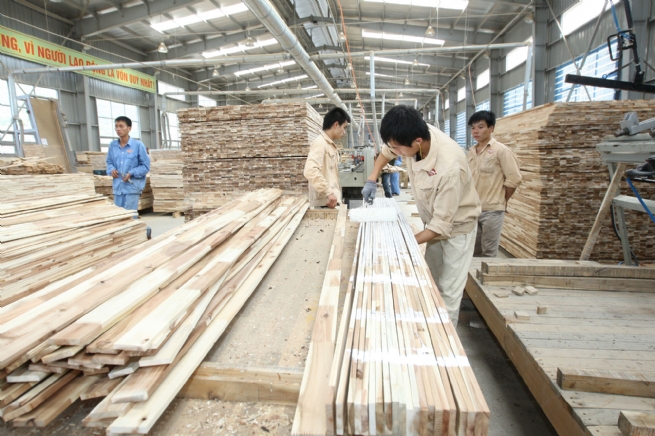
In the event that the DOC concludes that Vietnam's plywood circumvents trade remedy duty imposed on similar products from China, the United States will issue a tax imposition order on this Vietnamese product from the time of probe initiation. The duty will be the same as the highest rate imposed on Chinese products (anti-dumping tax: 183.36% and anti-subsidy tax: 22.98 - 194.9%).
As of June 2020, the Ministry of Industry and Trade dealt with 176 trade remedy cases against Vietnam’s exports. In the first six months of 2020 alone, the ministry handled 13 investigation cases against Vietnamese goods and six likely cases (more cases than in 2019).
According to the TRAV, investigated products are currently diverse, with seven cases involving wood products, or 4% of the total. Despite accounting for a small proportion of total trade defense cases, the level of investigation into wood products is on the rise.
On the other hand, the export value of recently litigated cases is much higher than those in the 2007-2017 period (the anti-dumping case of MDF, investigated by India in 2015, had an export value about US$3.1 million, while South Korean lawsuit against Vietnamese plywood had an export turnover of about US$170 million in 2019).
Business support solutions
According to DOC, the imposition of anti-circumvention duty is not targeted at Vietnamese products but to ensure the enforcement of trade remedies, currently applied to exports of other countries.
Vietnamese products made from Vietnamese materials or materials imported from non-Chinese sources may be allowed to use declaration mechanism to enjoy immunity from tax evasion measures.
Therefore, to date, in anti-circumvention investigations cases, anti-circumvention measures have not caused considerable impact on Vietnam's export value because Vietnamese companies actively use local inputs or import them from other countries rather than China to make exports.
|
Vietnam’s largest wood export markets include the United States, Japan, China, South Korea and the European Union (EU), accounting for 88.84% of the country's total wood export value. By market share, the U.S. accounts for about 50.09%, followed by Japan (12.46%) and China (10.92%). |
In order to effectively deal with trade defense cases in general and cases against wood products and plywood in particular, according to the Ministry of Industry and Trade, besides the Government's efforts, the wood industry and manufacturers play a decisive, important role in building value chains, modernizing the management system and developing lawful input sources to prove to investigating authorities that they are not dumping or evading tax.
For that reason, the ministry recommended that Vietnam's plywood exporters need to understand investigation mechanisms, regulations and procedures in the United States. Recently, the U.S. frequently changed probe regulations and procedures to make it easier to initiate investigation and imposition.
In many cases, investigators (such as the U.S. Customs and Border Protection) can probe on the sly. Regulations on “significant transformation” or requirements for “cooperation” and “provision of information” may be also changed from case to case. So, businesses need to find out to have a timely response to related conditions.
In addition, woodwork exporters need to actively improve their management system and data to make sure that they meet information requirements and proof of input origin, and, at the same time, necessarily cooperate with relevant authorities in importing countries in investigation cases.
They should formulate strategies to diversify products and export markets to disperse risks rather than focus on a single market as this can offer a reason for other countries to sue or impose trade remedies in case exports from Vietnam suddenly surge.
Last but not least, producers and traders of wood products essentially have domestic input development strategies to increase the added value of products, and this is also a long-term solution to cope with investigations into anti-circumvention and work closely with the Ministry of Industry and Trade to handle the case.
|
Processed wood products account for over 70% of the total wood export value and Vietnam’s woodworks are exported to 120 countries and territories around the world. |
Source: Vietnam Business Forum