

10:52:56 AM | 10/21/2020

Last March, the American Coalition for Fair Trade of Hardwood Plywood sent a request to the United States Department of Commerce to initiate an anti-dumping and countervailing investigation on certain hardwood plywood made in Vietnam. If this is the case, Vietnamese companies will likely lose this market.
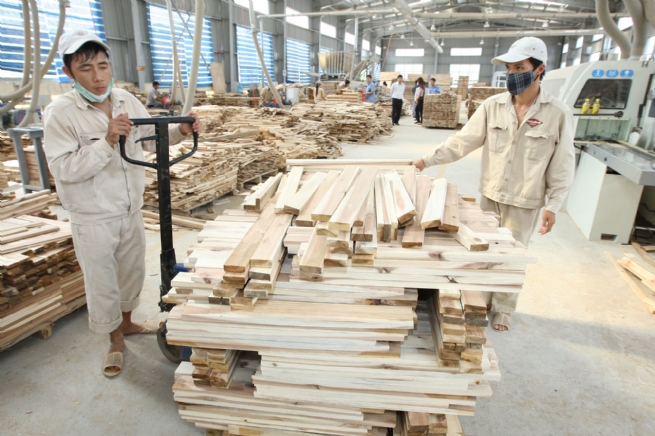
The U.S. said that, after facing the antidumping duty of 183.36% and the countervailing duty of 22.98 -194.9% on hardwood plywood originated from China, Chinese companies transferred tax-levied parts to Vietnam for assembly and then export to the U.S. to circumvent the very high tariffs mentioned above.
As a result, the export value of hardwood plywood products in China dropped drastically from US$800 million in 2018 to US$300 million in 2019. Meanwhile, exports from Vietnam increased rapidly, from US$63 million in 2017 to US$187 million in 2018 and US$309 million in 2019.
The U.S.’s antidumping investigation into Vietnamese plywood is causing a great impact on exports to this market. If the origin fraud is proven, Vietnam’s plywood will surely lose the U.S. market due to very high anti-dumping duty imposed on China. More importantly, customers will lose confidence in Vietnamese products. At the same time, this will affect products that use materials from plywood such as kitchen cabinets and bathroom cabinets.
Before the U.S., India and South Korea announced initiating antidumping investigations in late July 2020. Malaysia's Ministry of International Trade and Industry (MITI) also announced an antidumping probe into cold rolled stainless steel products originated from Vietnam and Indonesia in late July 2020. And MITI announced an administrative review of the 2016 antidumping duty imposed on cold rolled steel products originated from Vietnam.
Recently, the Trade Remedies Authority of Vietnam under the Ministry of Industry and Trade also released a watch list consisting of 13 exports at high risk of origin fraud and illegal transmission probes.
The list includes hardwood plywood, foam cushions, wooden cabinets, artificial stone, ceramic tile, copper pipes for vehicle tires, steel joint, steel wheel, pre-engineered steel, gas cylinder and packing pins.
But the story becomes more worrying as origin fraud risks may be found in other industries. The General Department of Customs delivered warnings about these increased risks when Vietnam joins new generation free trade agreements (FTAs).
Given this reality, the Ministry of Industry and Trade said that Vietnam needs a comprehensive, long-term strategy for developing production chains and increasing the added value of Vietnam's exports. Enterprises also play an important and decisive role to mitigate lawsuits on tax evasion and origin fraud. Vietnamese companies must not join or help origin fraud and illegal transmission. In reality, if these behaviors are found, importing countries will impose very heavy sanctions and companies will lose all related export markets as a result in many cases.
By Le Hien, Vietnam Business Forum


 Vietnamese





