

11:43:53 AM | 11/30/2020

Dropping seven places since 2019, Vietnam comes in at #25 while Thailand, Philippines and Indonesia are amongst the top 20 economies globally offering the most supportive entrepreneurial conditions for women

Women across the world have been disproportionally impacted by the COVID-19 pandemic – a staggering 87% of women business owners say they have been adversely affected. Overrepresentation in sectors hardest hit by the economic downturn (such as tourism, retail and F&B), the pronounced digital gender gap in an increasingly virtual world, and the mounting pressures of childcare responsibilities are only a few factors that have left women particularly vulnerable, particularly in economies such as Vietnam, South Korea and Thailand.
In tackling this stark disparity and unlocking the fullest potential of women in business, the Mastercard Index of Women Entrepreneurs (MIWE) 2020 report findings make a compelling case for building on targeted gender-specific policy best practices internationally.
Gender-targeted policies drive forward women’s entrepreneurial success
Now in its fourth year, MIWE highlights the vast socio-economic contributions of women entrepreneurs across the world, as well as providing insight on the factors driving and inhibiting their advancement. Through a unique methodology – drawing on publicly available data from leading international organizations, such as the OECD and International Labor Organization – MIWE 2020 includes a global ranking on the advancement of women in business in pre-pandemic conditions across 58 economies (including 15 in the Asia Pacific region), representing almost 80% of the female labor force.
The Ranking: top economies for women entrepreneurs
|
2020 Global Rank |
Economy |
Rank change from 2019 |
2020 MIWE Score |
2020 Asia Pacific Rank |
Economy |
Rank change from 2019 |
2020 MIWE Score |
|
1 |
Israel |
↑3 |
74.7 |
1 |
New Zealand |
↓3 |
70.1 |
|
2 |
United States |
-- |
74.0 |
2 |
Australia |
-- |
67.5 |
|
3 |
Switzerland |
↑8 |
71.5 |
3 |
Thailand |
↓1 |
66.90 |
|
4 |
New Zealand |
↓3 |
70.1 |
4 |
Chinese Taipei |
↑3 |
66.64 |
|
5 |
Poland |
↑11 |
68.9 |
5 |
Hong Kong SAR |
↓8 |
65.8 |
|
6 |
United Kingdom |
↑2 |
68.7 |
6 |
Philippines |
↓10 |
65.5 |
|
7 |
Canada |
↓4 |
68.6 |
7 |
Indonesia |
↑5 |
65.2 |
|
8 |
Sweden |
↑17 |
68.3 |
8 |
Mainland China |
↑6 |
64.71 |
|
9 |
Australia |
-- |
67.5 |
9 |
Singapore |
↓12 |
64.35 |
|
10 |
Spain |
↑4 |
67.3 |
10 |
Vietnam |
↓7 |
63.87 |
MIWE 2020’s top performing economy is a prime example of gender-specific support mechanisms having swift and significant results. For the first time, Israel tops the MIWE as best economy for women entrepreneurs worldwide, advancing from 4th place in 2019. With an ambition to double the number of female entrepreneurs within two years, Israel’s success has been driven by a focused institutional backing for SMEs – its ‘Support for SMEs’ ranking catapulted from 42nd place in 2019, to 1st in 2020.
Last year’s strong performers, the United States and New Zealand – although dropping from 1st to 2nd, and 2nd to 4th places respectively – demonstrate that economies with mature gender focused initiatives still out-perform on the global stage through continued focus on advancing conditions for women in business. In both these economies, favorable cultural perceptions of entrepreneurism, the high visibility of female leaders that serve as role models for aspiring entrepreneurs, and supportive entrepreneurial conditions play a crucial role in their success.
It is noteworthy that the majority of economies (34 out of a total of 58 in this report) have healthy MIWE scores of 60 to 70 such as Australia, Indonesia, Mainland China, Singapore, Vietnam (63.87) and Malaysia while 13 economies have lower scores of 50 to 60 such as Japan and India.
Of the 58 markets included in the Index, 12 moved up by five or more ranks year-on-year, while 10 fell by five or more. Asia Pacific’s fast-rising markets include Mainland China (+6) and Indonesia (+5) while the largest drops were seen in Singapore (-12), Philippines (-10), Hong Kong SAR (-8) and Vietnam (-7).
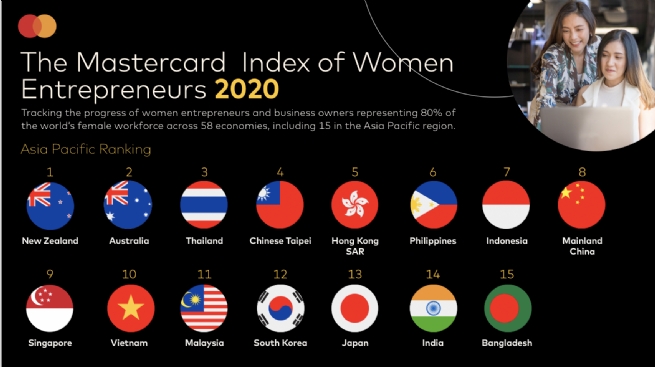
Women in Asia Pacific continue to make admirable progress in the business world. The Philippines, Thailand, Vietnam, and New Zealand ranked at #2, #6, #9 and #10 respectively for “Women’s Advancement Outcomes” which measures progress and degree of marginalization economically and professionally as businesses leaders, professionals, entrepreneurs and labour force participants.
“What the findings make clear is that regardless of an economy’s wealth, level of development, size, and geographic location, gender inequalities continue to persist – even pre-pandemic. What COVID-19 did is that it exacerbated an already problematic situation. It disproportionately disrupted women’s lives and livelihoods to a greater extent than men due to a few pre-existing factors: the jobs and sectors women tend to work in, childcare and domestic responsibilities and the pre-existing gender disparity in business.
Yet, through the pandemic we’ve seen women’s strength and endurance in the face of adversity. If anything, this year has illuminated how vast women’s potential really is. But this moment in time is fragile unless governments, financial services and business organizations come together to do three things: offer systemic support and programs to enable women to survive and thrive in this new normal, equip them with skills to navigate the digital world, and nurture an equitable, accessible financial services system that supports women’s work and entrepreneurship. These are not easy to deliver, but investments like these can yield priceless dividends for not only women, but society as a whole,” said Julienne Loh, Executive Vice President, Enterprise Partnerships, Asia Pacific, Mastercard.
“The pandemic has adversely impacted every individual, business and economy. Yet women entrepreneurs have shown their resilience by promptly adapting to new and digital ways of working, reimagining existing models, and tapping into new business opportunities. Mastercard is committed to supporting governments and financial institutions to create initiatives and programs that will empower women entrepreneurs to help drive Vietnam’s economic recovery,” said Winnie Wong, Country Manager, Vietnam, Cambodia & Laos, Mastercard.
D.A (Vietnam Business Forum)


 Vietnamese





