

10:17:47 AM | 10/25/2024

Growing mulberry, raising silkworms, and weaving silk is one of the oldest and most developed traditional crafts in Vietnam. Phung Xa commune is considered the cradle of mulberry growing, raising silkworms, and weaving silk with the legend of Princess Thieu Hoa, who taught the people the craft of growing mulberry, raising silkworms, and spinning silk. In the 1970s and 1980s, the village was known as the "Mulberry Capital" of the North, with silk products exported to Eastern European countries.
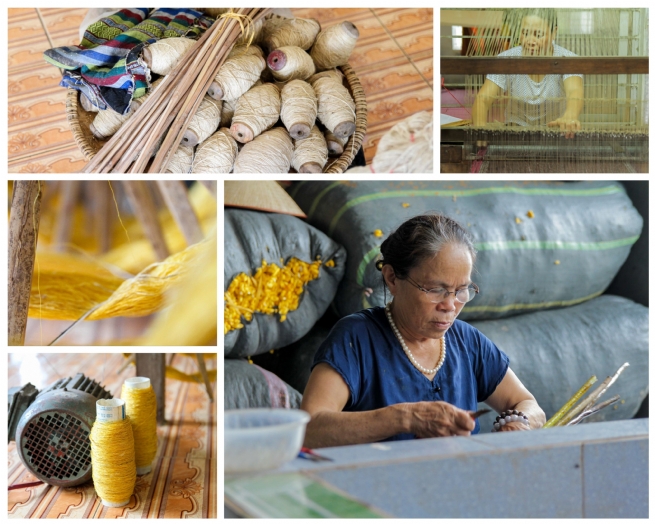
Phung Xa weaving village is one of the 3 destinations of the "Discovering the Nam Thang Long Heritage Road" tour, along with Quang Phu Cau incense stick craft village (Ung Hoa district), Binh Da communal house (Thanh Oai district), which have just been announced and put into operation by the Hanoi Department of Tourism.
Preserving the traditional silk weaving profession
Phung Xa silk weaving profession developed the most from 1986-1990. During this time, the village had hundreds of households engaged in weaving, with diverse products such as silk, satin, cotton towels... The products were not only consumed locally but also consumed in many provinces and cities across the country, especially exported to the former Soviet Union. Not specializing in weaving like Van Phuc silk weaving village (Ha Dong district), people in Phung Xa commune perform all stages of the traditional profession: From planting mulberry, raising silkworms, reeling silk to weaving, dyeing fabric...
Silk continues to go through many stages, requiring a lot of effort, time and dedication from the craftsman such as spinning, spinning silk, and reeling silk. Depending on the quality of the silk and the way it is twisted, there will be different types of silk with different qualities... Next is the stage of weaving. Weavers mix warp and weft threads to create many types of fabrics with different patterns and thicknesses... These are precious fabrics that feel cool in the summer, warm in the winter, and yet soft and luxurious... After weaving, the silk is dyed. With the secret of mixing natural colors, Phung Xa people create silk with eye-catching colors. With a love for the profession and a desire to preserve it for their descendants, some people in Phung Xa commune, including Meritorious Artisan Phan Thi Thuan, always try to research and study to revive the silkworm farming profession of their homeland. Ms. Phan Thi Thuan said: "Being attached to mulberry leaves and silkworms since childhood helped me understand the beauty of the profession very well, so when I saw families gradually abandoning the profession, I was very sad".
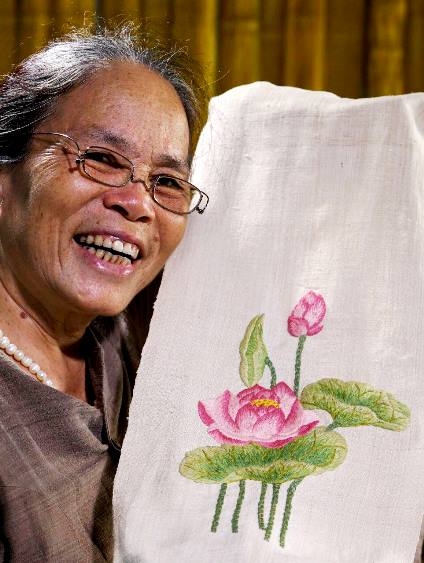
Meritorious artisan Phan Thi Thuan with her handmade silk scarf
Born and raised in a family with three generations of silk weaving, and having been passed down the profession since the age of six, therefore, for Ms. Phan Thi Thuan (born in 1954), mulberry trees, silkworm trays, and cocoons are as close to her as her flesh and blood. Witnessing the traditional profession fading away, she could not bear it. She was determined to keep her family's silkworm trays and spent a lot of effort to mobilize and organize silkworm raising households to preserve the profession. From the self-woven silk cotton blanket, the good news spread far and wide, and more and more customers knew about Phung Xa's products. Thanks to that, many silkworm and fabric weavers in the commune had more motivation to stick with the traditional profession.
Chairman of Phung Xa Commune People's Committee Vu Van Chuy said that the local government always creates favorable conditions for production households and businesses in the craft village borrow capital, invest in modern machinery for production. The craft village is one of the bright spots in the economic "picture" of the commune. Thanks to the good income from the industry, people have the conditions to build spacious houses and actively contribute to the construction of public welfare works, joining hands to beautify the homeland. Head of the Economic Department of My Duc district, Truong Anh Tuan, affirmed that thanks to the efforts to revive traditional crafts, households in Phung Xa commune have initially been truly successful with high-quality silk products. Thanks to that, they have not only enriched themselves but also contributed to preserving the typical beauty of the countryside along the Day River, promoting local socio-economic development, improving people's lives.

Lotus silk – a masterpiece from the national flower
The lotus is not only a decorative product but also has culinary, fashion, health values... This is also the reason why lotus products always bring high economic value. Lotus silk products produced by artisan Phan Thi Thuan are high-end products, used by the Government Office as gifts for heads of state. According to artisan Phan Thi Thuan, to weave a scarf 1.7m long, 0.25m wide, it takes 4,800 lotus stems. A diligent and skilled worker can only make 200 - 250 lotus stems in a day. It takes about 1 month to complete a scarf. Lotus silk fibers are thin and easily broken, so it takes a lot of skill and meticulousness to be able to draw the silk. In particular, all lotus stems must be processed within 24 hours, otherwise the stems will dry out, the silk will shrink and the yarn will be completely damaged.
At the end of 2017, Vietnam's lotus silk products were officially born. Meritorious Artisan Phan Thi Thuan became the first Vietnamese person to successfully weave fabric from lotus silk. Her name is recorded in Vietnam's lotus silk invention. Each lotus silk thread is thin and fragile and very easy to break, requiring the craftsman to be highly dedicated. The process of creating lotus silk is completely manual, meticulously and meticulously performed, so lotus silk products are often very expensive, often 7-10 times more expensive than similar products made from silk. Currently, this product is mainly made to order, or serves high-end customers, foreign customers because it is completely handmade, so the selling price is high.
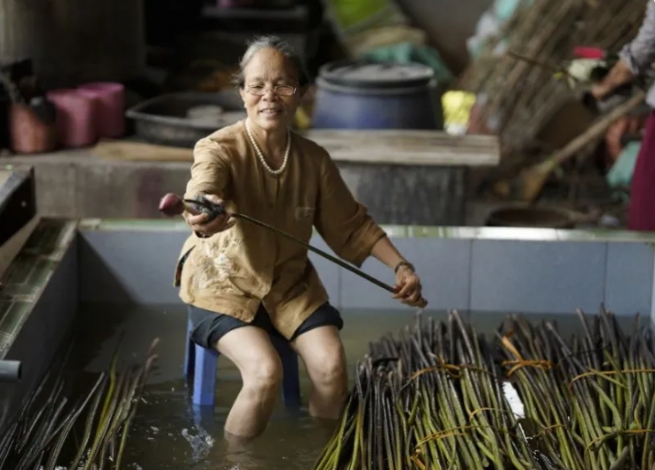
Lotus stem harvesting lotus silk production
Technical labor for spinning silk and weaving products accounts for a large proportion and the income of a worker ranges from 12-15 million VND/month. This is a new profession, creating lotus silk products with high economic value, environmentally friendly and at the same time creating sustainable development, contributing to the preservation and development of Vietnamese lotus trees", artisan Phan Thi Thuan shared
Phung Xa commune, My Duc district, Hanoi is famous for its mulberry growing, silkworm raising, silk spinning, and weaving. The sophisticated, unique silk products are woven from the silk threads in the stem of each lotus flower, not only a valuable commercial product, but also help attract a large number of tourists here, bringing high economic efficiency. In the face of fierce competition in the market, Phung Xa people want to maintain their profession, must improve product quality, create new, unique products so that the weaving profession can stand firm and be highly competitive in the market. Therefore, products made from interwoven silk need to be expanded, when in My Duc district there are about 300 hectares of low-lying land growing lotus, this is an abundant source of raw materials for the production of lotus silk thread. Mr. Vu Van Chuy said.
To date, Vietnam has become one of the few countries in the world that weaves fabric from lotus silk, including: Myanmar, Japan, Italy, France, Cambodia, and Vietnam. This is a significant success in the policy of "Parliamentary diplomacy actively contributes to promoting socio-economic development and international integration" of each country, thereby building a model of craft village tourism, poverty reduction, and sustainable development in Vietnam and other countries in the region.
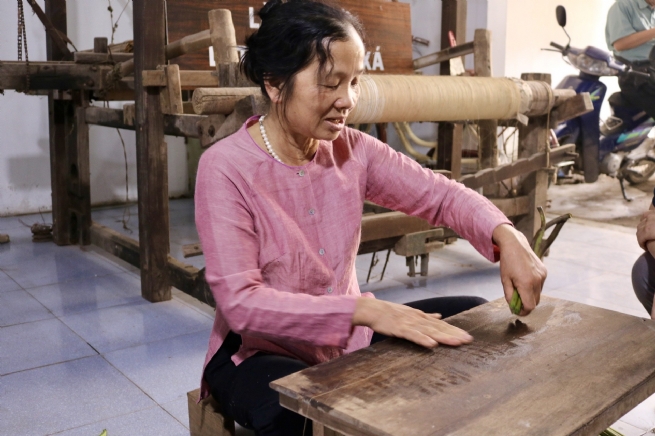
Spinning lotus silk requires meticulous skill of the craftsman
The lotus silk products are of high quality and well received by the market, but to develop further, they still face difficulties such as the lotus season starting from the end of May to the beginning of September every year, so the silk can only be obtained seasonally, the production stages are still mainly done by hand, so weaving lotus silk takes a lot of time. Therefore, the authorities need to provide more specific directions for the development of lotus silk, support product promotion, and build the lotus silk brand of My Duc district so that the lotus silk weaving profession can develop.
According to the Hanoi Rural Development Department: in the orientation of sustainable development of craft villages associated with tourism activities, the Hanoi People's Committee has issued a Plan on the development of the Creative Design Center, introducing and promoting promote OCOP products, craft villages associated with tourism in districts and counties in 2024.
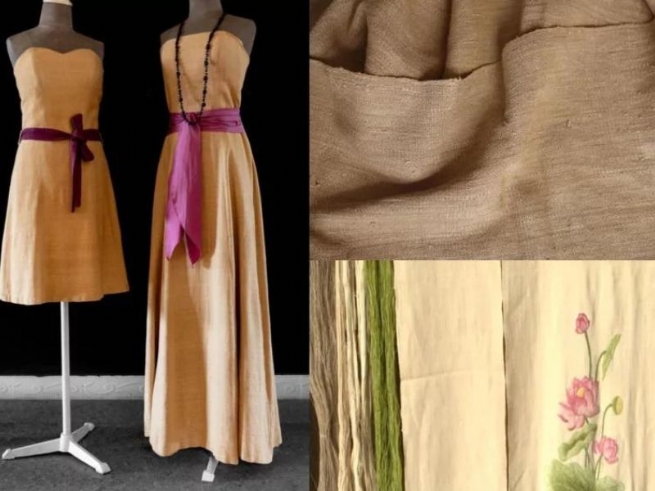
Products made from lotus silk
In 2023, products: lotus silk scarves, lotus silk embroidered silk paintings, ... will be evaluated and classified by the city in the OCOP program. In which, the product "Self-woven silk blanket" is classified as a 5-star OCOP product. By tirelessly bringing quality products to OCOP fairs, artisan Phan Thi Thuan affirms her brand in the awareness of consumers.
In addition, to sustainably develop tourism combined with experiencing traditional craft village culture, it is necessary to focus on environmental issues. After being spun, lotus stems will be reused as bio-fertilizer. Preserving the environment around lotus fields will make the lotus grow well and produce a lot of silk. It is the customers who use the factory's lotus silk products who have contributed to protecting the environment and promoting a green lifestyle.
Source: Vietnam Business Forum
The page in collaboration with Hanoi Rural Development Department
 April 24–25, 2026
 Kinh Bac Cultural Center, Bac Ninh Province


 Vietnamese





