

10:53:40 AM | 7/26/2025

Immediately after the merger of the three provinces Phu Tho, Vinh Phuc and Hoa Binh into the new Phu Tho province, the provincial leadership issued strong directives to ensure the effective functioning of the administrative apparatus, aiming to maintain uninterrupted services for people and businesses.
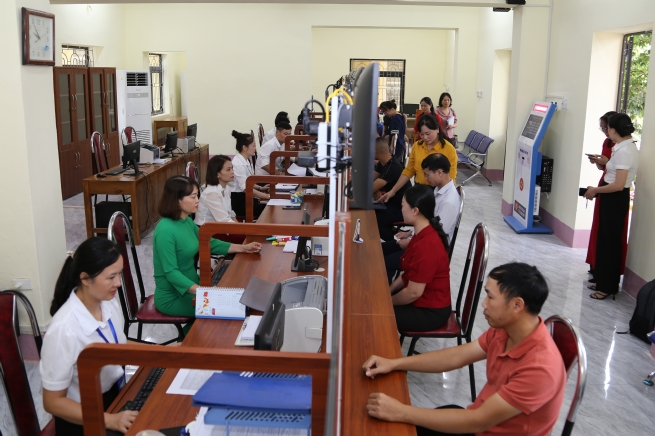
Phu Tho province ensures the smooth and uninterrupted delivery of public services
Opening up greater development opportunities
At the first meeting of the People's Council of the new Phu Tho province on July 1, Mr. Tran Duy Dong, Chairman of the Provincial People's Committee, delivered an inaugural speech, affirming his commitment to join forces with others to effectively implement the policies of the province and the central government regarding the construction of a strong, efficient and effective administrative system from the provincial level down to the grassroots, hence contributing positively to the overall development of Phu Tho.
He emphasized that the new province of Phu Tho has formed a unified administrative, economic and social entity of larger scale, integrated geographical space, history, culture, population and economic structures; and consolidated numerous drivers and added diverse potential and resources for growth and development. The new province, with a broader geographical reach and greater, more diverse advantages, borders the highest number of localities in the country, including Vietnam’s capital Hanoi. The province features an extensively connected transportation system; a gross regional domestic product exceeding VND354 trillion, ranking 6th out of 34 merged provinces and cities; an area of 9,361 square kilometers, ranking 15th nationwide; a population of over 4 million, ranking 7th; and a budget revenue ranked 11th nationwide. Much new room for development has opened up to support the province’s goal of becoming a hub for industry, services, logistics, renewable energy, sustainable agriculture, heritage tourism and ecotourism; a center for national and international events; and a province with high economic growth driven by science, technology, innovation, digital transformation and the private sector.
However, following the merger, the province’s administrative boundaries have expanded significantly; the terrain is predominantly mountainous and fragmented; economic growth quality and state budget revenues remain unstable; the private economic sector is weak; disparities in development and living standards among regions persist; and infrastructure remains inconsistent. These combined with global economic and political uncertainties, domestic economic headwinds, and adverse impacts of climate change, extreme weather and epidemics pose significant challenges to the province's development objectives in the coming time. Chairman Dong highlighted solutions to operate an effective two-tier local government model.
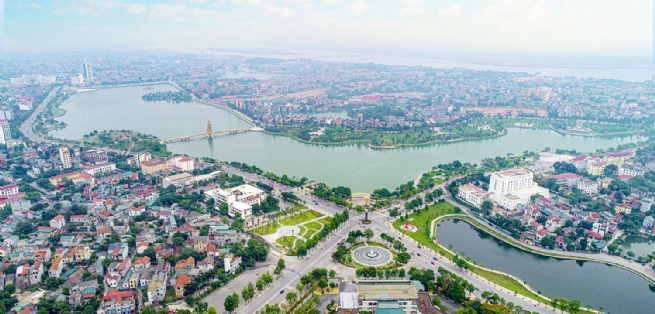
The province’s administrative boundaries have expanded significantly
Good infrastructure
At his working session with Vice Chairpersons of the Provincial People's Committee, Chairman Dong instructed immediate preparations for infrastructure, equipment, readiness, interconnectivity and effective operation of shared information systems which consist of the online meeting system, document management and executive system, and administrative procedure resolution information system, with the goal of identifying and addressing obstacles in a timely manner and launching official operations from July 1, 2025.
The Office of the Provincial People’s Committee reported on the organization and operation of commune-level public administrative service centers and on difficulties encountered during the implementation of administrative procedures under the two-tier government model. To ensure seamless operation of the administrative procedure resolution information system from day one of the merger, the Provincial People’s Committee promptly made preparations for infrastructure, equipment, readiness, interconnectivity and effective operation of shared information systems which consist of the online meeting system, document management and executive system, and administrative procedure resolution information system, with the goal of identifying and addressing obstacles in a timely manner and launching official operations from July 1, 2025. These systems were basically tested in a trial run on the morning of June 29, 2025. The Office of the Provincial People’s Committee regularly updated decisions from central ministries and agencies, proactively coordinated with provincial departments to submit for the Chairman’s approval the lists of administrative procedures applicable across the province.
Currently, the public administrative service centers of former Phu Tho, Vinh Phuc and Hoa Binh provinces continue operating in their original locations to work with citizens in their respective areas. All 148 communes have established fully staffed public administrative service centers. Some communes have also arranged staff to centers for document processing and result delivery.
As of June 30, 2025, VNPT basically configured the administrative procedure resolution information system for the new province of Phu Tho which started operations on July 1, 2025. The system was designed with user-friendly features for both citizens and public servants. Meanwhile, the old systems of Phu Tho and Vinh Phuc are still being maintained for reference and handling of pending or revised applications.
Regarding internet connectivity, VNPT and Viettel Phu Tho have upgraded their capacity to ensure stable and smooth system operations. With respect to the announcement and declaration of administrative procedures, the number of procedures before the merger was 1,879, including 1,495 at the provincial level, 268 at the district level and 116 at the commune level. After the merger, the total increased to 2,217, including 1,812 at the provincial level and 405 at the commune level.
So far, 36 decisions have been issued to announce the list of decentralized and delegated procedures in line with 28 governmental decrees, covering 1,490 procedures applied throughout the province, completing 100% of decisions on procedure announcement of central agencies.
Despite these efforts, several difficulties remain in implementing administrative procedures under the two-tier local government model. Some remote and mountainous communes still face challenges; equipment quality is not always guaranteed; and most civil servants were promoted from commune-level positions, so their IT proficiency is limited and their ability to operate the administrative systems remains weak.
Chairman Dong assigned Vice Chairpersons of the Provincial People's Committee, based on their areas of responsibility, to direct the effective implementation of tasks, ensuring seamless and efficient leadership and administration. This will create favorable conditions for all activities of people and businesses across the province.
Source: Vietnam Business Forum
 April 24–25, 2026
 Kinh Bac Cultural Center, Bac Ninh Province


 Vietnamese





