

2:32:23 PM | 11/10/2025

Under increasing pressure from major markets and global Net Zero commitments, Vietnam’s electronic supporting industry enterprises must adopt green transformation or risk being excluded from international supply chains. This change is both a challenge and an opportunity to improve production capacity and reinforce their position in the global value chain.
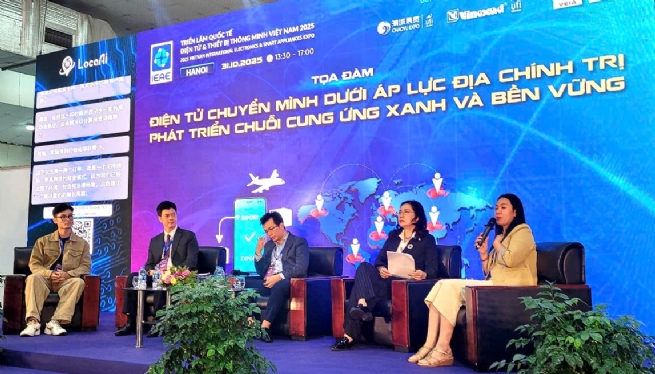
Keynote speakers discuss solutions to strengthen the electronics supporting industry
Pressure to decarbonize in global supply chains
At the roundtable discussion “Electronics under Geopolitical Pressure: Developing Green and Sustainable Supply Chains,” held on October 31 by the Vietnam Electronics Industries Association (VEIA) in cooperation with VINEXAD National Trade Fair and Advertising JSC and Vietnam Green Innovation Joint Stock Company (Green In), experts agreed that global supply chains are experiencing major disruptions and that Vietnam, as a key electronics manufacturing hub, is also impacted.
At the forum, Do Thi Thuy Huong, a member of VEIA’s executive board, emphasized that if Vietnamese firms do not shift to green production, they risk being excluded from global supply chains. She highlighted strict export-market policies in the EU, the U.S., and Japan, particularly the EU’s carbon border adjustment mechanism (CBAM) and emission-reduction requirements from major global companies such as Apple, Samsung, and Intel.
She said that Vietnamese firms must adjust their manufacturing models toward energy efficiency, invest in clean technologies and establish transparent ESG (Environmental, Social and Governance) management systems. These steps are now essential to maintain competitiveness as global trade shifts toward “green supply chains.”
In fact, many supporting-industry electronics firms in Vietnam rely heavily on orders from foreign-direct-investment (FDI) corporations, and when those global “big players” demand strong ESG evidence, Vietnamese suppliers cannot afford to lag. Failure to move quickly could lead to loss of market share or even exclusion from supplier lists.
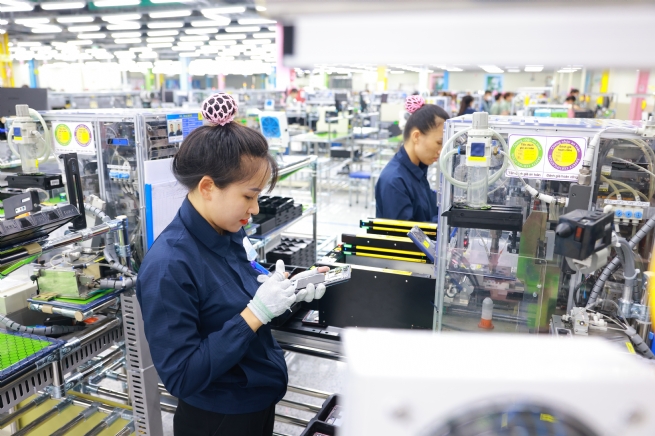
Samsung can be seen as a supporter, helping Vietnam’s supporting industry integrate into global value chains
Going green - inevitable path for Vietnamese enterprises
What was once considered a long-term goal has now become a matter of survival. “Vietnamese businesses should not wait to grow before going green; they should go green to grow,” said Nguy Thi Giang, Chairwoman and CEO of Green In.
In fact, the world has already introduced multiple tools to encourage greener production. For example, the Electronic Product Environmental Assessment Tool (EPEAT), administered by the Global Electronics Council, applies to product categories such as computers, televisions, and mobile phones. These standards require manufacturers to cut greenhouse gas emissions, extend product life cycles, and increase the use of recycled materials.
In Vietnam, domestic regulations are also tightening. More than 2,100 enterprises are now required to conduct greenhouse gas inventories, many of which belong to the electronics sector. At the same time, both manufacturers and importers must recycle post-consumer electronic products.
According to Dr. Bui Thanh Minh, Deputy Director of the Office of the Research and Development Board for the Private Economic Sector, in a rapidly changing world, enterprises must proactively transform by leveraging both government policy support and market pressure to strengthen their internal capacity. “If they wait, businesses will lose the opportunity to redefine their position in the supply chain,” he said.
Lai Hoang Duong, Director of Thanh Giong Computer and Communication JSC, warned that failure to meet ESG standards could lead to losing business contracts. He noted that companies that do not work toward ESG compliance may be forced to shut down. Even small steps, such as using electric vehicles for transportation, are an important starting point, he said.
Green transformation is both a challenge and a “ticket” for Vietnamese electronics supporting-industry enterprises to move up the value chain. Once they meet international standards, these firms will not only secure their position in global supply chains but also gain opportunities to expand exports and participate more deeply in high-value segments.
Vietnam has major advantages, including an abundant workforce, fast technological innovation, and a broad network of free trade agreements (FTAs). If government support policies are effectively connected with businesses’ proactive efforts, building a green supply chain in the electronics industry is entirely achievable. As “greening” becomes a common trend from multinational corporations to small producers, this shift is not only necessary but also an opportunity for Vietnam to strengthen its position on the global value chain map.
By Bui Lien, Vietnam Business Forum
 April 24–25, 2026
 Kinh Bac Cultural Center, Bac Ninh Province


 Vietnamese





