

3:57:05 PM | 11/11/2025

Vietnam’s Hydrogen Energy Development Strategy (Decision 165/QD-TTg dated February 7, 2024 issued by the Prime Minister) is moving from vision to action as businesses take the lead with concrete projects and innovative solutions. Among the pioneers, THDV Green Development Investment Consulting Joint Stock Company has proposed several initiatives that align with the nation’s green transition goals. One standout project is the “GH2 Agri-Industrial and Green Energy Circular Economy Complex” in Hai Phong City, developed under the technical advisory of Dr. Mai Huy Tan, Chairman of THDV Green Development Investment Consulting Joint Stock Company.
I. INTRODUCTION
The Resolution of the 13th National Congress of the Communist Party of Vietnam mentioned circular economy, green economy, sustainable development and environmental protection, and combating climate change.
The circular economy model has the following characteristics and criteria:
4 criteria on economics and investment efficiency:
- Saving production costs
- Rationalizing the input–output processes of the components
- Optimizing logistics and transportation processes
- Enhancing business and production efficiency
1 social-human criterion: improving labor productivity and income of workers
3 criteria on environment and climate change mitigation
- Minimizing waste during production and maximizing the utilization of waste to convert it into useful products
- Producing and efficiently using renewable energy forms in production
- Reducing emissions and contributing to climate change mitigation and environmental protection
The dynamic circular economy model is also supplemented with another important feature, which is the high after-tax profit margin to serve as a foundation for reinvesting profits for expanding the scale and revenue of the model, creating a driving force for rapid double-digit growth to contribute to the growth of local GRDP, thereby increasing the double-digit GDP growth of the economy.
II. GH2 AGRICULTURAL - INDUSTRIAL AND GREEN ENERGY CIRCULAR ECONOMY COMPLEX PROJECT
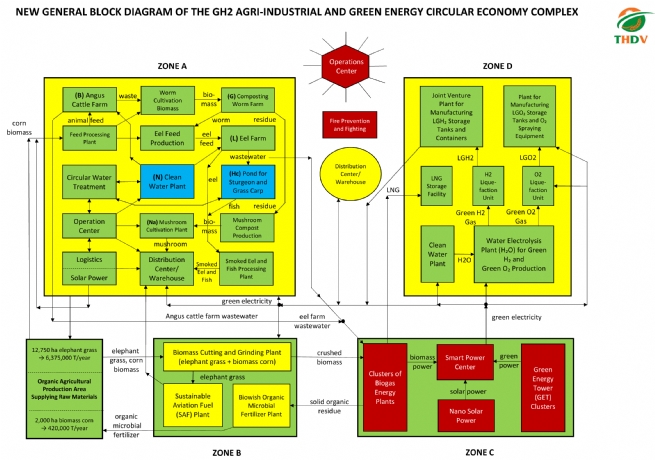
The proposed GH2 project will fully demonstrate the above 9 characteristics of a dynamic circular economy model. Based on practical surveys in Hai Phong city, especially in Cam Giang commune, this project includes 3 parts:
PART 1: has an area of 100 ha described in the investment items in Sub-area (A)
PART 2: 150 ha including investment items in 3 Sub-areas (B), (C), (D)
PART 3: 14,750 ha including 12,750 ha of elephant grass and 2,000 ha of biomass corn. This is the organic agricultural production area of farmers to provide biomass materials for the above-mentioned sub-areas of the project.
III. SOCIO-ECONOMIC AND ENVIRONMENTAL TARGETS
1. Investment capital (first 2 years): about US$1.5 billion
Total investment for the complex: US$3 billion
2. Expected revenue: around US$5 billion per year per complex
3. Main product groups
3.1. Renewable electricity: 5 billion kWh per year
3.2. GH2: 60,000 tons per year; GO2: 480,000 tons per year
3.3. Sustainable aviation fuel (SAF): 150 million liters per year
3.4. Angus beef cattle (Australian breed): 20,000 head per year
3.5. Eel: 24,000 tons of fresh eel and 10,000 tons of smoked eel per year
3.6. Smoked fish: 5,000 tons per year
3.7. Edible mushrooms: 4,000 tons per year
3.8. Microbiological organic fertilizer: 2.5 million tons per year
3.9. Containers: 1,000 containers and 100 special tanks per year for storing and transporting liquefied LGH2
3.10. Liquid GO2 storage tanks and GO2 gas spraying machines
4. High technology and modern equipment originating from Germany and other EU countries, Russia, Japan, Australia, USA, China
5. Investment efficiency, economic - social - environmental significance
5.1 Very high profit margin, contributing greatly to Hai Phong city budget through corporate income tax from US$150 million to US$300 million/year/complex
5.2 A complex will create jobs for 3,000 local workers, improving the lives of 15,000 farming families producing agricultural raw materials in Cam Giang.
5.3 Reduce greenhouse gas emissions by 4 million tons CO2/year/complex, with 15 complexes → reduce 60 million T CO2/year
5.4 The dynamic nature of the project is demonstrated by the high profit margin that allows after paying corporate income tax to the Hai Phong City budget, the after-tax profit will be used to reinvest in expanding the scale, the number of complexes invested in the period 2031-2035 will be up to 15 complexes. From there, this strategy will generate total revenue of about US$75 billion per year, based on 15 complexes each earning approximately US$5 billion annually. Thus, the revenue growth rate in the 10 years is expected to average 30%/year, contributing to the double-digit GRDP growth of Hai Phong city.
IV. GROWTH STRATEGY TO EXPAND AND SPREAD GH2 PROJECT IN THE NORTHEAST PROVINCES OF VIETNAM
The rural area of Hai Phong City (including 5 old districts of Hai Phong City and 17 old districts of the old Hai Duong City) can be planned with enough 150,000 ha for 10 GH2 complexes, about 46.4% of the natural land area of Hai Phong City.
Only 3 old districts of Bac Giang province (currently Bac Ninh) namely Luc Nam, Luc Ngan and Son Dong have enough area of 150,000 ha to spread the next 10 complexes. Quang Ninh province with an area of 617,820 ha has enough land potential of 300,000 ha, or 48.5% of the province's area for 20 GH2 complexes.
The next province in the Northeast region of Vietnam is Lang Son with an area of 831,010 ha, also has the potential to plan 390,000 ha, equivalent to 46.9% of the natural land area for 26 GH2 complexes.
Thus, in summary, the 4 cities and provinces of the Northeast region including Hai Phong, Bac Ninh, Quang Ninh, Lang Son have enough land potential of 990,000 ha to plan 66 GH2 complexes for the rapid growth period with 66 complexes until 2045 with an average revenue growth rate of 30%/year, achieving the target of total revenue of US$330 billion/year from 2045 onwards , making an important contribution to the double-digit economic growth of the Northeast region and of the entire GDP of the Vietnamese economy, making Vietnam a country with a modern, high-income economy. In particular, the Northeast region of Vietnam will become a center of renewable energy, production and export of liquefied green fuels such as Green hydrogen and sustainable aviation fuel SAF.
Source: Vietnam Business Forum





 Vietnamese





