

9:30:09 AM | 12/11/2025

As Vietnam has pledged to achieve net-zero emissions by 2050 at the 26th United Nations Climate Change Conference of the Parties (COP26), sustainable development and ESG (Environmental, Social, and Governance) practices are no longer optional but essential for business survival. Pressure from international policies, global supply chains, and domestic commitments is pushing Vietnamese enterprises to transform their mindset and development models.
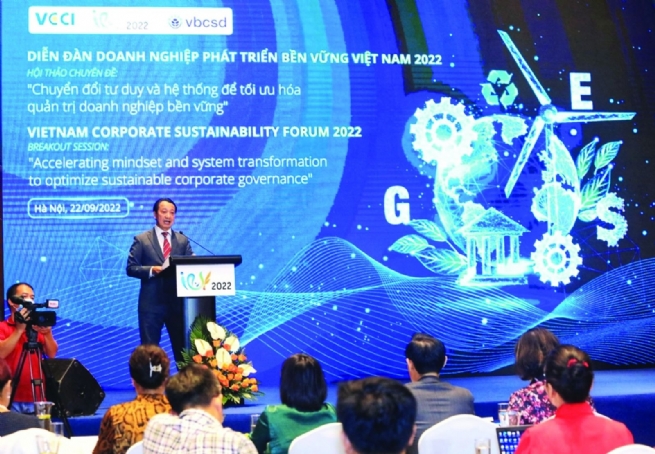
VCCI Vice President and VBCSD Chairman Nguyen Quang Vinh addresses Vietnam Corporate Sustainability Forum
Policy foundations for green business transformation
According to Nguyen Quang Vinh, Vice President of the Vietnam Chamber of Commerce and Industry (VCCI), the foundation for Vietnam’s green transition was laid more than 12 years ago. It began with Resolution 24-NQ/TW (2013) on proactively responding to climate change, managing natural resources, and protecting the environment. This was the first document to introduce a new development mindset, emphasizing that growth should not depend solely on GDP expansion but must be closely connected to sustainable development.
Building on that foundation, Vietnam has continued to institutionalize key policy pillars. Resolution 55-NQ/TW (2020) on the National Energy Development Strategy sets the goal of ensuring energy security while reducing emissions, prioritizing renewable energy, and promoting efficient energy use. Subsequently, Decision 1658/QD-TTg approved the National Green Growth Strategy for 2021-2030, with a vision to 2050, translating commitments into concrete, measurable objectives such as reducing greenhouse gas emission intensity per GDP unit, greening key economic sectors, and promoting sustainable consumption.
In this context, where the private sector plays a pivotal role in translating strategy into action, Resolution 68-NQ/TW on private sector development is regarded as a historic breakthrough. Currently, the private sector contributes about 50% of GDP and creates over 80% of total employment. Positioning this sector at the center of Vietnam’s sustainable development strategy reflects not only sound economic reasoning but also a clear political direction: achieving net zero requires empowering private enterprise.
Resolution 68 also introduces unprecedented incentives, allowing companies to deduct up to 200% of their research and development (R&D) expenses for tax purposes and to establish science and technology funds that can allocate up to 20% of taxable income. These direct financial levers encourage businesses to invest confidently in clean technologies, circular economy models, and emission reduction solutions. Notably, the resolution also calls for breakthrough institutional reforms and the development of a legal framework for emerging digital economy models, along with a regulatory sandbox mechanism to support pilot projects in green and innovative business initiatives.
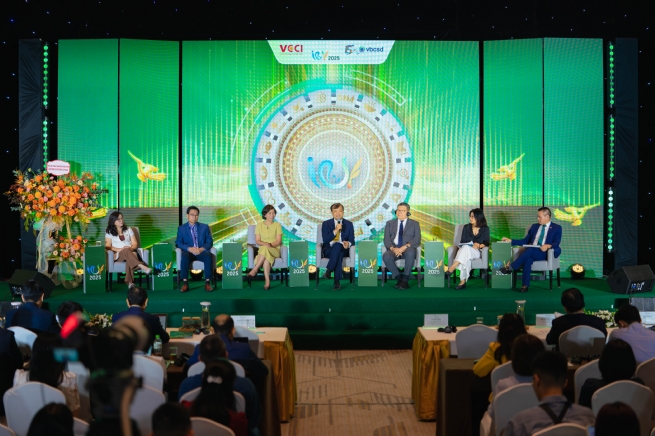
Experts and business leaders discuss at Vietnam Corporate Sustainability Forum 2025
ESG: from slogan to survival imperative
Although national policies have paved the way, the “greening” of Vietnam’s business community has advanced more slowly than expected. While a number of leading corporations have adopted ESG as a core strategy, established dedicated ESG committees, and conducted emissions inventories, most enterprises, especially small and medium-sized ones (SMEs), which make up over 97% of all businesses, remain in the early stage of familiarization.
According to the 2024 ESG Practice Assessment Report, among more than 1,000 surveyed enterprises, 39% had never heard of ESG, 62% were unclear about relevant regulations, and nearly 90% of SMEs had not disclosed any environmental information. The gap between awareness and action remains substantial.
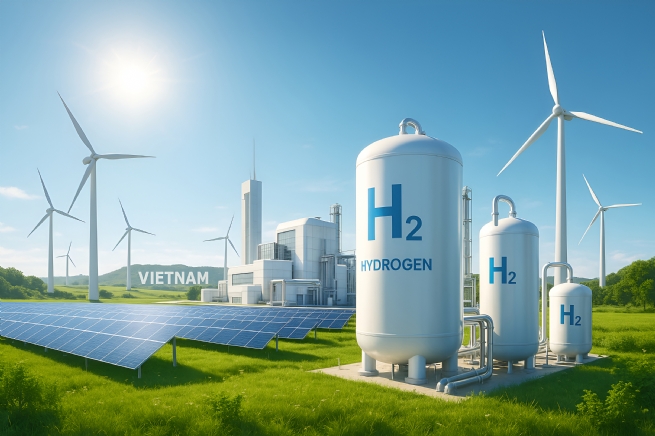
Vietnam has natural and logistical advantages to become the region’s hydrogen hub, but itmust “move fast” through international cooperation and “stand firm” by localizing technology
The reasons behind this slow progress include limited initial investment capital, restricted access to green credit, the absence of concrete measurement standards, and the pressure to comply with stringent international market requirements. Yet, for 97% of Vietnamese enterprises to transition together, concrete actions, practical tools, and adequate resources are essential.
At the same time, global supply chain shifts are making ESG a genuine “passport for business survival.” The European Union’s Carbon Border Adjustment Mechanism (CBAM), introduced in October 2023, requires importers to report emissions and will impose financial obligations through the purchase of carbon certificates starting in 2026. Meanwhile, multinational corporations such as Apple have mandated that their entire supply chain operate on 100% renewable energy by 2030. This means that if Vietnamese enterprises, especially SMEs in supply chains, fail to disclose emission data transparently and establish a clear Net Zero roadmap, they face the real risk of being excluded from global trade networks.
In response to these challenges, the role of domestic support organizations has become increasingly important. Since 2016, the Vietnam Chamber of Commerce and Industry (VCCI) has pioneered the Corporate Sustainability Index (CSI), a practical tool that enables businesses to self-assess, measure, and enhance their ESG performance. After nine editions, more than 4,000 enterprises have participated directly, and over 10,000 have used the index for strategic planning. Today, CSI functions as a soft standard that helps Vietnamese businesses align with international partners and prepare for the global movement toward mandatory ESG compliance.
By Huong Giang, Vietnam Business Forum


 Vietnamese





