

11:29:18 AM | 12/18/2025

As of the end of November 2025, Vietnam’s public investment disbursement reached VND553,250 billion, equivalent to 60.6% of the plan assigned by Prime Minister Pham Minh Chinh. Completing 100% of the disbursement in 2025 remains a major challenge due to multiple factors affecting the spending pace.
Substantial disbursement needed
Public investment is considered a key solution and driver for economic recovery and strong growth. Estimates show that during the 2021-2025 period, a 1% increase in public investment disbursement could contribute about 0.058 percentage points to GDP growth. Although disbursement is higher than in the same period of 2024, it still falls short of the target. With the deadline set for January 31, 2026, the remaining amount to be disbursed is substantial, approximately VND360,000 billion.
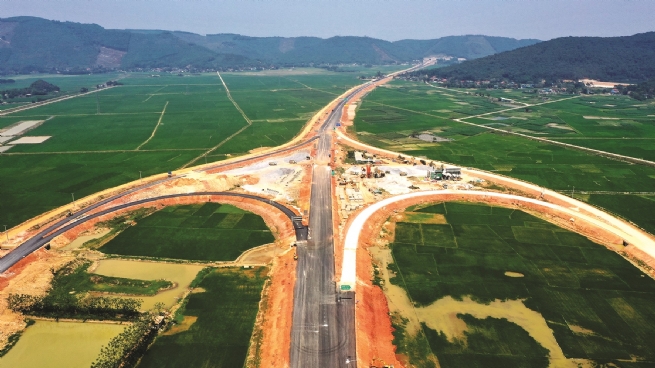
Public investment is considered a key solution and driver for economic recovery and strong growth
Infrastructure sectors, particularly transportation, require substantial public investment to ensure timely and high-quality completion of major projects. Vietnam plans to complete 3,000 km of expressways, 1,000 km of coastal roads, and begin construction on key railway routes, including Hanoi-Lao Cai-Hai Phong. Accelerating disbursement transparently and effectively, addressing procedural and land clearance issues, and enhancing coordination among agencies are essential to maintain development momentum.
The total public investment allocated to the Ministry of Construction in 2025 is VND80,302 billion, excluding VND6,970 billion of expired expenditure items awaiting approval. By the end of October 2025, disbursement reached VND40,916 billion, approximately 51% of the allocation, lagging by around VND5,634 billion compared with the schedule registered by project owners.
Several projects underperformed relative to the national average, including the Cho Moi-Bac Kan rural market, northern mountainous road connections, and expressway sections such as Chi Thanh-Van Phong and Van Phong-Nha Trang managed by Project Management Unit 7. Delays are caused by slow land clearance, insufficient supply of embankment materials, contractor delays, and unpredictable weather conditions, which create landslide risks and require additional time for mitigation.
In Hanoi, by November 22, 2025, approximately VND52,000 billion had been disbursed, equivalent to 62.1% of the plan assigned by Prime Minister Pham Minh Chinh and 50.1% of the city’s allocation. Significant gaps remain compared with the targets, with 386 projects facing land clearance difficulties. Disbursement is also limited by shortages of construction materials and volatile prices, which increase costs and slow progress.
Despite many infrastructure launches in 2025, including major bridges such as Van Phuc, Ngoc Hoi, Thuong Cat, and the third component of Ring Road 4 - Capital Region, execution continues to be challenged by land clearance delays at key national projects, including the North-South high-speed railway, the Lao Cai-Hanoi-Hai Phong line, and the Gia Binh Airport connection. Several major projects underway in Hanoi continue to strive for timely completion and high quality. Municipal authorities launched a 75 day high-effort period starting November 1, 2025, targeting over 80% disbursement by December 31, 2025, and full completion by January 31, 2026.
In Ho Chi Minh City, detailed allocation and disbursement plans for the public investment capital assigned by the Prime Minister of VND153,615 billion have been completed. As of December 5, 2025, total disbursement reached nearly VND73,812 billion, including VND73,346 billion for the 2025 plan, achieving 61% of the Prime Minister’s target and 47.7% of the city’s own plan. This rate exceeds the national average.
Nevertheless, meeting the full-year target requires significant additional efforts. The city has established three working groups to conduct on-site inspections of construction projects and hold local meetings under the principle of “decide on the spot, resolve on the spot” to expedite progress, address obstacles promptly, and ensure disbursement aligns with the schedule.
Efforts to achieve targets
In Official Dispatch 237/CD-TTg dated December 6, 2025, regarding efforts to accelerate public investment disbursement, Prime Minister Pham Minh Chinh commended 12 ministries and central agencies and 20 localities for achieving disbursement results above the national average, including areas affected by heavy rain and floods that still met their schedules and targets. At the same time, he issued strong criticism of 22 ministries, central agencies, and 12 localities that fell below the national average in disbursement.
To accelerate progress and strive to complete 100% of the public investment plan for 2025, the Prime Minister instructed ministries, central agencies, and provincial and municipal authorities to prioritize responsibility, intensify leadership, and implement key tasks and solutions more decisively, synchronously, promptly, and effectively. They are required to proactively address and resolve obstacles and difficulties in a timely and effective manner, with particular focus on accelerating land clearance, construction progress, and removing challenges related to land, resources, and other constraints.
Prime Minister Pham Minh Chinh directed the Ministry of Finance to apply digital transformation in monitoring, inspecting, and supervising the disbursement progress of ministries, central agencies, and localities, and to promptly report to the Prime Minister any agencies or localities with slow disbursement. The Ministry of Finance is also tasked with proposing flexible, practical management measures to ensure completion of the 2025 public investment disbursement target. The Ministry of Construction is to lead and coordinate with relevant agencies to closely monitor the construction materials market, particularly key materials, and to promptly propose and report solutions to Prime Minister Pham Minh Chinh to resolve difficulties and obstacles in ensuring supply and controlling construction material prices.
In particular, ministries, central agencies, and localities are instructed to proactively select and allocate 2026 budget capital for projects that have completed investment procedures and meet disbursement conditions. Detailed allocation and assignment of the 2026 state budget investment plan should be completed immediately after the Prime Minister approves the plan.
Quynh Anh (Vietnam Business Forum)
 April 24–25, 2026
 Kinh Bac Cultural Center, Bac Ninh Province


 Vietnamese





