

8:58:56 AM | 3/14/2026

At the national conference convened to study, disseminate, and implement Resolution 79-NQ/TW dated January 6, 2026 on state economic development and Resolution 80-NQ/TW dated January 7, 2026 on the development of Vietnamese culture issued by the Politburo, Chairman of the Party Central Committee’s Commission for Information, Education and Mass Mobilization Trinh Van Quyet clarified the new vision and higher standards set out in Resolution 80, highlighting several core and new points that define the position, stature, and overall profile of Vietnamese culture.
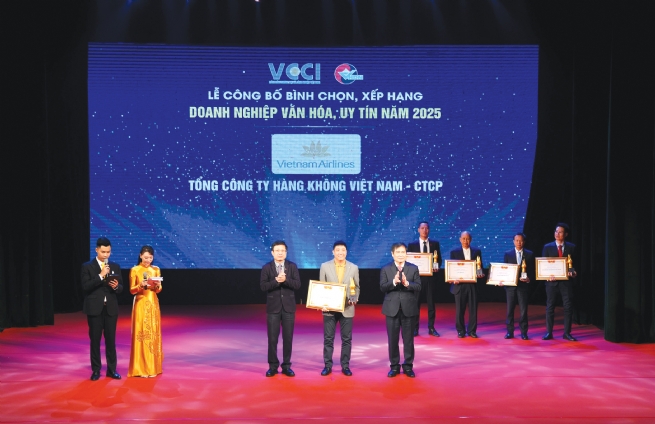
VCCI promotes a modern, sustainable business culture among Vietnamese enterprises, emphasizing ethics, transparency, and social responsibility. In the photo: Announcement ceremony of the Cultural and Reputable Enterprises 2025 , organized under the direction of VCCI
Setting specific targets for key cultural sectors
According to Trinh Van Quyet, earlier Party documents on culture mainly outlined broad directions and general goals, while specific targets remained largely at the level of orientation. Resolution 80, by contrast, not only affirms overall objectives for each sector but also sets clear targets to be achieved. In other words, it links higher quality requirements with measurable benchmarks in selected cultural fields. This reflects a more scientific and practical approach, avoiding general directives that cannot be assessed at each stage.
As an example, he noted that the overall objective for cultural industries is to “accelerate development and build a startup ecosystem for cultural industries and creative arts.” Alongside this goal is a target for the sector to contribute 7% of GDP by 2030 and aim for 9% by 2045, while developing 5-10 national cultural brands. Similarly, in line with the view that “investment in culture is investment in national development and the future of the nation,” the Resolution sets a clear target to allocate at least 2% of total annual state budget expenditure to culture, with gradual increases based on practical needs.
Trinh Van Quyet said previous resolutions did not directly specify such targets but left them to the State. In recent years, the goal was to allocate 1.8% of total state budget spending to culture, yet this level was rarely reached, with the highest year slightly above 1.7%. Resolution 80’s requirement of a minimum of 2%, with the possibility of further increases in line with actual conditions, marks a new step in cultural investment.
“By affirming a strategic breakthrough policy, the Resolution links perspectives, objectives, tasks, and solutions for cultural development into a coherent system,” he said.
Placing human development at the core
Building people has consistently been the central and highest goal in Party resolutions on culture. Resolution 80 fully carries forward this principle, further clarifying and expanding its content while emphasizing the close relationship between “developing culture to refine the socialist personality in the new era and building people in order to develop culture.”
Trinh Van Quyet said that although this view is not new, it has become more urgent. In recent years, there has been a tendency to separate these two tasks or to reduce culture to entertainment. A small minority has even denied its role in shaping people, treating culture, literature, and the arts simply as a “playground.”
A common expression of this view is to see culture as only a set of professional activities, without sustained attention to the central goal of human development. As a result, culture in recent years has not had a strong enough impact in shaping character and fostering a healthy cultural environment, contributing to signs of decline, distortion, and the spread of harmful and false values that have raised public concern.
To build and strengthen the personality of Vietnamese people in the new period, the Resolution calls for the coordinated implementation of cultural values, national values, family values, and standards of Vietnamese character. Based on research conducted since the 13th National Party Congress in 2021, Resolution 80 clearly defines the specific components of these value systems.
This marks an important step forward in both theory and practice, as these components will serve as benchmarks for society as a whole, for organizations and communities, and for individuals seeking self-improvement. Confusion and deviations from these standards will be addressed through culture and regulated by law.
Alongside the task of human development, the Resolution repeatedly emphasizes building a humane, healthy, and modern cultural environment. While continuing earlier thinking on improving living environments, Resolution 80 adds the requirement to “build a healthy digital information environment and cleanse the digital cultural environment” - a challenge that is both urgent and long term amid rapid and complex digital transformation. This approach reflects forward-looking and comprehensive thinking about the modern cultural environment.
To promote the values, strength, and identity of Vietnamese people and culture in the modern world, the Resolution calls for “proactive and active international integration in culture.” The key idea is to integrate culture into all external relations at the highest and most effective level across political, economic, cultural, social, defense, and security fields - both participating in integration and selectively absorbing the best of global culture, which are essential to cultural development in the modern era.

A site within the Yen Tu - Vinh Nghiem - Con Son - Kiep Bac Complex, recognized by UNESCO as a World Cultural Heritage site in July 2025
Culture as a particularly delicate and distinctive field
According to Trinh Van Quyet, viewing culture as a particularly delicate and distinctive field has shaped the perspectives, objectives, tasks, and solutions set out in Resolution 80.
First, the Resolution calls for a harmonious and balanced handling of the “internal relationships of culture,” especially the relationship between tradition and modernity, national identity and international integration, preservation and development. Party resolutions have consistently affirmed that Vietnam’s culture moves toward modernity on the foundation of tradition. Continuing this approach, Resolution 80 highlights national character, roots, and unique identity while also recognizing the aspiration and path toward modernity, contributing to the broader progress of human civilization.
The word “modern” appears ten times in Resolution 80 in defining development directions for cultural industries, cultural environments, cultural products, literature and the arts, cultural institutions, and digital creative spaces. This reflects the development requirements for Vietnamese culture in the new era.
The Resolution’s view of cultural distinctiveness is also reflected in its policy framework. It repeatedly refers to distinctive, breakthrough, and exceptional mechanisms aimed at unlocking creative potential and nurturing cultural talent.
Three key components for culture development
Resolution 80 identifies three key components as a central task for cultural development: building infrastructure, mobilizing and using resources effectively, and improving the quality of cultural human resources.
On infrastructure, the Resolution sets the objective to “focus on investing in and completing cultural infrastructure, prioritizing national-level cultural institutions that meet regional and international standards” - a requirement not previously stated in this way.
Regarding resources, the Resolution stresses the need to “ensure adequate funding for programs and projects, increase focused and prioritized public investment in culture, and attract the highest possible level of social investment.”
A core pillar of breakthrough cultural development is the development of a human resource strategy, especially for high-quality personnel and strategic-level officials. This includes planning, training, and capacity-building for leaders, managers, civil servants, public employees, workers, and key local officials, as well as building networks of cultural experts at home and abroad.
The Resolution also calls for advanced and modern standards in education and research on Vietnamese culture and civilization, taking into account their specific characteristics. Under current conditions, each of these tasks presents a significant challenge and requires innovative thinking and a long-term, urgent, and determined implementation plan.
Source: Vietnam Business Forum


 Vietnamese





