

12:51:42 PM | 2/20/2026

Vietnam identifies its European partners as companions in a new development era and is working closely with Europe to elevate bilateral cooperation to a new stature. Vietnam Business Forum introduces the article by Deputy Minister of Foreign Affairs Le Thi Thu Hang entitled “Vietnam-Europe Cooperation in 2025: Rising to a New Height.”
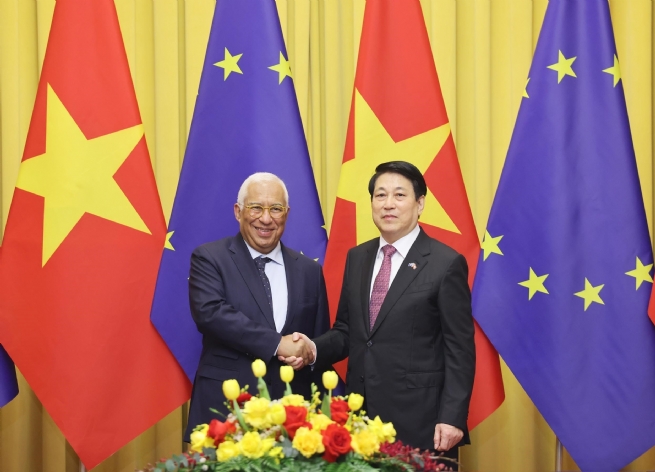
State President Luong Cuong (R) receives President of the European Council Antonio Costa
In 2025, Europe continued to present a mixed picture of opportunities and challenges, though overall conditions were brighter than in 2024. The Russia-Ukraine conflict remained complex but showed early signs of potential negotiations. Economic recovery continued, albeit at a modest pace, with EU growth reaching 1.4%; unemployment remained stable, while energy prices and inflation declined despite staying elevated. The EU reinforced its focus on self-reliance and resilience. Many European countries identified the need to renew growth models, viewing science, technology, innovation, and green and digital transitions as key drivers for economic recovery and competitiveness amid increasingly visible global economic fragmentation.
Meanwhile, despite facing significant challenges in 2025 from adverse external impacts and losses caused by severe natural disasters, Vietnam continued to achieve important results, maintained high growth momentum, set new export records, and preserved a stable, reliable, attractive, and safe environment for international partners, including Europe. Cooperation between the two sides has entered a new phase that was more dynamic, substantive, and in-depth.
Vietnam-Europe cooperation in 2025: rising to a new height
A outstanding feature of 2025 was the strong increase in high-level diplomacy across all Party, State, Government, and National Assembly channels, with delegation exchanges nearly doubling compared with 2024. In particular, Vietnam hosted 12 high-level European delegations, including visits by the King of Belgium; the Presidents of France, Hungary, and Lithuania; the Prime Ministers of Russia, Spain, and Kyrgyzstan; and the Speakers of parliament from five partner countries. Vietnamese senior leaders also paid seven visits to Europe, including visits of historic significance: the first official visit by a Vietnamese leader to Estonia since the establishment of diplomatic relations; the official visit by Party General Secretary To Lam to the Russian Federation to attend the ceremony marking the 80th anniversary of the victory over fascism; visits to traditional friends Belarus and Bulgaria; and subsequent visits to Northwestern Europe, including the UK and Finland. These visits conveyed Vietnam’s consistent foreign policy of independence, self-reliance, multilateralization, and diversification, as well as its role as a friend, a trustworthy partner, and a responsible member of the international community. Through these exchanges, Vietnam upgraded relations with nine countries in the region, confirming the increasingly elevated level of cooperation between Vietnam and European countries.
The year 2025 also recorded substantive progress in relations between Vietnam and European political parties and influential political forces. This included the participation of five European political parties in Vietnam’s major national celebrations, and especially high-level theoretical dialogues with Germany’s Left Party and Social Democratic Party, which strengthened political depth and strategic trust between Vietnam and its partners. The overall success of Vietnam’s European diplomacy in 2025 elevated Vietnam-Europe relations and expanded strategic cooperation space across political, economic, trade-investment, and science-technology domains, generating important resources for the country’s new development era.
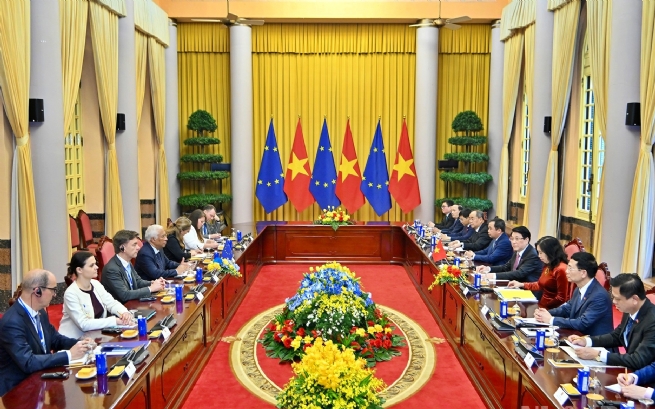
State President Luong Cuong at a working session with President of the European Council Antonio Costa during his official visit to Vietnam, January 28-29, 2026
Trade and investment continue to affirm their pillar role
After five years of implementation, the EU-Vietnam Free Trade Agreement (EVFTA) continued to deliver concrete results, making Vietnam the EU’s largest goods trading partner in ASEAN and positioning the EU as Vietnam’s fourth-largest trading partner. In the first ten months of 2025, two-way trade reached nearly US$61 billion, up 8.4% year-on-year. Meanwhile, progress toward the completion of the EU-Vietnam Investment Protection Agreement (EVIPA) accelerated, with Cyprus, Poland, and Germany ratifying the agreement during the year.
Investment cooperation remained a bright spot in Vietnam-Europe economic relations. EU enterprises continued to rank among Vietnam’s key sources of high-quality foreign direct investment, focusing on processing and manufacturing, infrastructure, logistics, finance and banking, high technology, and sustainable agriculture. The European business community continued to assess Vietnam’s investment and business environment positively, particularly regarding institutional reforms, administrative procedures, digital transformation, infrastructure development, and workforce quality, and further expanded investments, with Denmark’s LEGO Group as a representative example. Many cooperative projects between European enterprises and Vietnamese localities in energy transition, green finance, green infrastructure, and climate change adaptation were implemented, contributing to Vietnam’s commitment to achieve net-zero emissions by 2050. European investment was expected to bring not only capital flows but also access to advanced technologies and sustainable development models, contributing to improvements in growth quality and Vietnam’s development model transformation.
Science, technology, and innovation - A new direction
Science, technology, and innovation truly became a new pillar of Vietnam-Europe cooperation. Cooperation agreements signed in 2025 with Russia, France, Sweden, Estonia, and Central Asian countries reflected the timely response and strong commitment of European partners to accompany Vietnam amid major shifts in its development thinking in the new era, with science, technology, and innovation as growth drivers.
Practical cooperation in this field was actively implemented with the direct involvement of local authorities, enterprises, experts, research institutes, and universities from both sides. Priority areas included digital transformation, artificial intelligence, semiconductors, biotechnology, and quantum technologies -fields in which Europe holds strengths and Vietnam has growing needs in its economic modernization, competitiveness enhancement, and sustainable development.
Cultural exchange, tourism, and people-to-people diplomacy nurturing lasting friendship
The year 2025 featured many major cultural exchange and people-to-people diplomacy events, marking the 75th anniversary of diplomatic relations between Vietnam and the Russian Federation and between Vietnam and Central and Eastern European countries, the 50th anniversary of Vietnam-Germany relations, and the 35th anniversary of Vietnam-EU relations. A wide range of commemorative activities held throughout the year reflected the depth and vitality of Vietnam’s friendship with the region. These included the June 2025 seminar “75 Years of Vietnam-Central and Eastern Europe Relations: Preserving Friendship, Expanding Comprehensive Strategic Cooperation,” a cultural and arts festival in Russia in July 2025, the event “Vietnam-EU Day: A Cultural Bridge for a Sustainable Future” in November 2025, and the December 2025 workshop “50 Years of Vietnam-Germany Relations: Milestones and Prospects.” Notably, Vietnam Day was held for the first time at Red Square, attracting record attendance of millions of visitors. These cultural exchanges continued to serve as bridges of trust, strengthening mutual understanding and further deepening Vietnam-Europe ties.
Over the past year, Vietnamese audiences also experienced distinctive cultural and artistic events hosted by European countries, including a special concert by Germany’s Hessen Chamber Orchestra (October 2025), Austria’s Vienna concert series (November 2025), Russia’s Swan Lake ballet (November 2025), an art exhibition and gala concert by Poland’s OSP Nadarzyn Orchestra (November 2025), and a Bulgarian music night (December 2025).
In particular, the launch of new direct air routes to Europe: Milan, Italy (July 2025); Munich, Germany (October 2025); and Copenhagen, Denmark (December 2025) - contributed to a surge in Vietnam’s appeal in Europe and supported a new tourism record of over 20 million visitors in 2025.
2026: toward a new stature in Vietnam-Europe relations
The world entered 2026 amid unpredictable developments, and Europe also faced many challenges. However, Europe remains an important geopolitical and economic center. As a priority partner in its foreign policy, Vietnam seeks to work with Europe to improve the effectiveness of traditional areas of cooperation and expand cooperation into new fields such as green transition, digital transformation, renewable energy, green finance, high-quality workforce training, and aerospace.
To leverage the combined strengths of foreign relations pillars, mobilize international resources effectively, and expand development space so that Vietnam-Europe relations could “rise to a new height,” both sides required strong determination and close coordination at bilateral and multilateral levels.
First, sustained delegation exchanges and contacts at all levels and across channels were needed to fully utilize existing cooperation frameworks with European partners, consolidate the political foundation, and create momentum for cooperation across fields.
Second, greater effectiveness was required in implementing signed free trade agreements with regional partners such as the EU (EVFTA), the UK (UKVFTA), and the Eurasian Economic Union, while engaging remaining EU member states to complete EVIPA ratification and strengthening support for Vietnamese enterprises to access European markets, especially for agro-forestry-fisheries products.
Third, efforts should focus on delivering concrete projects and tangible results in science, technology, innovation, and education and training, contributing to the effective implementation of Vietnam’s strategic resolutions.
Fourth, the role of external information, cultural diplomacy, and people-to-people diplomacy should be advanced in connection with tourism and local-level cooperation, alongside stronger links between Vietnamese communities in Europe and both host countries and the homeland, thereby enhancing Vietnam’s image and creating a solid foundation for sustainable cooperation.
Fifth, coordination at multilateral forums should continue to advance multilateralism, respect for international law, free trade, and freedom of navigation, serving the shared interests of peace, stability, and sustainable development in the region and globally.
With these orientations, Vietnam identified its European partners as companions in the new development era and worked with Europe to elevate bilateral cooperation to a new stature in the very first year of the 14th National Party Congress term, toward the centennial goals and the successful fulfillment of the Congress’s mandates.
|
Vietnam and EU elevate relations to a Comprehensive Strategic Partnership On January 29, 2026, State President Luong Cuong and President of the European Council Antonio Costa held talks at the Presidential Palace during Antonio Costa’s official visit to Vietnam. Speaking to the press after the talks, the two leaders formally announced the upgrade of Vietnam-EU relations to a Comprehensive Strategic Partnership after 35 years of diplomatic relations, and agreed on orientations to develop an action plan to effectively implement the Joint Statement on the Vietnam-EU Comprehensive Strategic Partnership in the period ahead. The two leaders agreed to advance cooperation in science, technology, and innovation, establishing this as a new pillar of bilateral relations, particularly in areas where Europe has strengths in science, digital transformation, and connectivity; to fully and effectively implement the EVFTA and complete ratification of the EVIPA to deliver benefits for enterprises on both sides, especially by promoting high-quality EU investment flows into Vietnam; to maintain the effectiveness of the Vietnam-EU Defense and Security Dialogue mechanism; to advance cooperation in United Nations peacekeeping activities; and to expand cooperation in maritime security, cybersecurity, and crisis management. Both sides also agreed to strengthen cooperation on environmental protection and climate change response, the green economy, the circular economy, the marine economy, and clean energy. Duy Anh |
Source: Vietnam Business Forum


 Vietnamese





