

12:46:15 PM | 2/2/2026

Economic diplomacy holds special importance, helping to lead the way and open new paths, attract resources, create opportunities, and expand development space to drive Vietnam toward fast and sustainable growth in the new era.
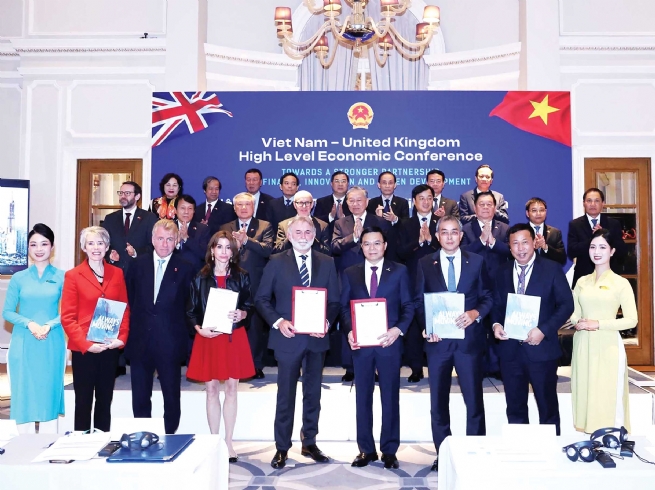
Party General Secretary To Lam witnessed the signing of cooperation agreements on his UK visit in October 2025, during which the two sides issued a Joint Statement upgrading Vietnam-UK relations to a Comprehensive Strategic Partnership
According to Prime Minister Pham Minh Chinh, throughout history and at every stage of national development, Vietnamese diplomacy has made significant contributions. From safeguarding newly won independence and striving for territorial integrity and national reunification, to breaking encirclement and embargo and advancing deep, comprehensive international integration, Vietnamese diplomacy has consistently left a clear imprint, helping to “turn risk into opportunity,” “turn difficulty into ease,” “shift the situation,” and “transform status,” thereby creating the most favorable external environment for national development.
In the mid-1970s, after national reunification and the restoration of peace, with strategic vision, clear thinking, and an accurate assessment of global trends and domestic conditions, the Party early identified economic diplomacy in support of post-war recovery as necessary and as a new direction requiring focused implementation. Since then, economic diplomacy has continued to leave a clear imprint at many milestones in the country’s development and strategic integration. Notable examples include studying global development models and trends to advise the Party and the Government in formulating economic development and national renewal policies in the 1980s; breaking encirclement and embargo, normalizing relations with major financial institutions, gradually integrating into the international community, and attracting foreign investment and assistance in the 1990s; and “pioneering and opening the way” for international economic integration through especially significant milestones of strategic meaning that reshaped the country from 1995 to the present. These milestones carried strategic meaning, opening major development opportunities and reinforcing Vietnam’s role and contributions within the regional and global economy.
Prime Minister Pham Minh Chinh said that over the past five years, the global environment has been unstable and uncertain, with more unfavorable factors than in the previous period; difficulties, challenges, opportunities, and favorable conditions intertwined, but difficulties and challenges outweighed the rest. Even so, with strong determination, sustained effort, and decisive action by the entire Party, people, and armed forces, Vietnam achieved important, pride-worthy, and historically meaningful development results across all fields. The economy increasingly demonstrated resilience to external shocks; in 2025, GDP growth reached 8.02%, placing Vietnam among the high-growth economies in the region and worldwide, while macroeconomic stability was maintained, inflation was controlled, and major economic balances were ensured. The size of the economy in 2025 reached about US$514 billion, with GDP per capita estimated at US$5,026, placing Vietnam in the upper-middle-income group. Traditional growth drivers performed effectively; Vietnam ranked among the top 15 developing economies globally in attracting foreign investment and among the top 20 worldwide in trade volume. New growth drivers made meaningful progress. Cultural and social sectors continued to advance; environmental protection received greater attention; national defense and security capacity was strengthened; independence, sovereignty, and territorial integrity were firmly safeguarded; and social order and safety were ensured.
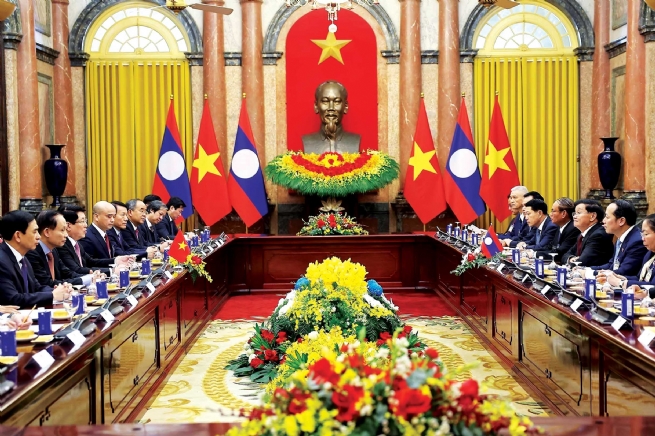
An overview of the meeting between Vietnamese State President Luong Cuong and Lao General Secretary and President Thongloun Sisoulith during his State visit to Vietnam, January 26, 2026
In particular, Prime Minister Pham Minh Chinh said that external relations and international integration stood out amid global difficulties, with economic diplomacy delivering tangible results. Technology diplomacy was advanced, contributing to progress in science and technology, innovation, and digital transformation. To date, Vietnam has signed and joined 17 free trade agreements (FTAs); established diplomatic relations with 194 countries, including all members of the United Nations; set up comprehensive partnership frameworks or higher with 42 countries, including 17 G20 members; and formed comprehensive strategic partnerships with all five permanent members of the United Nations Security Council. Vietnam has also undertaken important multilateral responsibilities, including re-election to the United Nations Human Rights Council for the 2026-2028 term, hosting the ASEAN Future Forum, the Fourth Partnership for Green Growth and the Global Goals 2030 (P4G) Summit, and the signing ceremony of the Convention against Cybercrime.
Entering a new development phase, Prime Minister Pham Minh Chinh said that, as global conditions are expected to remain complex and unpredictable, with difficulties and challenges generally outweighing opportunities and favorable factors, economic diplomacy faced the need for a strong transformation to align with the determination to achieve the nation’s two centennial strategic goals. The draft documents of the 14th National Party Congress called for “advancing comprehensive diplomacy in service of development, with economic diplomacy and technology diplomacy as focal areas.” Guided by the principle that “resources stem from thinking and vision; motivation stems from innovation and creativity; strength stems from the people and enterprises,” economic diplomacy and technology diplomacy in the coming period must absorb “three important lessons,” while renewing thinking and updating objectives, scope, target groups, and implementation methods in line with the “five mores” approach.
The “three important lessons” are as follows: First, perseverance in the path of national independence associated with socialism, together with steadfast adherence to a foreign policy of independence, self-reliance, multilateralization and diversification, proactive and active international integration, and being a friend, a reliable partner, and a responsible member of the international community. Second, firmness combined with flexibility, safeguarding national and ethnic interests while remaining adaptable in implementation to achieve objectives. Third, maintaining a thorough and in-depth grasp of developments, and providing timely, flexible, appropriate, and effective policy advice.
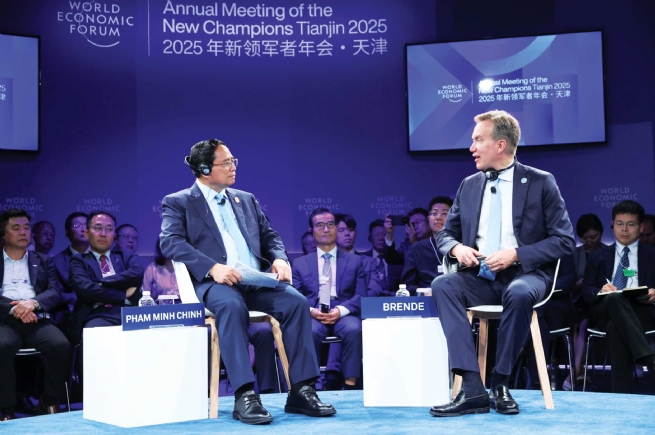
Prime Minister Pham Minh Chinh at a policy dialogue with Borge Brende, President and CEO of the World Economic Forum (WEF), June 2025
The “five mores” approach comprises: First, more strategic and agile thinking to promptly identify new trends, proactively seize opportunities, and enhance the economy’s adaptability. Second, greater focus and targeting in setting objectives and solutions, closely aligned with national development goals in each period. Third, broader and deeper overall relations with partners and cooperation across sectors, particularly in science and technology, innovation, and digital transformation. Fourth, more decisive and creative implementation, ensuring clear task allocation and substantive effectiveness in the spirit of the “six clarities: clear person, clear task, clear responsibility, clear authority, clear timeline, and clear results.” Fifth, greater proactiveness and responsibility in participating and contributing to international economic cooperation mechanisms and forums, as well as international and regional issues of strategic importance, in line with national requirements, capacity, and conditions, especially in global economic governance.
Above all, external affairs, particularly economic diplomacy, must fully embody the spirit of “loyalty and dedication,” “confidence and creativity,” “mettle and flexibility,” “negotiation and persuasion,” “top effectiveness,” and “the Fatherland above all.” With far-sighted vision, deep thinking, and bold action, and with due regard for time, intellect, and timely decisiveness, the diplomatic sector must continue to act as a pioneering and core force in bringing new opportunities, new momentum, and new external resources to support fast and sustainable national development, while advancing Vietnam’s standing in the international arena.
Entering the new development stage, external work in general and economic diplomacy in particular should focus on thoroughly internalizing and effectively implementing the Resolution of the 14th National Party Congress, along with resolutions of the Party, the National Assembly, and the Government, especially Politburo Resolution No. 59 on international integration in the new context. Priority is to be given to advancing cooperation in the economy, trade, investment, science and technology, digital transformation, green transformation, energy transition, education and training, healthcare, culture, labor, tourism, environmental protection, and climate change response. Technology transfer is to be promoted in key sectors of the economy such as nuclear energy, high-speed railways, and semiconductors, with the goal of completing construction of a semiconductor chip manufacturing plant by the end of 2027. Solutions are to be implemented in a coordinated manner to diversify markets, products, and supply chains; focus on tapping and using potential markets; step up promotion and branding of Vietnamese products abroad; and accelerate negotiations and the signing of FTAs with countries and regions in the Middle East, Central Asia, Africa, and Latin America. Priority support is to be provided to localities and the business community, especially small and medium-sized enterprises, in economic integration and international cooperation; active assistance is to be given to enterprises expanding investment and business abroad and participating more deeply in global value chains; and strong efforts are to be made to attract investment from major technology groups and Vietnamese experts overseas.
At the same time, the diplomatic sector, working closely with ministries, sectors, and localities, must maintain tight coordination in advising and proposing to competent authorities breakthrough mechanisms, policies, and solutions in external relations, with a strong focus on advancing economic diplomacy and technology diplomacy, thereby supporting the achievement of the double-digit growth target in 2026 and the years ahead.
Source: Vietnam Business Forum
 April 24–25, 2026
 Kinh Bac Cultural Center, Bac Ninh Province


 Vietnamese





