

10:23:42 AM | 2/11/2026

Amid continued volatility in the global economy, 2026 has been identified as a pivotal year for Vietnam to reposition its strategy for attracting foreign direct investment (FDI). FDI in 2026 will focus on high-quality capital flows with strong technology content, high value added, and broad spillover effects. This is not only a driver of economic growth but also an important foundation to improve competitiveness, promote innovation, and support long-term sustainable development.
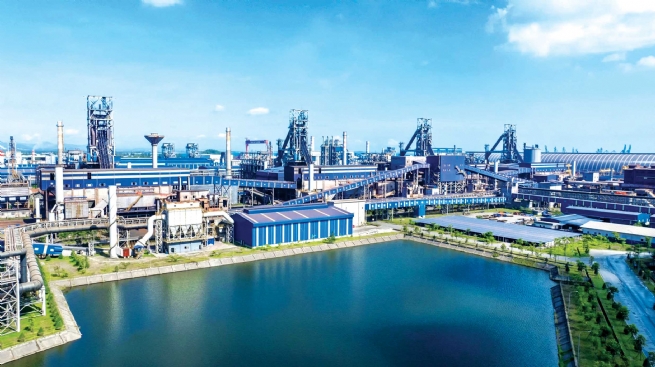
Industrial parks and economic zones across Vietnam are accelerating the transition toward green and sustainable models to attract high-quality foreign direct investment
High-quality FDI: leverage for sustainable growth
According to data from the National Statistics Office under the Ministry of Finance, total registered foreign investment in Vietnam as of December 31, 2025 reached US$38.42 billion, up 0.5% from the previous year. Disbursed foreign direct investment for the year was estimated at US$27.62 billion, up 9% year on year and marking the highest level in the 2021-2025 period. This result is highly impressive and meaningful amid domestic and global economic conditions influenced by international trade policies. It further confirms the growing appeal of Vietnam’s investment environment and strengthens confidence among foreign investors.
Notably, the structure of FDI has increasingly shifted toward quality, with a rising share in high technology, green industry, renewable energy, and the digital economy.
Among these, energy stands out as the most prominent sector. A series of LNG power, green hydrogen, and renewable energy projects have been proposed or accelerated by foreign investors. Examples include a consortium of investors from the U.S., Korea, and Singapore, together with Mekong Delta Investment and Development of Economic Maritime Zone JSC, proposing a US$10 billion investment to build the Ca Na LNG Power Center, while Korea-based SK Group expressed interest in investing US$2 billion in a 1,500MW LNG thermal power project in Nghe An province.
In addition, the Japan Bank for International Cooperation (JBIC) committed to providing US$20 billion in loans for 14 clean energy projects in Vietnam, focusing on renewable electricity and energy transition projects, and France-based green hydrogen infrastructure developer HDF Energy proposed a plan to invest about US$500 million in green hydrogen projects in Vietnam.
Moreover, in 2025 many projects related to electronics, semiconductors, new materials, and green manufacturing were implemented or expanded. HP Inc. of the U.S. sought to expand its supply chain in Vietnam with an annual export value of US$2-3 billion, while Samsung of Korea continued to expand production and R&D, reaffirming Vietnam as a strategic base. In particular, the textile recycling complex valued at about US$1 billion in Binh Dinh (now Gia Lai province), involving European investors and partners linked to the global fashion supply chain, has been viewed as a symbolic project for the trend of green FDI in Vietnam. The project aims to recycle and reuse textile materials, contributing to Vietnam’s integration into the global sustainable fashion value chain.
According to economic experts, in 2026 Vietnam continues to enter a new FDI era in which the goal is not only to attract capital but also to attract technology, governance capacity, ESG standards, and value chains. This is not only a growth driver but also an important foundation to improve competitiveness, promote innovation, and support long-term sustainable development.
Continuing to activate competitive advantages
According to the Foreign Investment Agency under the Ministry of Finance, in 2026 and the following years Vietnam will maintain its appeal to FDI thanks to its strategic location in Southeast Asia, a broad Free Trade Agreement (FTA) network, a market of more than 100 million people, and large demand for energy, infrastructure, and consumption. The orientation toward high-quality FDI, green economy, and high technology helps Vietnam adapt well to global investment trends.
To increase the attraction of high-quality FDI in 2026, Vietnam has been advised to continue promoting administrative reform and adjusting policies toward greater transparency, consistency, and convenience for investors.
At the Autumn Economic Forum 2025, during meetings with leaders of 20 leading global technology and financial corporations, Prime Minister Pham Minh Chinh affirmed: “We commit to implementing the millennium goals and the Net Zero emissions pledge by 2050. Vietnam stands ready to open its market and create a legal corridor to welcome green capital, green technology, and digital technology from international partners.”
He added that Vietnam will promote cooperation and technology transfer and needs support from international friends and leading global enterprises, especially in artificial intelligence, biotechnology, quantum technology, semiconductors, and nuclear energy.
Deputy Minister of Finance Tran Quoc Phuong assessed that with the goal of double-digit growth in the 2026-2030 period, one important solution is to mobilize all social resources for development investment, in which foreign direct investment remains a key source. The Ministry of Finance has been preparing a Project on Developing the Foreign-Invested Economy and a Project on Attracting a New Generation of Foreign Investment, with orientations toward open, attractive, and superior institutions and policies.
According to Dr. Dang Thao Quyen of RMIT University, Vietnam still has much work to do and needs to shift from broad incentives to conditional and targeted incentives to attract strategic capital flows while protecting long-term economic interests. The new-generation FDI model must not only attract capital but also become a lever to enhance technology capacity, promote innovation, and support sustainable development.
Together with efforts to amend laws such as the Land Law, Planning Law, Investment Law, and tax laws including the Personal Income Tax Law and Tax Administration Law, Vietnam’s investment and business environment will continue to improve. In particular, the National Assembly’s approval of the revised High Technology Law and especially the amended Investment Law will provide an important institutional push. The amended Investment Law introduces key reforms, such as reducing pre-inspection procedures, shifting strongly to post-inspection, moving from licensing to registration or notification, narrowing dozens of conditional business lines, and giving priority to high technology, innovation, and the green economy, the core directions for FDI attraction in Vietnam.
In addition, regarding infrastructure, Vietnam has been accelerating many national projects such as expressways, coastal roads, ports, airports, and urban rail and metro lines. This approach shortens implementation time and opens new industrial and urban development corridors.
At the same time, the deployment of the two-tier local government model provides an opportunity to strengthen investment management capacity at provincial and commune levels, along with institutional reform and digitalization of administrative procedures.
These changes have been considered fundamental, helping Vietnam continue to attract more high-quality FDI in 2026 and in the years ahead.
However, an expectation in increasing FDI attraction in 2026 is the need to promote deeper links between domestic enterprises and the FDI sector through policies encouraging the use of domestic materials and suppliers. It is necessary to encourage FDI enterprises to raise the share of local procurement, support Vietnamese suppliers to improve quality standards, and jointly participate in R&D projects. This will not only increase domestic value but also enhance the spillover effects of FDI on the economy.
By Thu Ha, Vietnam Business Forum


 Vietnamese





