

10:30:11 AM | 2/9/2026

Vietnam has entered a phase in which the digital economy is not only a strategic objective but also a key factor in resilience and expansion amid global volatility. The question, however, is how the digital economy can truly scale up in 2026, with greater depth and stronger sustainability.
Strong gains in the digital economy
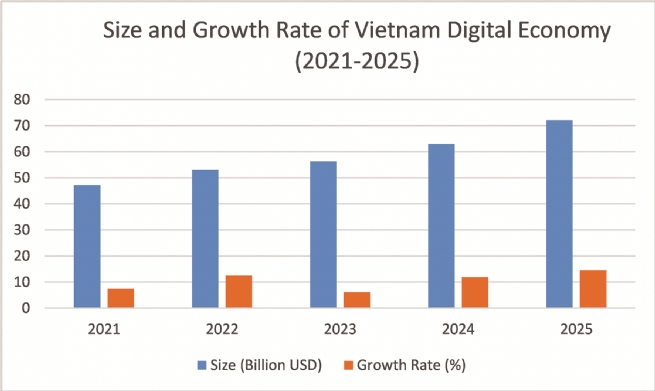
According to Le Trung Hieu, Deputy Director General of the National Statistics Office, the share of the digital economy’s value added in Vietnam’s GDP rose steadily from 12.87% in 2021 to 14.02% in 2025, equivalent to about US$72.1 billion. This growth occurred amid a challenging global economic environment and reflects a strategic shift as core technology sectors and digitalization in traditional industries play a larger role in the economy.
Information from the National Statistics Office shows that Vietnam’s GDP at current prices in 2025 was estimated at about US$514 billion, with GDP per capita exceeding US$5,000. These figures indicate that the economy has continued to sustain its growth momentum while confirming the expanding role of the digital economy in the overall growth structure.
This development is evident in digitalization across public services, cashless payments, e-commerce, and large-scale data platforms deployed nationwide. In e-commerce, digital ecosystems have expanded broadly, from fintech companies to online trading platforms. Models developed by Vietnamese enterprises such as Tiki, with its optimized domestic logistics system, along with regional platforms operating actively in Vietnam such as Shopee and Lazada, which support digital payments and cross-border trade, have created strong momentum in the digital consumer market. These examples show that digital transformation has extended beyond urban areas to provinces, improving access to services and enhancing transaction efficiency.
In the service sector, the use of information technology in production, operations, and management has become more common, contributing to higher productivity and lower operating costs. Alongside corporate digitalization efforts, public management agencies have also advanced digital transformation in administrative reform, aiming to build a more efficient and transparent e-government. This process extends beyond technology adoption to include changes in governance approaches and improvements in service delivery for residents and businesses.
Viewed more broadly, recent data show that the digital economy has expanded not only in scale but also in depth, influencing production structures from financial services and high-tech industries to national competitiveness. Although its share of GDP reached just over 14% in 2025, this level provides an important foundation for higher targets in the 2026-2030 period, particularly as the National Digital Transformation Strategy sets a goal for the digital economy to account for around 30% of GDP by 2030.
Addressing constraints to sustain growth
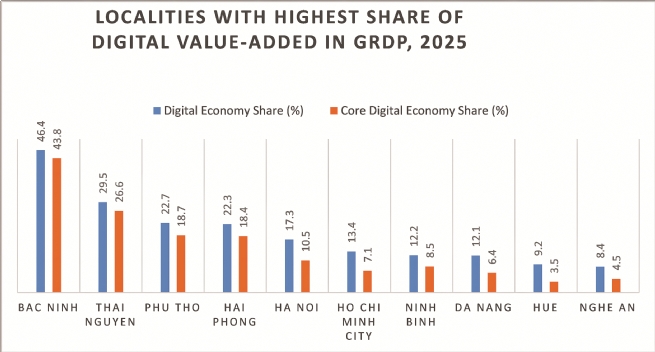
Despite these achievements, Vietnam’s digital economy continues to face both internal and external barriers. One of the most significant challenges is the digital development gap between regions and between large enterprises and small and medium-sized enterprises, resulting in uneven benefits from digital transformation. According to recent reports, some localities such as Bac Ninh, Thai Nguyen, and Hai Phong have digital economy shares in GRDP exceeding 20%, while many other provinces reach only 6-10%, indicating wide disparities in infrastructure capacity and digital readiness.
Many localities lack high-quality digital infrastructure and skilled human resources capable of operating big data, AI, and complex analytics systems, directly affecting competitiveness in an increasingly integrated environment.
At the same time, experts believe Vietnam needs to further refine its legal framework related to data and cybersecurity. As data increasingly becomes a strategic asset, regulations on privacy protection, data ownership, and information security standards will shape the confidence of consumers and investors. The legal framework needs to be designed with greater flexibility to support innovation while remaining sufficiently robust to limit risks in the digital environment, particularly for data-driven and platform-based business models.
Digital human resources remain a major bottleneck. According to Ngo Dinh Duc, General Director of POCD Consulting Corporation, while Vietnam has a large young workforce, shortages of specialized skills such as data science, cybersecurity, and digital system architecture are limiting the expansion of advanced technology applications. This situation requires closer coordination among government, enterprises, and the education system to improve training quality and meet the evolving needs of the digital economy.
Opportunities for Vietnam in the 2026-2030 period are significant as global digitalization continues to accelerate, along with the shift of international supply chains toward the ASEAN region. Vietnam can capture this opportunity by investing strongly in modern digital infrastructure, encouraging innovation, and developing advanced legal frameworks to protect intellectual property in the digital environment. In particular, technologies such as artificial intelligence, the Internet of Things (IoT), cloud computing, and open data will act as key platforms helping Vietnam narrow the gap with leading technology countries.
By Giang Tu, Vietnam Business Forum


 Vietnamese





