

9:09:02 AM | 3/16/2026

The renewed escalation of the U.S.-China trade war beginning in 2025 has led to record tariff barriers and triggered a broad shift of global capital. Amid this unprecedented wave of supply chain relocation, Vietnam is at a turning point, with the opportunity to move beyond its image as a low-cost assembly base and become a strategic link in the global trade network.
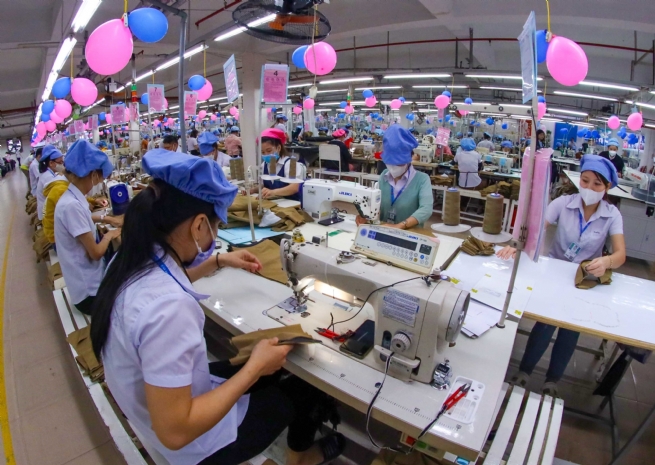
In 2025, Vietnam’s textile and garment industry recorded impressive exports of about US$46 billion, reaching 138 countries and territories
New link in the “China +1” strategy
The year 2025 ended with major milestones in Vietnam’s foreign direct investment (FDI) and international trade. Total registered FDI exceeded US$38 billion, while disbursed capital reached its highest level in five years. At the same time, total trade turnover approached US$930 billion, highlighting strong growth in manufacturing and exports and the increasingly central role of the foreign-invested sector in Vietnam’s growth model and global integration.
The structure of capital inflows is also shifting. FDI, previously focused on labor-intensive industries, is now moving toward high technology, electronics, semiconductors, and clean energy. Samsung’s decision to set up an R&D center in Hanoi and Apple’s relocation of dozens of suppliers to Vietnam show the country’s growing role in global value chains, changing from an “assembly workshop” into a hub for research, design, and product development.
Vietnam’s advantage as a new link in global supply chains rests on three main pillars. First is its strategic location next to China, the world’s largest manufacturing hub, allowing multinational companies to diversify risk without disrupting existing supply networks. Second is its extensive integration framework, supported by 17 free trade agreements, including the Comprehensive and Progressive Agreement for Trans-Pacific Partnership (CPTPP) and the EU-Vietnam Free Trade Agreement (EVFTA), which provide valuable tariff preferences for goods made in Vietnam. Third is growing investor confidence amid rapid global supply chain restructuring.
According to experts, Vietnam is emerging as a new manufacturing center attracting strong interest from major corporations as they adjust their global strategies. In practice, the alignment between the world’s readiness to take risks for innovation and domestic enterprises’ efforts to strengthen internal capacity is creating a favorable turning point. If institutional reforms continue, workforce quality improves, and infrastructure development progresses, Vietnam will be able to turn opportunity into long-term advantage in the next stage of development, a stage in which growth depends not only on scale but also on the quality and depth of value added.
Coordinated solutions to remove structural bottlenecks
A late-2025 report by the International Labor Organization (ILO) highlighted a paradox: Vietnam is one of the largest beneficiaries of global supply chains, yet also one of the most vulnerable. More than 20 million jobs are linked to global supply chains, showing heavy reliance on external demand. Manufacturing remains the main driver of growth, but up to 82% of jobs in the sector depend on exports.
The most urgent challenges involve logistics infrastructure, transport costs, and the limited development of supporting industries. Localization rates in electronics are only about 5-10%, meaning Vietnam mainly operates at the lowest assembly stage. Dr. Mac Quoc Anh, Vice Chairman of the Hanoi Association of Small and Medium Enterprises, said the greatest risk for Vietnamese firms is the slow improvement of governance capacity. Most SMEs remain in low-value segments with thin margins and limited ability to withstand global shocks.
The risk of “growing old before growing rich” is increasing, as Vietnam’s population is aging among the fastest worldwide. If the country does not fully use the next 10 to 15 years to raise labor productivity and technological capacity, it will find it difficult to overcome environmental measures such as the Carbon Border Adjustment Mechanism (CBAM) and strong competition from countries like India and Indonesia.
To address structural constraints and strengthen Vietnam’s position in global production networks, the Ministry of Industry and Trade has outlined several key measures.
First, it calls for a new approach to foreign investment. Vietnam can no longer attract capital at any cost but must apply stricter selection criteria, with clear conditions. Incentives should be linked to advanced technology transfer and commitments to purchase goods and services from domestic firms. The Ministry of Industry and Trade will oversee this process to ensure new projects match global demand trends and national development priorities.
Second, the Ministry aims to strengthen linkages among domestic enterprises. Through support policies under decrees on supporting industries, the Government is helping Vietnamese companies upgrade their capabilities to become key component suppliers. The goal is to enable local firms to integrate more deeply into the production networks of major corporations instead of remaining in simple, easily replaceable roles.
To reduce dependence on a few traditional markets, Vietnam needs to make full use of its 17 signed trade agreements to expand exports globally. At the same time, promoting cross-border e-commerce can help smaller businesses reach international customers more directly and rely less on costly intermediaries.
As the population ages, Vietnam can no longer depend on abundant low-cost manual labor. Vocational training must be fundamentally reformed, with education more closely linked to practical skills and market demand. Giving priority to areas such as semiconductor chips and automation will help workers improve productivity and earn higher incomes, while also reducing the risk of future labor shortages.
Finally, maintaining macroeconomic stability remains crucial. According to Chu Thanh Tuan, Deputy Head of Bachelor of Business at RMIT University Vietnam, despite global uncertainty, Vietnam must protect currency stability and keep inflation under control. Resources gained during periods of strong growth should be invested in infrastructure, including roads, ports, and clean energy, to build the resilience needed to handle unpredictable changes in global markets.
By Huong Ly, Vietnam Business Forum


 Vietnamese





