

9:56:03 AM | 3/26/2026

The shift toward a multi-centered trade landscape is reshaping the global economy, pushing Vietnam to speed up its export market diversification strategy to reduce dependence and improve resilience against external shocks.
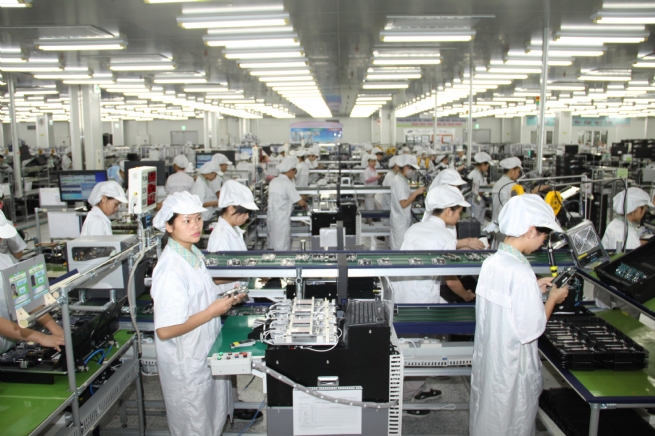
Vietnam records strong export growth in electronics, computers, and components
Multipolar global trade and its impact on Vietnam’s exports
Global trade in 2025-2026 continues to develop within a multi-centered structure, as major growth centers such as the United States (U.S.), the European Union (EU), China, and ASEAN expand their influence at the same time. Strategic competition, supply chain restructuring, selective protectionism, and new green standards are leading to a more fragmented trade environment than in the earlier phase of globalization.
This situation is reflected in international analysis. In early 2026, AP News reported that the European Union has been expanding and diversifying trade ties with Asian economies to reduce reliance on a small number of major partners, with Vietnam seen as an important destination in the EU’s trade rebalancing strategy. This shows that “multipolarization” is no longer just an academic concept but a clear policy choice among major economic centers.
Against this backdrop, Vietnam faces both opportunities to expand its markets and pressure to adapt. Export turnover in 2025 reached approximately US$475 billion, total trade turnover exceeded US$930 billion, and the trade balance remained in surplus. This record performance reflects the strength of the manufacturing and export sectors.
The market structure is becoming more diversified, although a significant level of concentration remains. The U.S. is the largest export destination, followed by the EU, China, and ASEAN as other key partners. Data from the Ministry of Industry and Trade (MoIT) show that the U.S. still accounts for the largest share of total exports, while the proportion going to Asian and European markets has gradually increased.
Foreign-invested enterprises (FDI) continue to account for a large share of total exports, particularly in electronics, computers, components, and mobile phones. This supports growth but also puts pressure on domestic firms to strengthen their capacity and move deeper into value chains.
Acting Minister of Industry and Trade Le Manh Hung said the industry and trade sector must adapt proactively to a more divided global trade environment, diversify markets and supply chains to reduce risk, and enhance the economy’s self-reliance. This reflects a shift in policy thinking from expansion alone toward greater balance and sustainability.
Leveraging new-generation FTAs and expanding into new markets
Within a multipolar trade structure, new-generation free trade agreements such as the Comprehensive and Progressive Agreement for Trans-Pacific Partnership (CPTPP) and the Regional Comprehensive Economic Partnership (RCEP) remain key pillars of Vietnam’s market expansion strategy. Deep tariff cuts, clear rules of origin, and trade facilitation measures enable Vietnamese goods to reach more markets at more competitive costs.
According to the MoIT, the use of tariff preferences under free trade agreements (FTA) has continued to rise, especially in CPTPP and RCEP member markets. The increased issuance of preferential certificates of origin (C/O) shows that businesses are becoming more active in taking advantage of integration benefits.
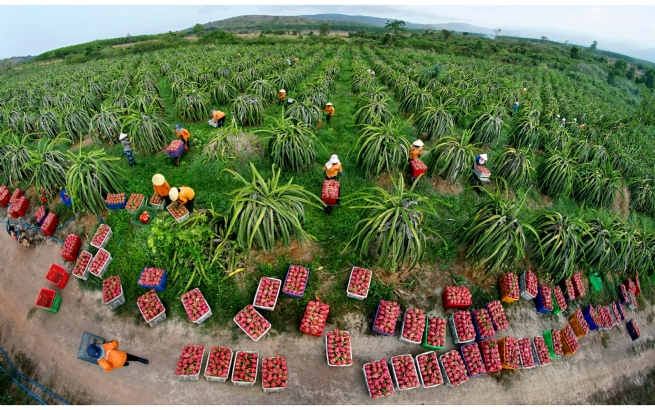
Harvesting dragon fruit for export
However, as market standards become stricter, particularly in environmental protection, emissions, and traceability, FTA opportunities can only be fully realized if enterprises strengthen their internal capacity. Requirements related to green transformation, the circular economy, and ESG standards have become market entry conditions in many developed economies.
In practice, strategies focused on niche and emerging markets are delivering results. Instead of competing directly in mass-market segments, many companies are moving toward higher value-added products such as processed agricultural goods, organic food, internationally certified seafood, and textiles that meet environmental standards. Exports to the Middle East, South Asia, and several African markets have grown thanks to rising consumer demand and lower competitive pressure. This shows that significant market potential remains for businesses with clear and well-prepared entry strategies.
At the same time, reducing reliance on a small number of major partners is also a way to manage risk. The increase in trade remedy investigations in recent years is a clear reminder of the risks that come with heavy concentration in a single market.
According to the Trade Remedies Authority under the MoIT, the number of investigations involving Vietnamese exports remained high in 2025.
In this context, market diversification means more than adding new destinations; it requires restructuring the overall export strategy to achieve better balance across regions. Enterprises need to invest in market research, develop their own brands, increase technological content, and strengthen quality control instead of relying mainly on contract manufacturing. In a multipolar trade environment, growth must go together with risk diversification, and integration must be matched with greater self-reliance.
Diversifying export markets, making effective use of new-generation FTAs, and actively entering niche and emerging markets will be three main pillars for improving economic resilience. When national policy and business strategy move in the same direction, Vietnam will be better positioned to strengthen its role in an increasingly multipolar and highly competitive global trade network.
By Giang Tu, Vietnam Business Forum





 Vietnamese





