

9:34:48 AM | 3/27/2026

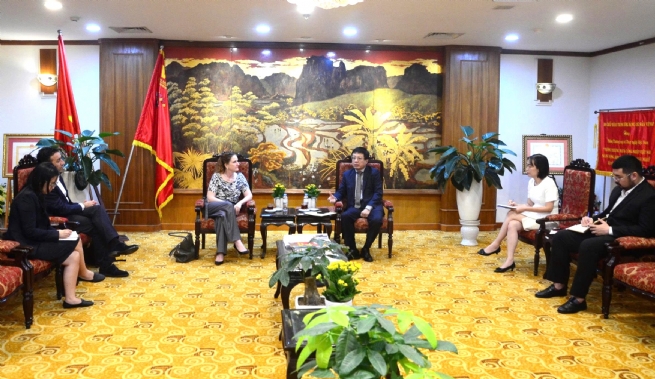
The meeting between President of the Vietnam Chamber of Commerce and Industry Ho Sy Hung and New Zealand Ambassador to Vietnam Caroline Beresford highlighted significant untapped potential as Vietnam accelerates reforms, upgrades value chains, and adapts to global economic uncertainties during a recent working session in Hanoi.
The meeting took place after Vietnam-New Zealand relations were upgraded to a Comprehensive Strategic Partnership in 2025, while the global economy faces challenges such as geopolitical tensions, supply chain restructuring, and stricter sustainability standards.
Strong trade foundation with a US$3 billion target
According to data shared at the meeting, Vietnam is currently New Zealand’s 14th-largest trading partner and fifth in ASEAN.
In 2025, Vietnam’s imports from New Zealand reached over US$784 million, up nearly 30% compared to 2024. Meanwhile, Vietnam’s exports to New Zealand totaled about US$710.6 million, up 3.5%.
As a result, Vietnam recorded a trade deficit of around US$73.4 million with New Zealand.
The trade structure between the two countries is complementary: Vietnam exports electronics, computers and components, seafood, cashew nuts, garments and footwear, while importing dairy products, agricultural goods, timber and production materials from New Zealand.
In terms of foreign direct investment, New Zealand currently ranks 39th out of 149 countries and territories investing in Vietnam, with 55 active projects and total registered capital of about US$208 million. These projects are mainly in real estate, education and training, processing and manufacturing, and agriculture, forestry and fisheries.
Notably, both countries are members of key free trade agreements such as CPTPP and RCEP, providing a strong framework for expanding bilateral trade and investment. The two sides have also set a target of raising bilateral trade to US$3 billion in the coming years.
Speaking at the meeting, VCCI President Ho Sy Hung emphasized that Vietnam will continue to pursue an export-oriented growth model, while regarding foreign direct investment (FDI) as a key driver of competitiveness and deeper integration into global value chains.
Vietnam is also accelerating infrastructure investment, administrative reforms, and reforming its legal framework to respond to changing economic conditions.
Vietnamese businesses adapt to global uncertainties
Addressing global challenges, particularly tensions in the Middle East, VCCI President noted that rising logistics and transportation costs are putting pressure on businesses.
However, Vietnamese enterprises have adapted by diversifying markets, transport routes and sources of raw materials, as well as increasing inventories to reduce risks. They continue to maintain stable production while ensuring product quality and delivery schedules for international partners.
From an international perspective, Ambassador Caroline Beresford highlighted Vietnam’s emergence as a dynamic economy and an increasingly attractive destination for foreign investment, particularly in electronics and semiconductors. She noted that Vietnam’s infrastructure development, institutional reforms and its ambition to establish international financial centers are key factors helping the country move up the global value chain.
She also underscored strong cooperation potential in education, human resource development, high-tech agriculture and innovation. She proposed increasing two-way business delegations to strengthen market linkages and explore new investment opportunities.
Both sides agreed that Vietnam-New Zealand relations hold significant room for growth, particularly in high-tech agriculture, education and sustainable supply chains.
Increased business exchanges, investment connectivity and cooperation within regional frameworks such as APEC are expected to help achieve the bilateral trade target in the coming years.
Thu Huyen (Vietnam Business Forum)





 Vietnamese





