

1:44:27 PM | 2/2/2026

Spring brings joy and the drive for innovation. For Vietnamese entrepreneurs, 2026 opens a new development journey, a time when thinking, action, and aspiration need to be unlocked and spread strongly.
 |
Three new trends for enterprises
Never before has the world moved at such an urgent and unpredictable speed as today. Entering 2026, the global business environment is no longer a field for simple linear models. Complex geopolitical shifts, extreme climate conditions, and the rapid pace of technological change intersect, forming a business landscape that is both demanding and filled with breakthrough opportunities never seen before.
According to the World Economic Forum, after technology, the green economy is now the fastest growing sector worldwide, valued at over US$5 trillion annually and possibly reaching US$7,000 billion in the next five years. Delaying the green transition today means higher costs in the future. The green economy is, therefore, not only a responsibility but also one of the largest business opportunities of the twenty-first century.
In that context, sustainable business has become a mandatory operating standard with three major trends reshaping how enterprises exist and develop:
First is the pressure for green transition and carbon neutrality. Competitiveness is no longer measured only by product quality but by the carbon footprint across the entire life cycle. Enterprises indifferent to the environment will gradually be removed from global supply chains.
Second is the rise of Environmental, Social, and Governance (ESG) as a factor guiding capital flows. ESG has become the common language of international investment. Financial institutions increasingly prioritize funding for enterprises with strong ESG governance, narrowing access to finance for outdated business models.
Third is the clearer role of AI and digital technology. Beyond improving operating efficiency, AI supports measurement, management, and transparency of ESG. The concept of green AI is taking shape, aiming to save energy, reduce emissions, and directly serve sustainable development goals.
Breaking the mindset of cost burden
The year 2026 marks a turning point for Vietnam with a solid macro foundation shaped by strategic decisions on sustainable development, green growth, and digital transformation. In the context of deep integration and new-generation free trade agreements (FTAs), these commitments open a new era for enterprises - the central actors in policy implementation.
However, that opportunity will become real only when each business leader dares to face the core question of survival: continue along the old path or actively create a sustainable development road for the enterprise.
The answer lies in unlocking mindsets. The largest challenge today does not come from resources or technology but from the approach to problems. When sustainable development, green transition, or ESG are still seen as a compliance duty or an added cost affecting short-term profit, that viewpoint itself becomes a barrier that needs early removal.
When an enterprise invests in more transparent governance, more efficient energy use, or better care for employees and the community, the results are not limited to reputation or brand development. Practical benefits appear directly in labor productivity, in stronger resilience to risks, and especially in long-term competitiveness in the international arena. Unlocking mindsets is the decisive starting point to break inertia and create momentum for breakthrough actions.
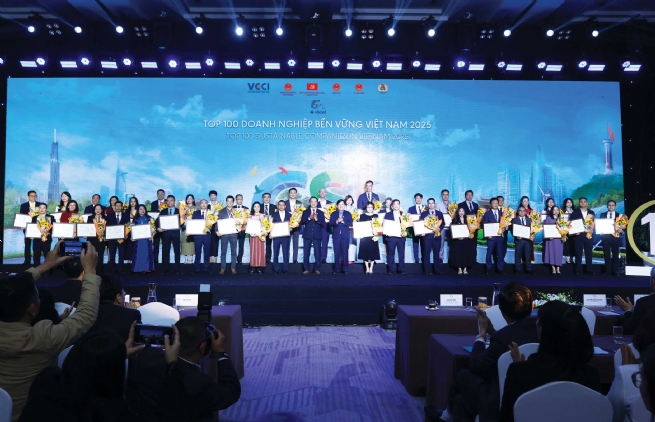
Top 100 companies honored with the certificate of recognition for sustainable business at the Announcing Ceremony of Sustainable Companies in Vietnam 2025
From passive adaptation to active creation
However open the mindset may be, it becomes meaningless if not turned into concrete action. The year 2026 is expected to be a pivotal year for the Vietnamese business community to carry out a historic shift in action: from passive adaptation to active creation.
This proactiveness is not limited to self-effort by enterprises but expands in two directions: vertically, joining with the Government to implement policies, and horizontally, large enterprises guiding and supporting smaller firms in supply chains.
To make this real, action does not need to be trillion-VND projects or attempts to realize many plans at once. Every enterprise can begin with suitable but persistent steps, from reviewing governance models to increase transparency, optimizing energy to reduce costs, to building basic ESG reporting systems. The core issue is not the scale of action but the correctness and persistence.
In that journey, the role of accompanying organizations is very important. The Vietnam Chamber of Commerce and Industry (VCCI) and the Vietnam Business Council for Sustainable Development (VBCSD) will continue their mission to connect policy with practice, providing tools, training programs, dialogue platforms, and cooperation so that Vietnamese enterprises gradually improve sustainable development capacity in line with international standards and domestic conditions.
As Lunar New Year 2026 approaches, looking back on the journey so far and ahead to the future, there is full confidence in the spirit of the Vietnamese business community. With more open thinking, stronger innovation, and effective cooperation between the Government and enterprises, challenges can be transformed into momentum and pressure into opportunity. The business community needs to unlock mindsets and unlock actions starting from strategic decisions today. When each enterprise transforms, the economy will change positively, and when enterprises stand firm, the nation gains a solid foundation to enter a new development era.
On the occasion of Lunar New Year 2026, I extend my best wishes to the business community for good health, determination, and confidence to stay firmly on the path of sustainable development and join hands in creating a green era for Vietnam’s economy.
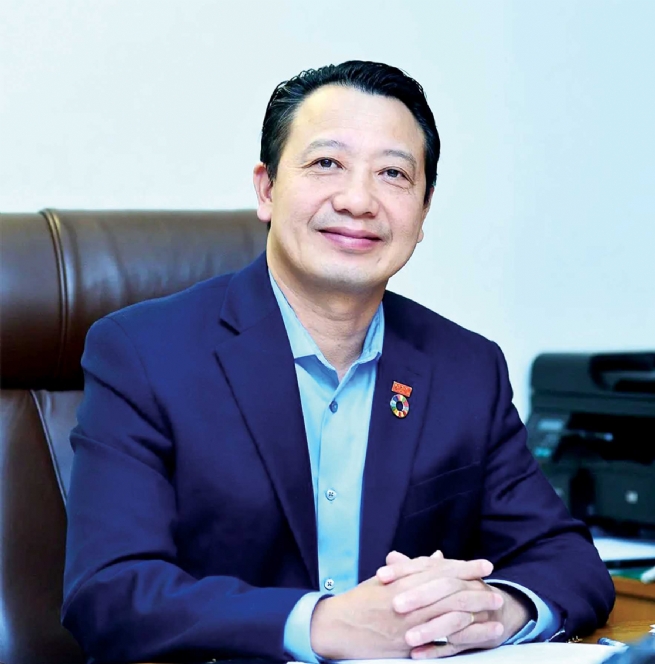
Nguyen Quang Vinh, Vice President of VCCI, Chairman of VBCSD
Source: Vietnam Business Forum


 Vietnamese





