11:37:42 AM | 8/12/2026

To achieve the goal set by the First Provincial Party Congress Resolution, becoming a well-developed, comprehensive, sustainable, and upper-middle-income province by 2030, Tuyen Quang's fiscal strategy extends beyond balancing revenue and expenditure. The provincial finance sector is gradually shifting from simply safeguarding public funds to mobilizing resources by strengthening budget discipline, managing public assets more effectively, using public investment to lead private capital, and improving the quality of investment attraction.
Sound revenues, targeted spending to drive sustainable growth
During the first half of 2026, Tuyen Quang's estimated state budget revenue reached VND4.2285 trillion (US$169.1 million), equal to 58.8% of the central government's target and 58% of the provincial plan. The revenue mix showed solid performance. Domestic revenue totaled VND4.00035 trillion (US$160 million), with the non-state sector contributing VND1.4218 trillion (US$56.9 million), achieving 59.2% of its annual target.
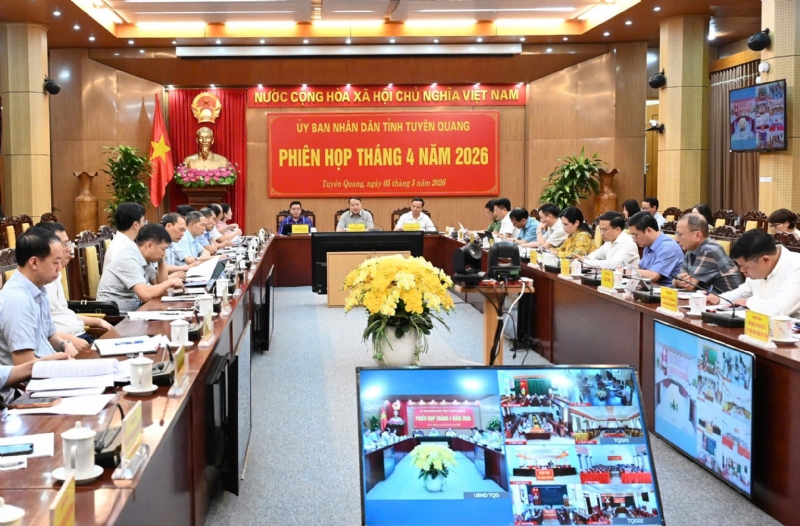
Chairman of the Provincial People's Committee Phan Huy Ngoc chairs the province's regular 2026 meeting, connected online with local communes and wards (Photo: Tuyen Quang Online)
On the expenditure side, budget discipline is guided by a long-term development perspective. Local budget spending during the first six months was estimated at VND26.2047 trillion (US$1.048 billion), including VND7.8045 trillion (US$312.18 million) allocated to development investment. The province prioritizes sectors capable of creating new production capacity and reducing long-term costs. As of June 26, 2026, authorities completed the appraisal and final settlement of 122 projects, saving nearly VND14 billion (US$560,000) for the state budget, following savings of VND31.37 billion (US$1.25 million) during the first 11 months of 2025.
In managing local public finances, Tuyen Quang has determined that revenue collection should foster future revenue sources, expenditures should be directed to their intended purposes, and public assets should be managed as development resources rather than remaining idle. The province has completed the initial disposal of 1,128 surplus public buildings and land properties, generating VND1.3759 trillion (US$55 million), equivalent to 71.2% of the annual target, transforming public assets from dormant holdings into financial resources that support development.
Public investment as a growth catalyst
Tuyen Quang is a mountainous province that continues to face significant development challenges. Socioeconomic conditions remain constrained, the average poverty rate is relatively high, many communes and villages are classified as especially disadvantaged, and infrastructure remains incomplete, particularly transport links within the province and across regions. Each year, central government transfers cover about 80% of local budget expenditure responsibilities, reflecting a continued reliance on central budget support for investment resources. Against this backdrop, developing an integrated infrastructure system is essential to strengthening competitiveness and unlocking room for socioeconomic growth.
Therefore, public investment in Tuyen Quang is not simply about disbursing or using budget funds. It is also a tool for the Government to build infrastructure ahead of demand, remove bottlenecks, create a foundation and build confidence to attract and guide private investment over the long term. As of June 30, 2026, the entire state budget capital plan had been allocated in detail to specific tasks, programs and projects. The province is working to accelerate key infrastructure projects.
According to the Tuyen Quang Department of Finance, public investment should be viewed not just within a single fiscal year, but for its longer-term impact on the local economy: “Every dong of public investment has real value only when it creates opportunities for private investment. For this reason, the Department advises prioritizing projects that improve connectivity, accelerate site clearance, reduce logistics costs, and unlock private capital.”
Public investment efficiency is measured not only by construction volume, but by its ability to shorten goods transport times, complete site clearance on schedule, and remove procedural bottlenecks. Tuyen Quang is also directing private capital toward targeted value chains, laying a solid foundation for a new investment cycle.
During the second half of the year, Tuyen Quang considers public investment disbursement a key task for achieving double-digit growth. The province is applying monthly KPIs and reallocating capital from delayed projects. To remove remaining bottlenecks, it has proposed additional central funding for key projects, including the Tuyen Quang-Ha Giang Expressway (both phases), Tuyen Quang Provincial General Hospital, and combined boarding schools in border communes.
Attracting quality and selective investment
Tuyen Quang's investment attraction strategy for 2026-2030 goes beyond inviting investors. It is a structured program with clear leadership, targets, screening criteria and accountability. Under Resolution No. 81-NQ/TU, the Department of Finance is responsible for monitoring implementation and integrating investment promotion into the province's financial and development governance framework.
The targets are clear: attract 150 new projects with VND70-75 trillion (US$2.8-3 billion) in additional capital, including VND15-20 trillion (US$600-800 million) in FDI, and at least three companies from the Vietnam Top 500. In the first six months, the province approved or adjusted 11 projects with VND3.06526 trillion (US$122.61 million) in registered capital and established 546 new businesses. This shows that capital flows are gaining momentum as the province sends clearer signals on infrastructure, planning, procedures and clean land availability.
A defining feature of the province's governance approach is decisive action on delayed projects. The decision to terminate 12 projects is part of efforts to “clean up” the investment environment. Allowing weak projects to occupy land would distort market signals and limit opportunities for capable investors. Selective investment attraction must therefore go hand in hand with removing inefficient projects.
Tuyen Quang seeks capital from businesses with strong implementation capacity, advanced technology, long-term commitment and the ability to create meaningful added value. Investment success is measured not only by project numbers or registered capital, but also by alignment with planning, efficient land use, budget contributions, job creation, supply chain development and the province's competitiveness.
Tuyen Quang's screening process revolves around three core questions: Does the project generate meaningful added value; is it compatible with local planning and livelihoods; and does the investor have sufficient financial and technological capacity to implement it? Applying these criteria consistently will help the province avoid the trap of pursuing quantity over quality.
Following the administrative reorganization, the province's larger scale requires stronger capacity for resource allocation and development coordination. Tuyen Quang has mapped out a clear path: discipline to accumulate, investment to create spillovers, and selectivity to raise quality. When fiscal resources are managed strategically, the province will have greater capacity to build a more proactive, resilient and sustainable growth cycle.
Ha Thanh - Trinh Long (Vietnam Business Forum)