11:13:32 AM | 5/11/2026

Following the Investment Promotion Conference in late March 2026, with total registered capital of about US$33 billion, Gia Lai has entered a clear transition phase: from expanding investment attraction to screening, selecting, and implementing projects based on quality and real efficiency.
Shaping clear development axes
At Investment Promotion Conference 2026, Gia Lai granted investment policy approvals and signed memoranda of understanding (MOUs) for a total of 273 projects, with combined registered capital of about US$33 billion. This scale reflects the locality’s strong appeal to investors. However, the key significance lies not in the registration figures, but in the creation of a large enough portfolio to reshape development strategy. From this point, Gia Lai has begun shifting from a dispersed investment attraction model to organizing clearly defined development axes. Investment flows are no longer driven by low-cost advantages, but directed toward areas capable of forming industry clusters and value chains. Specifically, Gia Lai is shaping a Central Highlands-Coastal linkage axis: the inland region provides raw materials and onshore energy; the coastal zone expands offshore energy, develops logistics, processing, and port connectivity. From this structure, the investment portfolio converges on three pillars: renewable energy, agricultural processing, and high-tech agriculture, three links forming a complete value chain.
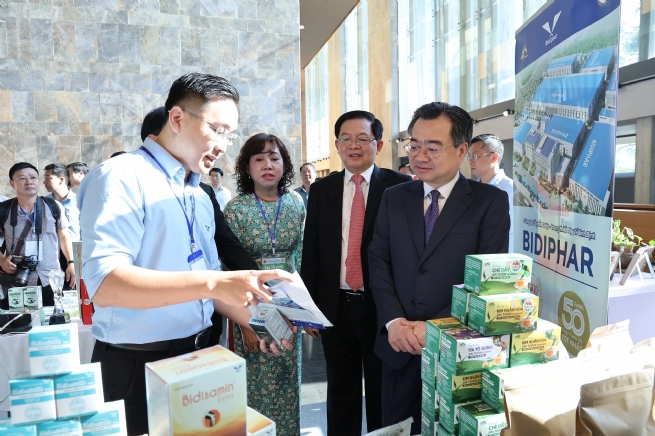
Chairman of the Central Commission for Policies and Strategies Nguyen Thanh Nghi and Deputy Prime Minister Ho Quoc Dung visit a local specialty booth at the Gia Lai Province Investment Promotion Conference 2026
Within this framework, energy plays a leading role, but under a new logic: not as isolated generation, but as foundational infrastructure for the entire production system. Onshore power provides the initial base, while offshore projects expand scale in line with the National Power Development Plan VIII. However, the pace of project registration is outpacing implementation capacity. Many large projects still depend on three key conditions, legal frameworks, power planning, and grid connection capacity, and therefore remain at the preparation stage rather than moving into operation.
In agriculture and processing, the shift is toward higher value rather than higher output. With advantages in coffee, rubber, and fruit crops, Gia Lai is gradually moving away from raw exports toward deep processing linked to export markets. As quality requirements and traceability standards continue to rise, this is no longer optional, but a condition for maintaining profit margins and competitiveness.
Overall, the most important change lies not in the scale of the project portfolio, but in how projects are selected. Gia Lai is shifting from prioritizing quantity to selecting based on implementation capacity and real contribution, moving from expansion to optimization, where the quality of capital flows begins to determine growth efficiency.
Strengthening capital absorption capacity
Following Investment Promotion Conference 2026, Gia Lai has entered a new phase focused on strengthening capital absorption capacity and converting registered capital into actual investment. With a large number of projects already approved or completing documentation, the focus has shifted fully to implementation management.
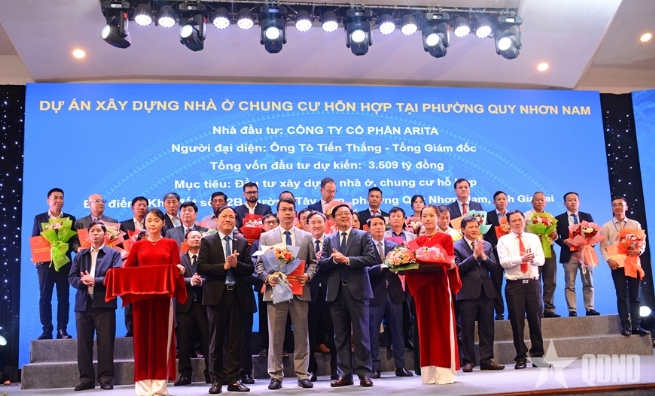
Leaders of Gia Lai Province present the investment decision for Phase 1 of the Phu My Port project to Phu My Investment Group (PMG) at the Provincial Investment Promotion Conference 2026
The challenge now lies in the readiness of underlying conditions. In practice, there remains a significant gap between commitments and execution. In the energy sector, the province has more than 1,000MW of wind and solar power in operation, but new projects still depend on the National Power Development Plan VIII and regional transmission capacity, leading to a situation where projects exist but grid connections do not. In agriculture, although Gia Lai has more than 105,000 ha of coffee with annual output exceeding 300,000 tons, deep processing remains constrained by logistics infrastructure. Connectivity to Quy Nhon Port still depends largely on National Highway 19, with high transport costs creating a bottleneck for large-scale processing industries and limiting the development of integrated value chains.
At the same time, land availability is under increasing pressure. Many projects have received approval but face delays due to site clearance and land-use conversion issues. With a high share of agricultural and forest land, this is no longer a simple administrative matter but a cross-sector coordination challenge; if not resolved, capital flows risk remaining in a “waiting for land” phase. In addition, procedural complexity and inconsistencies in implementation across different levels continue to extend the time from approval to execution.
As the investment portfolio reaches a large scale, Gia Lai has moved into a phase of regulating capital flows in line with actual absorption capacity. The current size of the economy shows a clear gap between investment demand and implementation capacity: GRDP in 2025 is estimated to have grown by about 7.2%, reaching approximately VND270,700 billion; budget revenue exceeded VND28,000 billion, while annual public investment remains at only a few trillion VND and faces ongoing disbursement pressure.
In this context, absorption capacity becomes the decisive factor. The issue is no longer the number of projects, but the ability to convert commitments into actual capital and concrete economic activity. Budget pressure is not due to a lack of resources, but to the need to move ahead with infrastructure investment before revenue streams are fully realized. With high spending requirements for transport, site clearance, and technical infrastructure, medium-term fiscal balance depends directly on setting the right priorities for public investment.
Accordingly, public investment must shift from broad allocation to unlocking bottlenecks, thereby enabling private capital flows. The focus is on three key areas: energy grid connections, land availability and logistics for processing industries, and transport corridors linking the Central Highlands with the coast. Without coordinated action in these areas, private capital is unlikely to move from commitment to implementation. Tran Cang, Director of the Gia Lai Department of Finance, said that capital scale only has meaning when it is converted into real outcomes and stable revenue, rather than remaining at the commitment stage.
At the same time, the need to restructure the project portfolio based on readiness has become clearer. Some projects already have relatively complete underlying conditions, but most still depend on land, planning, and infrastructure, creating a wide gap between registration and implementation capacity. To narrow this gap, Gia Lai is strengthening project-level monitoring and digitizing progress tracking to reduce cumulative delays across the system. On that basis, improving the investment environment becomes a key condition, with the focus shifting from incentives to building a transparent, stable, and predictable environment. Administrative reform is being accelerated toward a single focal point, reducing intermediaries and making processing timelines public to lower time costs for businesses. In particular, the goal of reducing investment procedure timelines from 242 days to 60 days, and within economic zones from 145 days to 38 days, reflects a strong push for institutional reform.
In addition, greater consistency in policy implementation across agencies and levels is being reinforced to limit discrepancies in application, which have been a major cause of delays and higher compliance costs.
Sharing this direction, Pham Anh Tuan, Chairman of the Gia Lai People’s Committee, affirmed the goal of building a government that is disciplined, accountable, and decisive in execution, while ensuring a stable and consistent investment environment and supporting businesses throughout project implementation.
By Vietnam Business Forum





 Vietnamese