

1:27:32 PM | 2/10/2026

The Japan External Trade Organization’s fiscal year 2025 survey reported a notable figure: 67.5% of Japanese enterprises in Vietnam were profitable, the highest level in 16 years. However, behind this strong profit performance are persistent bottlenecks in administrative procedures and a growing shortage of human resources.
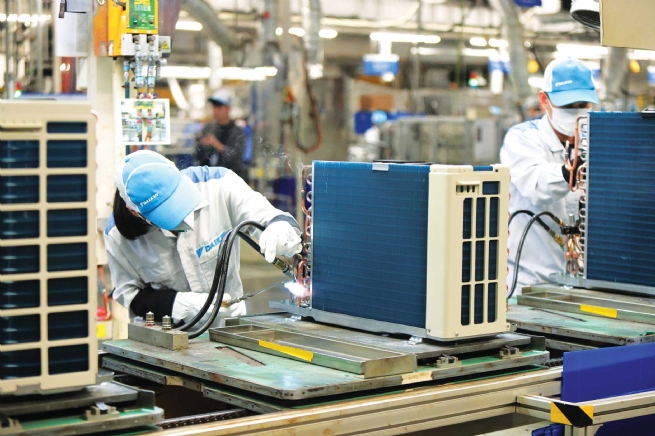
Air conditioner assembling at Daikin Air Conditioning Vietnam
Rising profits, Vietnam leads the region
According to Haruhiko Ozasa, Chief Representative of the JETRO Hanoi, business conditions for Japanese enterprises in Vietnam in 2025 were the most favorable since the aftermath of the 2008 global financial crisis. The proportion of profitable enterprises reached 67.5%, up 3.4 percentage points from the previous year, officially surpassing the ASEAN average (65.3%) for the first time in half a decade.
The survey shows that profit growth in the manufacturing sector was mainly driven by rising demand in export markets, accounting for 53.9%. Meanwhile, non-manufacturing enterprises benefited from the expansion of Vietnam’s domestic consumer market at 55.0%. Notably, several sectors recorded strong improvements in business performance, including Finance and Insurance, where 92.9% of enterprises were profitable, and Electrical and Electronic Equipment Components, with a profitability rate of 86.8%.
Japanese investors maintain strong commitment to remaining and expanding in Vietnam. With 56.9% of enterprises confirming plans to expand operations within the next two years, Vietnam retained its top position for investment readiness within ASEAN for the second consecutive year. Criteria such as expanding domestic market demand (67.4%) and rising exports (25.6%) continued to attract new projects, reflecting solid confidence among Japanese enterprises in Vietnam’s long-term growth potential.
Cumbersome procedures and human resources challenge
However, JETRO’s survey also signals risks in the investment environment that, if not addressed promptly, could gradually weaken Vietnam’s advantages. The primary concern remains complex administrative procedures, with 67.5% of enterprises reporting difficulties, a share that continues to increase. Investors pointed to delays in licensing, contract approvals, and tighter fire prevention and safety requirements as factors undermining cash flow and expansion plans.
More concerning is the shift in the relative importance of legal risks and labor costs. This year, issues related to an incomplete legal framework and limited transparency in implementation (58.7%) overtook rising labor costs (57.3%) to become the second-largest barrier. Open-ended survey responses also mentioned inappropriate requests for unofficial payments and inconsistent interpretation of regulations across localities, complicating centralized management.
At the same time, recruitment challenges have intensified further. As many as 48.2% of enterprises reported that hiring has become significantly more difficult than two years ago, with the figure rising to 66.7% in the manufacturing sector. The reasons go beyond higher wage expectations to include intense competition for talent from enterprises from China, Korea, and Taiwan (China). In Northern Vietnam, up to 76% of manufacturing enterprises are facing labor shortages, directly threatening the operation of high-technology production lines.
Path forward for supporting industries
The most notable bright spot in the 2025 survey is the growth of local suppliers. The share of procurement from domestic enterprises reached 18.3%, the highest level since the survey began. Although the overall local procurement rate (including purchases from Japanese enterprises operating in Vietnam) stood at only 38.1%, the orientation toward “expanding local procurement” expressed by 49.4% of enterprises points to a significant opportunity for Vietnam’s supporting industries.
Nevertheless, the path toward deeper participation in Japanese value chains remains challenging. Japanese enterprises continue to cite concerns over insufficient quality and technical capabilities among local suppliers (54.4%) as well as weak cost competitiveness. These are issues Vietnamese enterprises need to address if they aim to replace sourcing from China, which is itself increasing its procurement share in Vietnam to 14.8%.
On the market front, Japanese enterprises in Vietnam are showing flexible adaptation to geopolitical developments. Although 33.8% of enterprises exporting to the U.S. expressed concern about negative impacts from tariff policies, they remain committed to maintaining this market through internal cost reductions and price renegotiations. At the same time, a diversification trend is taking shape, with greater attention given to India and other ASEAN markets to reduce reliance on a single destination.
The year 2026 marks a new milestone, as Japanese investor confidence in Vietnam stands at a very high level. However, to translate this confidence into substantive and sustainable capital inflows, Vietnam needs decisive reform of administrative procedures and a structured human resources development strategy to ease talent shortages faced by investors. The advantage of low costs is gradually diminishing, and the time has come for Vietnam to compete on transparency and high-quality human capital.
By Huong Ly, Vietnam Business Forum





 Vietnamese





