2:11:52 PM | 9/11/2026

In modern enterprises, data has become a core resource alongside people, processes, and capital. Organizations seeking greater efficiency, faster decision-making, and sustainable growth need a reliable data foundation to support their operations.
Yet many businesses continue to invest heavily in technology platforms, reporting systems, automation, and AI without first answering a fundamental question: Is the data behind these initiatives actually trustworthy?
This is no longer a question for IT alone. It is a strategic issue for boards, executive teams, and business leaders.
Duplicate records, inconsistent definitions, disconnected systems, and conflicting reports may appear to be minor technical problems. Over time, however, they can undermine decision-making and strategy execution across an organization.
Unhealthy data rarely appears as one major technical failure. More often, it shows up through recurring questions in management meetings: Why do two reports show different numbers? Which system should we trust? Why does preparing a management report take several days? Are different business units working with the same customer without knowing it? What information is our decision-support system actually using?
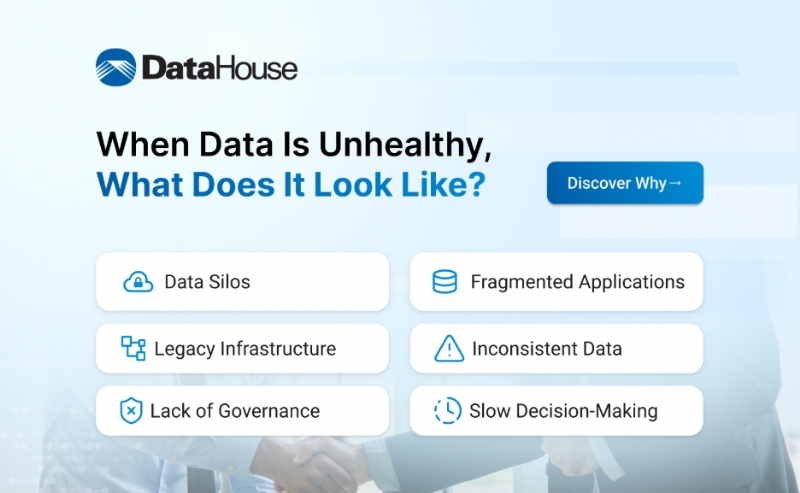
When these questions become routine, the problem is no longer a single report or application. It reflects a weakness in the organization’s ability to govern, connect, and use data effectively.
For large, multi-unit organizations, this challenge is particularly common. Systems may have been implemented at different times for different branches or functions. As a result, the same customer, transaction, or service may appear differently across systems, slowing operations and weakening consolidated reporting.
In financial services, where accuracy, traceability, and timeliness are critical, disconnected information across core banking, CRM, lending, and payment systems can affect customer insights, risk management, compliance, fraud detection, and credit assessment.
Fast-growing businesses face a similar challenge. As CRM, ERP, e-commerce, logistics, and payment platforms multiply, a single customer may exist under several identifiers while an order carries different statuses across departments.
The result is often paradoxical: leadership has access to more data and more reports than ever, yet still lacks a single, trustworthy version of operational truth.
Leadership teams do not need to audit every system to understand whether their data foundation is healthy. They can begin with five simple questions: Do we know where the data critical to our operations resides? Does the same business metric produce the same result across departments? Can we trace a number in a report back to its original source? Is there clear ownership for important data, or are issues automatically pushed to IT? Can teams use data directly in daily decision-making, or must they still reconcile information manually?
If an organization struggles to answer several of these questions, the issue may not be a lack of data. The underlying operating model may simply not be strong enough to support confident decisions.
A common misconception is that data health simply means removing errors or duplicates. In reality, a healthy data environment depends on several interconnected capabilities: data quality, governance and accountability, integration across departments, traceability, and usability.
A company can invest in modern technology and still operate with information it cannot fully trust. Likewise, it can introduce detailed governance policies that employees rarely apply in daily operations.
Technology alone does not create data health. It requires the right combination of governance, accountability, operating processes, and technology.
This becomes even more important as organizations accelerate investment in AI and automation. Many businesses are asking, “Where should we apply AI?” But another question should come first: “Is our data reliable enough for AI to depend on?”
However capable an AI or automation solution may be, its outputs depend on the information behind it. If source data is outdated, duplicated, incomplete, or inconsistent, automation can reproduce and amplify those problems at greater speed and scale.
A more sustainable path is: Trusted data → governed data → connected data → automation and AI-ready data.
There is also no universal data architecture suitable for every company. The starting point should not be “Which technology should we buy?” but rather: “Which operational or strategic problem are we trying to solve?”
Technology choices should follow the organization’s structure, regulatory requirements, security environment, growth priorities, and governance model.
Rather than attempting an enterprise-wide transformation immediately, organizations can begin with one critical operating chain and follow a practical five-step approach.
First, diagnose where critical data resides, how it moves between departments, and where unreliable information creates the greatest business risk.
Second, stabilize the most important data flows by introducing quality rules and controls, resolving issues as close to their source as possible.
Third, govern by establishing clear accountability through defined data owners, stewards, business definitions, quality rules, access policies, and responsibilities.
Fourth, connect systems and data sources to make trusted information available across departments.
Finally, scale into higher-value capabilities such as executive reporting, unified customer views, predictive analytics, process automation, and AI-enabled operations.
One reason data governance initiatives fail is that they attempt to change too much at once.
A more practical approach is to select one high-impact business process, assign ownership, measure data quality, identify its sources, resolve key integration issues, and return that information to business teams as a trusted resource.
When departments begin to experience tangible improvements, such as faster reporting, fewer manual reconciliations, and more consistent decisions, data governance stops feeling like a compliance exercise. It becomes part of how the organization operates.
Automation and AI can transform the way organizations work, but they cannot replace a trustworthy data foundation.
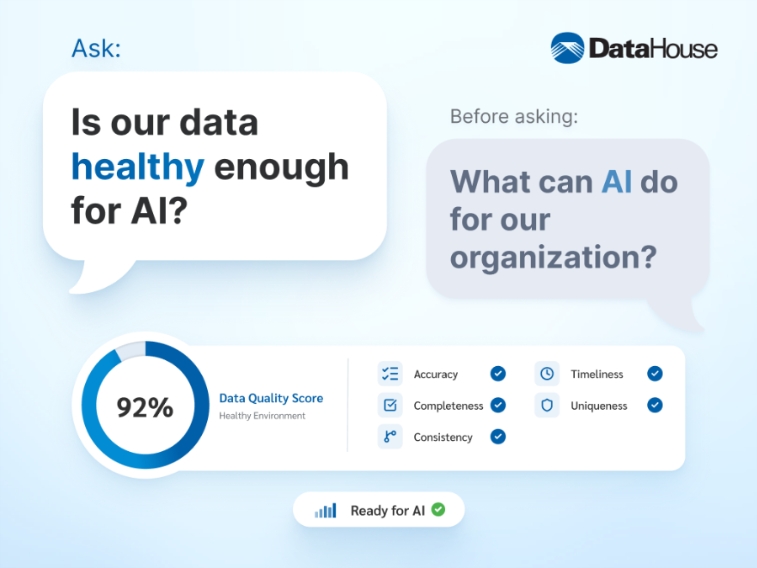
So before asking, “What can AI do for our organization?”, leaders should first ask:
“Is our data healthy enough for AI?”
The next competitive advantage will not necessarily belong to the company with the most data. It will belong to the organization that can govern, connect, and translate its data into consistent and actionable decisions.
DataHouse works with organizations across the United States and APAC to strengthen enterprise data capabilities through practical strategy, governance, integration, analytics, and technology solutions.
From assessing data health to building modern data platforms, DataHouse helps organizations establish the trusted foundation required for data-driven growth, automation, and AI adoption.
Before your next data or AI initiative, understand the health of the foundation behind it.
Contact DataHouse to learn more about a Data Health Assessment: infor@datahouse.com
By Vietnam Business Forum