10:25:47 AM | 9/21/2026

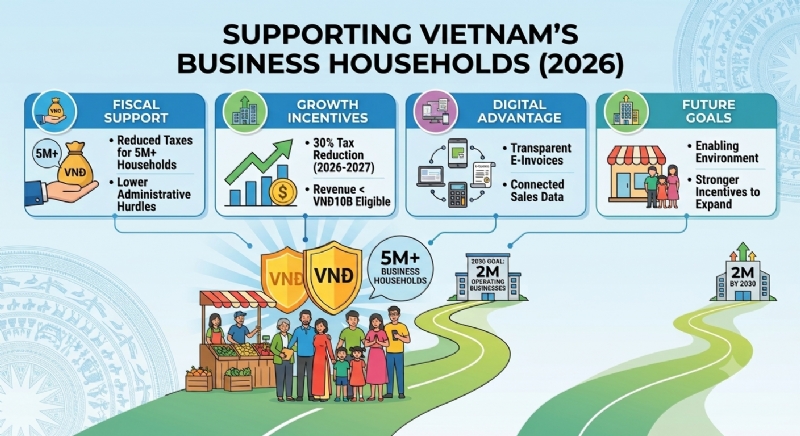
New tax, financial, and digital transformation policies are freeing up resources, lowering compliance costs, and broadening growth opportunities for over 5 million household businesses. Coupled with a 30% tax reduction for individuals and enterprises generating up to VND10 billion (US$384,615) in annual revenue for 2026-2027, the focus now turns to eliminating execution bottlenecks and creating stronger incentives for household businesses to expand.
New Fiscal Support Policies
Household businesses have long been regarded as the “lifeblood” of the domestic market, comprising more than 5 million households and around 10 million workers. However, “the health of this sector is showing worrying signs of decline,” said Dau Anh Tuan, Deputy Secretary General and Director of the Legal Department of the Vietnam Chamber of Commerce and Industry (VCCI).
A VCCI survey conducted in April 2026 of around 1,000 household businesses found that 81.5% reported lower revenue in 2025, 33% intended to scale back operations, and only 1.8% planned to expand. Household businesses face pressure from weaker purchasing power and competition from e-commerce and imported goods, while the shift to new management methods and increased requirements for e-invoices and revenue transparency are also adding to the burden.
According to Cao Thi Thanh Lan, a representative of the Department for Management and Supervision of Tax, Fees and Charges Policies under the Ministry of Finance, the annual revenue threshold for tax exemption has been significantly adjusted within a short period, from VND100 million (US$3,846) under the previous method to VND1 billion (US$38,462) from 2026.
In addition, the policy providing a 30% tax reduction for individuals and businesses with annual revenue of no more than VND10 billion (US$384,615) was approved by the National Assembly and will apply in 2026-2027. These measures aim to support household businesses, individual businesses, and small and medium-sized enterprises (SMEs) in developing production and business activities, reducing compliance time, costs and concerns, in line with the goal of having around 2 million operating businesses by 2030.
According to Dau Anh Tuan, support policies for household businesses need to shift from a “relief” mindset toward creating an enabling environment and institutional framework that allows the sector to develop on its own. For small-scale household businesses with thin profit margins, reducing tax obligations not only lowers the amount payable but also frees up resources for working capital, inventory purchases, equipment investment or business expansion. This approach to tax policy aims to create growth incentives rather than focus solely on budget revenue.
At the same time, tax administration is moving rapidly toward digitalization. Decree 70/2025/ND-CP, effective June 1, 2025, expanded the use of electronic invoices generated from cash registers connected to tax authority data, promoting greater revenue transparency and creating a foundation for support policies to reach the right beneficiaries more effectively.
Reducing Compliance Costs
Cao Thi Thanh Lan said the revenue threshold is not the only issue. During the transition to new management and filing methods, household businesses still face difficulties in meeting tax, accounting and invoicing obligations. Unlike businesses with dedicated departments, a household owner often handles sales, inventory management, cash flow and administrative tasks simultaneously, so even a minor regulatory adjustment can lead to significant changes in actual operations.
Nguyen Thi Thu Ha, Deputy Secretary General of the Vietnam Tax Consultants’ Association (VTCA), said that through interactions with household businesses at markets, industry associations and tax agencies, most households do not seek to avoid their tax obligations but want to comply fully. The difficulty lies in a complex and fragmented regulatory system, leaving many households unclear about which regulations apply and how to comply correctly. In her view, policy assessments need to consider the cumulative impact of several obligations at the same time, rather than examining individual regulations separately.
Ha welcomed the 30% tax reduction for 2026-2027 but said it is a time-bound measure. In the longer term, the tax calculation threshold should be linked to criteria for microenterprises, with appropriate transition mechanisms, avoiding overlapping obligations with e-commerce, prioritizing guidance over penalties during the initial period, and studying ways to support household businesses in covering the compliance costs they incur.
According to Dr. Nguyen Dinh Cung, former Director of the Central Institute for Economic Management (now the Institute for Policy and Strategy Studies), the policy of converting households into businesses is directionally correct, but an open business environment is needed for households to develop according to market principles. When compliance costs are controlled and the benefits of scaling up become clear, household businesses will have their own incentives to grow.
Against the backdrop of a growth target of 10% or higher that requires maximum resource mobilization, more than 5 million household businesses represent significant potential. Dau Anh Tuan said it is necessary to continue assessing whether support policies are sufficient, timely and properly targeted so that household businesses can develop more strongly, operate with greater transparency and gradually transition into businesses when they meet the necessary conditions.
By Huong Ly, Vietnam Business Forum