1. April 27, 1963: The Chamber of Commerce of the Democratic Republic of Vietnam was established
On April 27, 1963, on behalf of the Council of the Government, Prime Minister Pham Van Dong signed Decision No. 58-CP approving the Charter of the Chamber of Commerce of the Democratic Republic of Vietnam, marking the establishment of the Chamber.
In the early stage, the Chamber of Commerce of the Democratic Republic of Vietnam maintained and expanded trade relations between Vietnam and other countries, mainly non-socialist countries, in order to expand economic relations with other countries, broke the economic embargo, and studied market surveys and international trade laws, so as to support enterprises to do business or expand operations.
Activities of the Chamber of Commerce of the Democratic Republic of Vietnam were tied to wartime missions and achieved positive results. The Chamber played a considerable role in approaching capitalist market countries, breaking the siege and embargo, and laying the stepping stone for building trade relations and exchange between Vietnam and other countries.
2. 1976: Taking over Saigon Chamber of Commerce and Industry and expanding activities nationwide
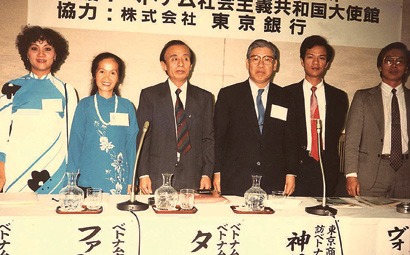
Mr Ta Ca (3rd from the left), VCCI Acting President, and a Vietnamese business delegation at a trade and investment promotion meeting, Japan, 1992
After the reunification of Vietnam, the Chamber was designated to take over Saigon Chamber of Commerce and Industry at 65 Dong Khoi, Ho Chi Minh City. It was a highly professional, large and prestigious institution with important voice and role among big businesses and entrepreneurs in Southern Vietnam. However, in a rush to impose the centrally controlled economy in Southern Vietnam after 1975, most enterprises collapsed, followed by the disintegration of the whole network of business community and membership of the Saigon Chamber. The work had to start again from the beginning to promote trade and organise the business community in Southern Vietnam.
The Chamber expanded its activities nation-wide not only in foreign trade but also developing industries to rebuild the country after the war.
3. 1982: Officially named the Vietnam Chamber of Commerce and Industry (abbreviated Vietcochamber and later VCCI) - the largest trade promotion agency in Vietnam
After the country was reunified in 1975, the activities of the Chamber of Commerce of the Democratic Republic of Vietnam were expanded nationwide. It not only focused on Vietnam’s foreign trade expansion, but also supported domestic production development and industrial development to rebuild and develop the economy after the war. Therefore, at the beginning of 1982, with the consent of the Prime Minister, the Chamber was renamed the Vietnam Chamber of Commerce and Industry, abbreviated Vietcochamber and later VCCI.
Doi moi (reform), initiated in 1986, created a new vitality for the economy and provided the opportunity for VCCI’s powerful development. With its vast experience in promoting cooperation with market economies, VCCI was one of leading organisations to implement doi moi policy and made positive and active contributions to promoting trade relations between Vietnam and other countries and attracting foreign investment into Vietnam. During this period, VCCI was the largest foreign trade promotion agency in Vietnam. VCCI was a pioneer in exploring and expanding international markets.
4. 1993: Holding 2nd Congress, becoming an independent entity and making rapid development
In 1993, from an agency under the management of the Minister of Foreign Trade, from the authorisation of the Prime Minister, VCCI became an independent organisation with two basic functions of (1) representing the business community and advising the State, and (2) promoting trade and investment. The additional function of representing the business community marked a great growth for VCCI. As a national agency representative of the Vietnamese business community, VCCI played an important part in promoting the formation and development of market economic institutions in Vietnam, the development of enterprise and entrepreneur forces, and improving the business and investment environment. VCCI also became an important bridge for State authorities and businesses to share the common objective of developing the national economy.
When it was disaffiliated from the Ministry of Foreign Trade in 1993, VCCI had 130 employees, but now the number has exceeded 1,000. Most of them are young and 85 per cent hold university degrees or higher.
As regards material facilities, starting with a very humble estate, only a 600-square metre downgraded head office, VCCI has to date built a nationwide system of trade and investment promotion centres covering 40,000 square metres in total. VCCI has developed and established a system of representative offices and branches in different localities nationwide.
In April 2003, VCCI successfully held the fourth National Congress. On June 12, 2003, the Prime Minister issued Decision No. 123/2003/QD-TTg approving amendments and supplements to the Charter of the Vietnam Chamber of Commerce and Industry.
These events marked a new era: adding functions and tasks, expanding and improving operations.
5. 2001: Establishing Vietnam Women Entrepreneurs Council and awarding Golden Rose Cup
In 2001, the Vietnam Women Entrepreneurs Council (VWEC) was formally established to gather enthusiastic, pioneering women entrepreneurs striving for the growth of women-led businesses. To date, the council has achieved initial successes in building the country-wide network of women entrepreneurs, organising trade and investment promotion programmes, conferences, training programmes and information channels for women entrepreneurs. The Golden Rose Award was created to honour Vietnamese businesswomen for their excellent achievements in business leadership and administrative talent - an important force in the cause of national economic construction.
6. 2003: Compiling and publishing "Uncle Ho with Vietnamese Enterprises and Entrepreneurs"
Starting in 2003, VCCI studied and popularised President Ho Chi Minh ideology in the business community and in VCCI-policy recommendations, especially popularising his thoughts and standpoints about the role of entrepreneurs and his instructions on the business cause of entrepreneurs. VCCI has published many research documents and organised many major conferences and scientific seminars on Uncle Ho with businesspeople and on tasks of building the entrepreneur force in Vietnam in the new context and honouring entrepreneurs under his ideology.
7. 2004: Hosting annual meetings and dialogues between the Prime Minister and businesses
This activity was initiated by VCCI in 1995 under the administration of late Prime Minister Vo Van Kiet, as many enterprises and entrepreneurs reported facing emerging problems needed to be tackled to boost production and business. This was a chance for enterprises to report their problems to the head of the Government. This meeting was also an economic forum that helped forge consensus between the Government and the business community in building and enforcing economic policies and decisions at the national level.
In 2004, Prime Minister Phan Van Khai decided to make the meetings with the business circle into annual events held in October. At these meetings, many policy recommendations and economic problems were heard and settled by the head of Government, ministers and leaders of relevant bodies.
With the continuous efforts of VCCI, highlighted by the meetings between the Prime Minister and business executives, the mechanism for dialogues between the Government, ministries and State management agencies with the business community gradually took shape. The annual meetings are now much-awaited by the business community. The spirit of dialogues has a strong ripple effect, inspires business executives, and raises the accountability of public authorities.
8. October 13, 2004: First Vietnam Entrepreneurs’ Day
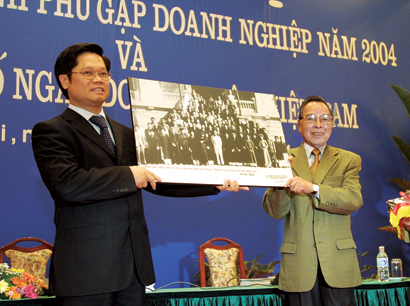
In 2004, VCCI President Vu Tien Loc (left) receives a photo of Uncle Ho taken with industrialists and commercialists from Prime Minister Phan Van Khai (right)
On October 13, 1945, more than one month after the Democratic Republic of Vietnam was founded, President Ho Chi Minh sent a letter to the Vietnamese industrialist and commercialist circle. In his letter, Uncle Ho emphasised the important role of the industrialist and commercialist circle in national construction. At the request of the VCCI President and business organisations, the Prime Minister decided October 13 to be the Vietnam Entrepreneurs’ Day. This important milestone showed the high esteem of the Party and the State to the contributions of Vietnamese business community and entrepreneurs in the process of national renovation and construction.
Since 2006, VCCI has bestowed Thanh Giong Cup for outstanding Vietnamese entrepreneurs on Entrepreneurs’ Day in recognition and praise of the business community and entrepreneurs for their contributions to the cause of the country’s doi moi (reform). The honour also helped them boost their brand images in the process of international integration, accelerate their trade and investment promotion activities, and strengthen their confidence in the building of the nation. This is the most prestigious award of the business community.
9. May 26, 2005: First release of provincial competitiveness index (PCI)
The provincial competitiveness index, or PCI, is a tool to assess and rank the performance, capacity and willingness of provincial/municipal governments to develop business-friendly regulatory environments for private sector development. PCI was developed by a group of experts from the Vietnam Chamber of Commerce and Industry (VCCI) and the Vietnam Competitiveness Initiative (VNCI) Project, funded by the US Agency for International Development (USAID).
PCI was first published in 2005, covering 42 provinces and cities. From the second release, in 2006, all 63 provinces and cities in Vietnam were included.
PCI is an important "voice" for the business community about business environments in Vietnamese provinces and cities. After eight years with annual releases, PCI has confirmed its prestige and important role. It is not only a ranking order, but also a mirror for provinces and cities to look at and create targeted reform for local governments; a measure of the degree of enforcement and effectiveness of many government policies; a reliable and objective information channel for investors and businesses, and a source of useful information for support programmes of foreign donors and international organisations.
To date, more than 40 provinces and cities in Vietnam have issued resolutions, directives, decisions and action plans to improve their local business environment and competitiveness based on PCI information. PCI patterns and methodologies of Vietnam have been applied and developed by other countries and donors.
10. 2006: Organising meetings in conjunction with APEC Vietnam
APEC was considered the most important external activity of Vietnam in 2006. Together with hundreds of side events, the 14th APEC Economic Leaders' Meeting raised Vietnam’s profile to a new height. VCCI-hosted side meetings like ABAC, CEO Summit and Doing Business with Vietnam really opened up huge opportunities in business cooperation for Vietnamese enterprises, especially when they were on the threshold of WTO entrance.
VCCI’s successful hosting of side events also contributed significantly to the overall success of APEC 2006. This also illustrated the determination of the Vietnamese business community towards international integration. The side events including the APEC CEO Summit, ABAC and Doing Business hosted by VCCI opened up many opportunities for businesses especially those from Vietnam. The successful hosting of these events contributed greatly to the success of APEC 2006.
The APEC CEO Summit 2006 in Vietnam set a new record in attendees. As many as 1,200 delegates were present at the summit, including 700 foreigners. The images of Vietnam in the wake of ABAC Meeting, CEO Summit and Doing Business with Vietnam completely changed the perspective of investors. For the Vietnamese business community, especially SMEs, the APEC CEO Summit gave a new vision to the face of the entire country and the world, from which they identified global risks and challenges ahead to overcome. The CEO Summit put capital and governance on the front page, thus bringing Vietnamese businesses to a new height.
At the review meeting on APEC 2006, VCCI President Vu Tien Loc, Chairman of the APEC CEO Summit 2006, was honourably bestowed the Second-Grade Labour Order by the President of Vietnam. Besides, 23 VCCI units or individuals were honoured with the Certificates of Merit from the Prime Minister on this occasion.
11. 2008: Setting up Central Council for Vietnam Business Associations and Employers Council of Vietnam
With the role of a national agency representing business associations and employers in Vietnam and with the recognition that building a network of strong business associations plays a crucial role in improving linking capacity and action coordination in the business community, and enhancing the competitiveness of the Vietnamese economy, after the fifth Congress, the Executive Board decided to establish the Central Council for Vietnam Business Associations and the Employers Council of Vietnam with the main functions of guiding and supporting the formation and networking of business associations in the country. Currently, over 100 of the largest business associations in provinces and cities in Vietnam have joined the Central Council for Vietnam Business Associations and the Employers Council of Vietnam.
12. 2010: Launching the Vietnam Business Council for Sustainable Development
The Vietnam Business Council for Sustainable Development (VBCSD) is co-chaired by Dr Doan Duy Khuong, VCCI Vice President, and Mr Gary Schutz, CEO of Holcim Vietnam Co., Ltd. Many founding members are large Vietnamese and foreign companies like Holcim Vietnam, Unilever, Shell Vietnam, APCO, Rolls-Royce Vietnam, Vietnam National Coal and Mineral Industries Holding Corporation Limited (Vinacomin), FPT Corporation, and Ho Chi Minh City Securities Corporation.
The overall mission of the council from now to 2020 is to build a sustained and dynamic Vietnamese business community to successfully integrate in the 21st century, and contribute to national economic development, social progress, poverty reduction, environmental protection, and sustainable development of the country.
Besides, VBCSD serves as a bridge for Government agencies and businesses to convey information and reflect the real needs of enterprises. Furthermore, it strengthens its role of policy advice and recommendation.
13. 2012: Taking coordination of Vietnam Business Forum (VBF)
Vietnam Business Forum (VBF) is a structured and ongoing policy dialogue between the Vietnamese Government and the local and foreign business community to work for a favourable business environment that attracts private sector investment and stimulates sustainable economic growth in Vietnam.
In February 2012, the International Finance Corporation (IFC), a financial arm of the World Bank Group (WB), officially transferred the coordination function of the VBF Secretariat to VCCI and a consortium of 15 foreign and local chambers of commerce and business associations (VBF Consortium). VCCI President Vu Tien Loc and EuroCham Chairman Alain Cany co-chaired the forum.
The participation of VCCI and the VBF Consortium in the construction and operation of VBF marked a major turning point for VBF. The presence of Vietnamese Deputy Prime Ministers to both Mid-term and Annual VBF Meetings in 2012 demonstrated the Government’s strong support and long-term commitment to a cooperative relationship with the business community.
Under the coordination of VCCI and VBF Consortium, VBF has established eight priority working groups, namely Banking Working Group, Capital Market Working Group, Infrastructure Working Group, Investment & Trade Working Group, Education Working Group, Mining Working Group, Automotive and Motorcycle Working Group, and Tourism Working Group.
14. 2012: Co-chairing Vietnam Economic Forums
The Spring and Autumn Economic Forums are two semi-annual forums organised by the Economic Committee of the National Assembly of Vietnam in collaboration with the Vietnam Chamber of Commerce and Industry and the Vietnam Academy of Social Sciences under the sponsorship of the UN Development Programme.
The forum is considered the premier platform for discussing economic strategies, policies and development orientations of Vietnam.
The economic forum is attended by parliamentarians, top-notch economists of Vietnam, donors, enterprises and business associations. VCCI President, representing VCCI and the business community, has chaired many meeting sessions at this important forum.
Vietnam economic forum has received many positive reviews from the National Assembly, as well as domestic and international economists. This is one of the most open, most eagerly awaited forums as it provides a medium for social and economic analysts to give policy recommendations to policymakers and National Assembly deputies.
15. December 9, 2011: Politburo’s Resolution No. 09/NQ-TW on entrepreneurs. In 2012, VCCI coordinated with ministries, agencies and localities to implement the Resolution nationwide.
For the first time, at the request of VCCI, the Politburo issued an individual resolution on Vietnamese entrepreneurs, Resolution No. 09/NQ-TW dated December 9, 2011, on building and promoting the role of Vietnamese entrepreneurs in the period of accelerating industrialisation, modernisation and international integration.
Currently, Vietnam has over 600,000 businesses, 1 million individual business households, and 133,000 cooperatives and farms. Each year, about 80,000 new businesses are established. The entrepreneur force plays a huge role in national industrialisation and modernisation. Therefore, removing difficulties and creating a favourable environment for the development of the contingent of entrepreneurs will help the national economy improve competitiveness and efficiency as well as achieve sustainable, self-reliant and independent development. The introduction of Resolution No. 09/NQ-TW generates a source of great encouragement, confidence and strength for the Vietnamese entrepreneurs to continue to withstand and overcome difficulties and obstacles arising from the process of socioeconomic development.
Resolution No. 09/NQ-TW and other resolutions of the Party are innovative thinking and policies of the Party towards businesses and the private sector. From then, the Vietnamese entrepreneur community has their role, position and development orientations clearly specified. It joins forces with the working class, peasants and intellectuals to play an important role to build up national unity to realise the country’s objective of industrialisation and modernisation.
PV







 Vietnamese





