From a small urban zone set up in 2008, with its young and strong growth momentum, Phu Ly City is unremittingly striving to become a second-grade urban zone by 2020. To learn more about the urbanization process of this city situated on three rivers (the Day, Nhue and Chau Giang), Vietnam Business Forum interviewed Mr Bui Van Hung, Secretary of City Party Committee and Chairman of City People's Committee. Ngo Khuyen reports.
2015 is the final year of the five-year development plan from 2011 to 2015. Could you please introduce some of the major economic development highlights in the latest five years?
Indeed, every citizen in Phu Ly must feel happy to see the robust development in the past five years. Economic growth was stable at a double-digit speed, averaging 14.8 percent per year. Per capita income significantly improved, reaching VND66.94 million. The economic structure shifted towards a positive pattern in 2015, constituted by 59.65 percent industry and construction, 37.2 percent trade and service and only 3.14 percent agriculture.
Firstly, trade and services expanded rapidly. Infrastructure was invested to become a key driver of economic development. Authorities at all levels not only care about planning, investment attraction and market expansion, but also encourage and facilitate all economic sectors to operate. Thus, the city is home to more than 7,000 business units which employ over 31,000 workers. Each year, Phu Ly welcomes 50-60 new companies and 600 business households which add vitality to the vibrant business life. In the past five years, this sector saw an average annual growth of 13 percent. In 2015, total retail revenue of goods and services reached VND4,678 billion. The annual export value increased 22.86 percent in the 2011-2015 period.
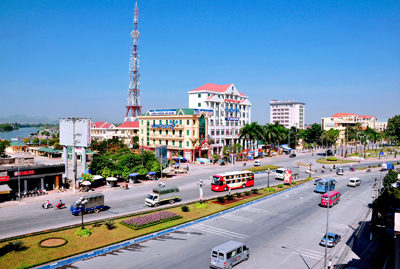
Besides, the urban face was increasingly uplifted thanks to good investment for urbanisation development and effective attraction of development investment resources. In October 2013, the city expanded its administrative territory from 34.27 square kilometres with 12 wards and communes, to 87.87 square kilometres with 21 administrative units and over 135,000 residents. This was a favourable precondition for Phu Ly to become a second-grade urban zone. To realise this target, the Ha Nam Provincial People's Committee assigned the Department of Construction to coordinate with the Phu Ly City People's Committee to hire a French consulting unit to plan adjustments to Phu Ly construction to 2030, with a vision to 2050. With the goal of building a synchronised urban infrastructure structure and space, the city also directed four urban zoning projects, covering 2,440 ha and established 76 detailed plans for the construction of 1,226 ha of urban zone.
While publicising planning works, inspections and treatments of urban planning and urban construction violations, the city government was also resolute on construction site clearance to speed up project progress. Thus, the city achieved positive results in development investment and mobilisation of development investment resources. Total social investment capital reached VND20,037 billion in the 2011-2015 phase. Many completed major projects are being effectively operated.
Besides, the city saw an average annual industrial growth of 15.74 percent. In 2015, Phu Ly has 1,274 active manufacturing enterprises which are expected to generate VND11,686 billion of production value and employ 36,000 workers.
After the administrative boundary was expanded, the city’s agricultural land area increased to over 4,000 hectares, accounting for 45 percent of its natural area. By promoting this advantage, the city has accelerated the restructuring of crop and livestock farming, and the application of technical progresses and new technologies, while simultaneously carrying out many projects and models, including large arable fields, mushroom production, cash crop cultivation and livestock husbandry in buffer zones. Agricultural production value was brought to VND120 million per hectare in 2015.
According to development strategies, Phu Ly City will be upgraded to a second-grade urban zone by 2020. What solutions will the city take to accomplish this goal?
The development orientation of Ha Nam province and Phu Ly City to 2020, with a vision to 2030 and 2050, has set many development goals, including the construction of Phu Ly City into a second-grade urban zone by 2020. Accordingly, Phu Ly City will be the administrative and political centre of the province, a high-quality medical centre of the Hanoi region and southern Red River Delta provinces, a training centre for the Hanoi region and a clean, environment-friendly industrial producer. By 2025, Phu Ly City will have a population of 225,000 people with sufficient economic and technical criteria for a second-grade urban zone. This is a great goal in the long term, while the implementation is not in a long time; thus, it needs the attention, support and guidance of provincial government and relevant departments, the effort of the city government and the consensus of the people.
Defining that planning must go one step ahead, the province has planned the construction of Phu Ly City to 2030, with a vision to 2050, with seven functional areas: (1) Education and training development centre, (2) high-quality medical centre, (3) administrative centre, (4) commercial service centre (old urban quarters), (5) ecological urban zone (6) industrial zone, and (7) high-tech agricultural zone. On that basis, the city has also planned subdivision development to provide the groundwork for urban development projects. Phu Ly has also allocated priority capital for urban infrastructure projects, including urban transportation projects, water supply projects and social infrastructure projects. Together with that, the city government has strengthened coordination with other districts and departments in the province, and guided its functional departments to make necessary adjustments to detailed urban area plans, functional zones and artery traffic routes. Phu Ly has also paid attention to training and fostering management leadership skills for officials, enhancing the quality of advice and service of functional units, and attracting talents. The city has accelerated public administration reform in all aspects of operation, with the philosophy shifting from a ‘governing’ administration to a ‘serving’ administration. Together with upgrading and refurbishing old urban areas, the development of new residential and urban zones is being carried out synchronously to meet the demand for commercial and social housing. The government of Phu Ly has also created favourable conditions for projects to be deployed, and advised the provincial government to introduce better incentive policies to draw more resources for development. Besides, it has raised public awareness of civilised behaviour in modern life.




 Vietnamese





