

10:09:11 AM | 3/9/2020

Manufacturers and exporters are gradually being hit harder and harder by the impacts of the coronavirus epidemic. According to experts, the support of the domestic market with nearly 100 million people is an important solution right now.
Supply chain disruption
According to the Ministry of Industry and Trade, a series of key manufacturing industries such as electricity - electronics, garment and textile, leather and footwear, and automobile assembly and manufacturing are facing input shortages and facing the risk of production suspension.
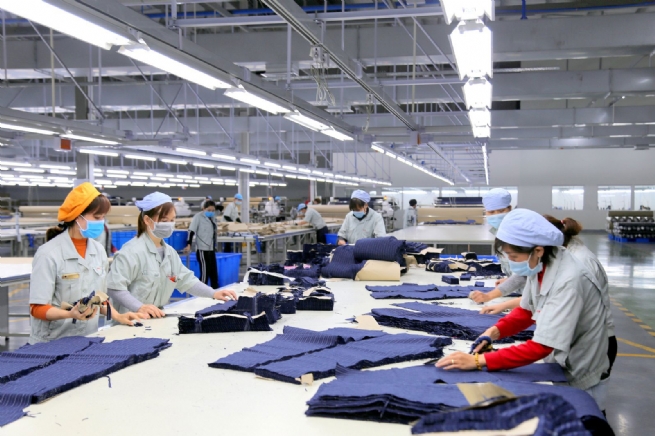
Without enough inputs imported from China, electronics and automobile sectors of Vietnam are encountering tough hardships. Electrical and electronics products like telephones and TVs are the biggest imported and exported items between Vietnam with China and South Korea. In 2019, Vietnam imported about US$40 billion of electronic components, including US$16.8 billion with South Korea (accounting for 42%), US$13.8 billion with China (34%) and US$1.7 billion with Japan (4.2%).
Currently, the automobile manufacturing industry is mainly importing components from China. Up to more than 70% of Vietnamese truck assemblers and manufacturers rely on key components from China. In 2019, Vietnam imported nearly US$4 billion of auto parts, including US$700 million from China (accounting for 17.54%), US$1.14 billion from South Korea (28.57%) and US$720 million from Japan (18.04%).
Every year, the garment and textile industry imports about 60% of fabric, more than 55% of fiber and about 45% of auxiliary inputs from China for production. The leather and footwear industry imports over 60% of raw materials, mainly from China, South Korea and Taiwan.
The above facts show the dependence of many economic sectors on China and Northeast Asian economies for both output and input markets. Therefore, when a contagious epidemic breaks out, countries that restrict import and export will significantly affect the global value chain.
The fulcrum is the domestic market
Dr. Vu Tien Loc, President of the Vietnam Chamber of Commerce and Industry (VCCI), said that the long-term solution is focusing on the domestic market, diversifying international markets, reshaping the value chains by restructuring the economy, increasing competitiveness and resilience, and reducing the overwhelming dependence on any market.
“To reach the world market, you have to stand firm on the domestic market. No one can assure that not only the United States and China, but even Japan and South Korea will not find a way to return to protect their domestic markets in the future,” he emphasized.
Remarking on the importance of the domestic market, Deputy Minister of Industry and Trade Do Thang Hai said that the “Buy Vietnamese Campaign”, a broad movement that encourages Vietnamese people to give priority to Vietnamese products on their shopping list, and the “Vietnamese goods win Vietnamese consumers” Program, need more impulses. Over the past time, these movements have been on the right track and brought about great results for manufacturing enterprises as well as the whole economy.
Deputy Minister Do Thang Hai said that Vietnamese companies must promote their all production and business capacity to meet the needs of domestic consumers.
Mr. Tran Thanh Man, Secretary of the Party Central Committee, Chairman of the Central Committee of the Vietnam Fatherland Front, Head of the Central Steering Committee on the Campaign, advised businesses to uphold their responsibility to consumers; seriously apply science, technology and innovation to production; increase production, business and service capacity; promote products, develop distribution systems, gradually dominate the domestic market, and better meet consumer needs.
According to the Ministry of Industry and Trade, Vietnamese goods in domestic supermarkets still secure high shares e.g. Vissan (95%), Satra (90-95%), Co.opmart (90-93%) and Vinmart (63 %).
A report by the ministry also revealed that the share of Vietnamese goods in foreign-run supermarkets accounts for 60-96%, namely Lotte (82% by revenue and 84% by items), Big C (96% by revenue), AEON (80% by product items), Auchan (65% by product items), and MegaMarket (95% by product items). For traditional retail channels, the share of Vietnamese products in markets and convenience stores account for 60% or more of the total.
With a booming middle class in a population of 100 million, with an emerging economy, the domestic market must be the fulcrum and the biggest resource for national development. Despite the impact of the Covid-19 epidemic, the total retail sales of consumer goods and services still rose by 8.3% year on year since the start of this year. In the first two months of 2020, total retail sales of consumer goods and services reached VND863.9 trillion (US$37 billion), up 8.3% over the same period of 2019. If inflationary factors are excluded, the growth will be 5.4% (versus 9.3% growth in the same period of 2019).
By Huong Ly, Vietnam Business Forum






 Vietnamese





