

1:53:50 PM | 5/6/2020

Digital technology and digital economy platforms will change business models, industry structures and even sectoral economies in unprecedented ways. The digital economy can create new opportunities and growth engines for the overall labor productivity of the economy.
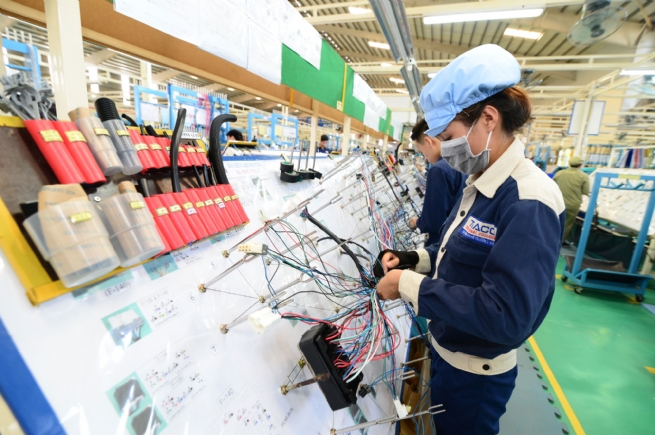
Digital economy changes business models and increases labor productivity
In the Vietnam Annual Economic Review 2019 titled “Improving labor productivity in the context of digital economy” published by the National Economics University, labor productivity is important for long-term economic growth. Low productivity is a factor that hinders economic growth by both speed and sustainability.
According to Dr. To Trung Thanh, Head of Scientific Management Department under the National Economics University, boosting productivity growth is currently an important goal to which Vietnam has paid much attention. However, productivity improvement in Vietnam is still much slower than expected and is also difficult to be reached.
“To step into a new period of growth, Vietnam needs stronger contributions of labor productivity improvement. To achieve higher labor productivity growth in the time to come while old growth engines almost run out, new motivations are needed. The digital technology and digital economy platform is a choice for that,” he said.
In the coming years, digital economy development will certainly be a new driver of productivity growth. Automation and digitization will gradually replace many production stages of many economic sectors, helping reduce costs, increase profits and employ fewer workers. Digital technology can be applied in almost all economic sectors and make major changes in production methods and labor productivity in all economic sectors. Some industries may soon take advantage of digital technology to make big changes in output and productivity, such as manufacturing and processing industries, transportation - logistics, finance - banking, healthcare and education and high-tech agriculture.
Digital technology will change business models, industry structures and even industrial economy in unprecedented ways. Digital economy can create new opportunities and growth engines for the overall labor productivity of the economy. However, it can only help labor productivity growth if labor can be reallocated to more productive areas as needed. If there are structural barriers in the use of new technologies as well as effective labor allocation, the impact of digital economy will be trivial. In addition, the impact of digital economy on productivity growth of each industry and economic sector will vary due to their different characteristics and technological absorption capacity. Therefore, the research into the impact of digital economy on labor productivity of enterprises, fields and economic sectors along with labor mobility trends across industries and economic sectors will help Vietnam figure out new motivations that the digital economy brings to propose appropriate solutions to promote overall labor productivity growth of the economy in the 2020-2030 strategic period.
The report has four scenarios of digital economy and forecast labor productivity based on digital economy by 2030. In Scenario 1: The economy grows slowly and the average annual growth of labor productivity is 6.25%, of which the digital economy contributes only 0.43%. In scenario 2: The digital-transformed economy will expand digital application and develop the information technology industry, the respective rates will be 6.97% and 1.15%, respectively, and the labor productivity growth and contribution level of the digital economy will be the highest among all scenarios. In Scenario 3: Digital exporters, given that the development of Vietnam's IT industry is based on outsourcing for other countries but the adoption of internal digital technologies across industries is low, the respective rates are 6.32% and 0.50%. In Scenario 4: Digital consumers, given that Vietnam's industry uses IT products and services from other countries, the respective rates are 6.50% and 0.68%.
Thus, in 2020-2030, each year, only the digital economy contributes 7-16.5% out of 100% of overall labor productivity growth. Without doubt, the contribution of the digital economy is very important to economic productivity and performance, and serves as a new driving force for rapid improvement of labor productivity.
Policy recommendations for improved labor productivity
The report said, to improve labor productivity in the digital economy, a framework strategy is needed to underpin legal and institutional orientations and corridors for digital transformation. The goal that Vietnam aims at is the transition scenario, which means that digital synchronization in all sectors and fields of the economy must start from State management. In order to have a digitally transformed economy, we need a huge amount of resources, not only coming from the State budget, but also from the society, including the private sector and the FDI sector. Hence, it is necessary to create basic conditions to attract investment capital for economic digitization, namely digital infrastructure and services. There is a need for renovating the education and training system by changing management, methodology, documents and new subjects closely linked to digitization.
In particular, it is necessary to apply preferential economic policies on tax and credit for businesses investing in science and technology, innovation, high-tech application and production modernization; encourage, facilitate and support businesses to start up, innovate and improve production techniques and technologies, and train and foster human resources and businesspeople. In addition, attention should be paid to incentives for digital technology application to the manufacturing and processing industry, which plays a huge role in the economy and overall labor productivity.
The Government also needs to strongly support enterprises, especially SMEs, in the ICT and scientific-technological industries. These two industries take advantage of digital technology to improve labor productivity and create digital platforms and support the development of other economic sectors.
For their part, businesses should have a strategy to improve labor productivity based on knowledge and technology, focus on improving technological capacity, innovating and applying advanced production and management technology to improve business performance and productivity. It is important to accelerate the application of cloud computing to cut costs, save time and enhance business performance, especially storage, sharing, big data analysis and growth planning.
| Labor productivity of Vietnam, though having a relatively high growth rate in the region, is currently at a very low level. Compared with some other countries in ASEAN, Vietnam's labor productivity in 2019 was only about one fifth of Malaysia, a third of Thailand and China, a half of Indonesia, and nearly a half of the average ASEAN labor productivity. Vietnam's labor productivity is at the low of ASEAN, even lower than the Philippines, Laos and Myanmar, only higher than Cambodia. Vietnam's labor productivity per capita is less than 10% of the United States, approximately 25% of China, Indonesia, Thailand and over 50% of Malaysia. Over the past two decades, Vietnam has not reduced its productivity gap with other countries in the region, the distance has even further widened. Vietnam is facing a clearer risk of lagging behind. |
By Lan Anh, Vietnam Business Forum






 Vietnamese





