

10:21:27 AM | 5/4/2020

Humans are decisive to the operation of any organization, including business. Human resources are one of the inputs that determines the result as well as the long-term development of any company. High-quality human resources are a top concern of all companies. Therefore, in the past years, Nghe An province has fostered the entrepreneur force and obtained initial achievements.
Entrepreneur training in Nghe An
According to a report released by the Department of Planning and Investment, Nghe An province has a total of over 20,000 businesses with about VND10 trillion of registered investment capital, mostly from micro, small and medium-sized enterprises (MSMEs). The business sector contributes 60% of the province’s budget revenue. Nghe An province-based enterprises are engaged in various industries, with the trade and service sector accounting for the largest share of 32.19%, followed by the construction sector with 24%, the mining industry with 12.64%, the agriculture and forestry with 5.4%, and the fishery with 0.26%.
However, not many businesses have good human resource management (HRM) policies, strategies and approaches. Very few small and medium-sized enterprises (SMEs) have long-term personnel plans. In addition, job analysis, recruitment, performance evaluation and skills development training have not been performed methodically and effectively. Nghe An people are industrious and diligent, but, according to employers, their capacity, especially the sense of responsibility and labor discipline, are not high.
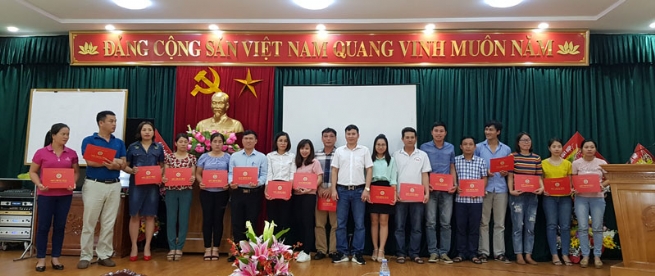
On December 5, 2012, the Nghe An Provincial People’s Committee issued Decision 4892/QD-UBND approving the project on fostering entrepreneur force for 2012-2015, with a vision to 2020. In the past seven years, the Department of Planning and Investment has worked closely with the Public Affairs Department under the Provincial Party Committee, Nghe An Economic University, business associations, entrepreneurs and related agencies to successfully organize 115 seminars for 9,516 people, including 25 entrepreneurship classes, 41 business administration classes, especially 16 advanced administration classes for chief executive officers (CEO) and 18 symposiums. Attendants are business leaders, managers and owners.
In additional classes opened in collaboration with Nghe An Economics University, business associations, the North SME Development Support Center, the Business Development Department, VCCI Nghe An Branch, provincial departments also organized training courses and dialogues when there are new policies related to business.
However, annual business training courses are only short-term, theme-based, and not really as effective as expected. According to surveys, many CEO training classes are attended by only administrative officers and accountants, making the goal of 100% of business leaders and managers with a firm grasp of basic knowledge about corporate governance unachievable. Besides, classes lectured by invited professors from universities and institutes in Hanoi and Ho Chi Minh City do not provide the knowledge that SMEs really need. The provincial budget for entrepreneurship classes is too small while the cost of a course is high, forcing course organizers to reduce the training time, contents or invite less qualified lecturers and speakers.
Currently, enterprises really need qualified human resources. Foreign enterprises firms are spending a lot to recruit talent from universities, but SMEs in Nghe An have not paid much attention to this issue. Businesses and schools lack close cooperation for mutual benefits because there are no policies allowing businesses to invest and cooperate with schools. The schools themselves have not adapted well to integration initiatives and take necessary skills for a smart and industrialized economy.
Consistent personnel training solutions for SMEs needed
To raise high quality human resources for SMEs in Nghe An province, it is necessary to launch consistent solutions, with key tasks being worker recruitment, training and re-training in the long term.
First, human resource training needs to go in line with economic development
Training human resources in line with business development is a must. This is one important requirement helping businesses recruit personnel as they want. Human resource training solutions will be clearer and more reasonable, consistent with the current size, style and corporate culture.
It is necessary to integrate business and development strategies to plan human resources for divisions in a reasonable manner. What are staff positions in a department? What are the job tasks of the staff? What are the needs of the business? What skills are needed?
The company needs an employee evaluation and survey report to figure out training and human resource policies for its right business direction. Thus, human resource training solutions will surely bring great benefits for long-term economic development.
Second, encouraging employees to self-study and organizing annual training programs
Businesses need to coordinate with education and training facilities to provide access to advanced training for their employees. It helps their employees improve their own qualifications even while they are at work. It is necessary to organize personnel training courses, improved and developed by new and old personnel flows and senior and inferior levels to have best personnel training solutions.
Employees are supported to have self-study and self-development. Periodically delivering skills materials via email or organizing rewarding emulation programs is also a way for employees to self-motivate learning and practice right at the business.
Third, employing the right persons in the right place and creating a learning environment in the business
These are two solutions to highly qualified training and very important for human resources development. In new personnel recruitment and training plans, there is a need for talent development criteria. Discovering, fostering and employing talents in the business in a reasonable manner will produce high results in business performance and development. Creating a learning environment is extremely important to develop employee talent. Specifically, companies must discover, foster, recruit and employ high-quality and talented human resources and must capitalize on their gray matter in research, manufacture and application of research results, and encourage them to learn and improve professional qualifications and skills, thus building a powerful force of top-tier officials and expert specialists in all fields, organizations and businesses.
Enterprises need to implement solutions for training human resources in the short term and in the long term. At the same time, they need to organize online training solutions, promote employees' self-learning and self-improvement. Through online human resource training courses, they can grasp what employees are aiming for, thereby developing their competencies in the right place and enhancing the work performance by 3-4 times.
Fourth, in order to make the best use of training resources that are right for them, businesses and schools must actively work together and cooperate for mutual benefit
The “thirst” for high quality human resources in enterprises will be difficult to be solved, without understanding and cooperation between schools and businesses, especially in the context of the Fourth Industrial Revolution. The nature of the Industrial Revolution 4.0 is based on the foundation of digital technology and the integration of advanced smart technologies to create a series of changes in technology, management and many new industries. In particular, Industry 4.0 will result in major changes in labor supply and demand, posing challenges to the labor market and changes in the labor structure. Therefore, training high quality human resources will be an urgent issue.
Training employees is also much different than earlier. Previously, we specialized in one-sector technical training, but now the boundary of industries is increasingly blurred and technology-linked cross-sector trends become common.
So, how to train students with interdisciplinary skills is important.
Currently, high quality human resources are inadequate and impossible to meet practical requirements. This requires universities to consider and research the needs of industries and industrial enterprises to figure out what the market needs, and will need in the future.
In order to train quality human resources suitable for the future workspace, some skills such as problem solving, team-working and digital knowledge are top skills for students to adapt to the working environment in the era of the Fourth Industrial Revolution.
The supply-demand link between schools and businesses is very important. It helps the former understand and capture the needs of the latter in technique, technology and especially knowledge, skills and competencies of candidates applying for positions in enterprises, thus helping the former build appropriate training programs. In addition to improving training quality, schools need to shift training towards what the market needs. Students gain career skills and access to businesses, and foster soft skills. Schools need to send students to experience real production at businesses and deploy cooperation training programs before they recruit.
For that reason, small and medium-sized enterprises (SMEs) in Nghe An province need to proactively develop and implement policies on training and developing human skills. Then, they can have a high quality workforce and solve business problems because, after all, the quality of human resources will determine both strategic success and financial success at any business. In fact, training will equip skills to meet current and future jobs, combining on-the-job and off-the-job training forms for employees to apply their knowledge to work and improve their creativity and boost the performance of the business.
By Dr. Dinh Van Toi, Director of Center for Foreign Languages and Computer Science,
Nghe An Economics University






 Vietnamese





