

10:00:38 AM | 5/6/2021

By overcoming numerous market difficulties and high transportation rates, Vietnam has made robust growth of wooden furniture exports. Wood processing in Vietnam is still very attractive to investors, including foreigners.
At the working meeting with the Vietnam Timber and Forest Products Association (Vifores) on April 23, 2021, Minister of Agriculture and Rural Development Le Minh Hoan told relevant bodies to socialize resources to support brand construction and development of Vietnamese wood products helping to earn US$18-20 billion from export in 2025 and US$23-25 billion in 2030.
Rising cost of freight
Vifores Chairman Do Xuan Lap said that woodwork exports reached nearly US$12.5 billion in 2020 and US$3.7 billion in the first three months of 2021, up 41.5% year on year. Up to 90% of export value of wood and forest products came from the United States, Japan, China, the European Union and South Korea.
He said, wood exporters went through many difficulties and challenges in the first three months of 2021. First among them is the rising cost of freight.
For example, the U.S. market is expected to import US$7.8-8 million of wooden furniture in 2021, estimated to store in 500,000 containers.
However, shipping costs to this market are volatile. Before September 2020, the shipping rate for a container to the U.S. market was US$4,000-5,000 but it soared to US$8,000 - 9,000 (even sometimes US$11,200) in the first quarter of 2021.
Meanwhile, in the European market, the sea freight rate increased from US$400-500 per container on the import direction. The average rate in November 2020 was US$1,100 per 40-foot container but it climbed to US$1,500 in March 2021.
More investment in advanced technology
Minister Le Minh Hoan appreciated the wood business community for overcoming difficulties and achieving very high growth of wood export.
The export value of wood products and forest products increased by five times over the past 15 years, from US$2.8 billion a year in 2006-2010 to about US$8 billion a year in 2011-2020, with over US$13 billion in 2020.
This achievement affirmed Vietnam's position in the international wooden furniture market. The wood and forest product processing capacity has grown rapidly in scale, quantity, quality and efficiency of production and business. This sector has attracted more investment from the private sector.
“Vietnam had about 1,200 wood processors in 2006 but it now has nearly 6,000 processors, including about 1,000 foreign-invested processors which registered to invest nearly US$6.5 billion,” he emphasized.
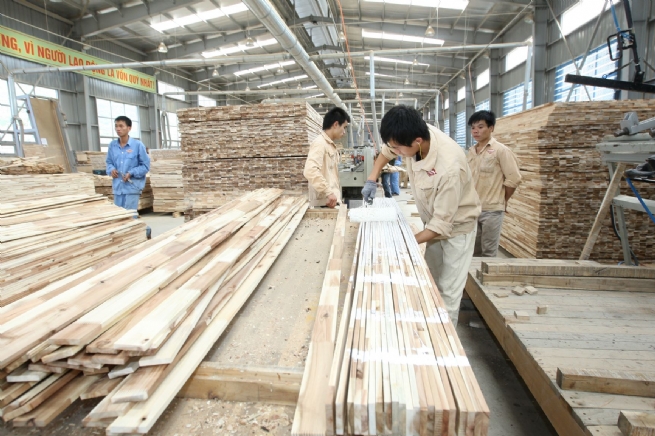
Wood companies have been focusing on investing heavily in modern equipment to make sophisticated products. This has helped them to create high-quality, high-class products that meet domestic and international consumer tastes.
Workers in this industry have also increased strongly in number. Up to now, more than 500,000 are working for the wood industry, 55-60% of whom are trained.
“The wood business community should continue to adopt advanced technologies for wood processing facilities; apply mechanization and automation to reduce labor costs, save and utilize inputs for processing, create uniformity and ensure product quality,” he recommended.
Enterprises should invest in projects using by-products from wood processing, wood glues and accessories for the wood processing industry. Besides, it is necessary to develop the engineering and supporting industries for the wood processing industry. At the same time, it is necessary to socialize resources to support building and developing Vietnamese wood product brands. Vietnam will strive to earn US$18 - 20 billion from woodwork and non-timber forest products by 2025 and US$23-25 billion by 2030.
Source: Vietnam Business Forum
 April 24–25, 2026
 Kinh Bac Cultural Center, Bac Ninh Province


 Vietnamese





