

9:28:03 AM | 12/25/2023

In light of the anticipated intricate and unpredictable global and regional developments, General Secretary Nguyen Phu Trong underlined the imperative for a reformed and fortified approach to foreign affairs and diplomacy, characterized by the distinct essence of "Vietnamese bamboo."
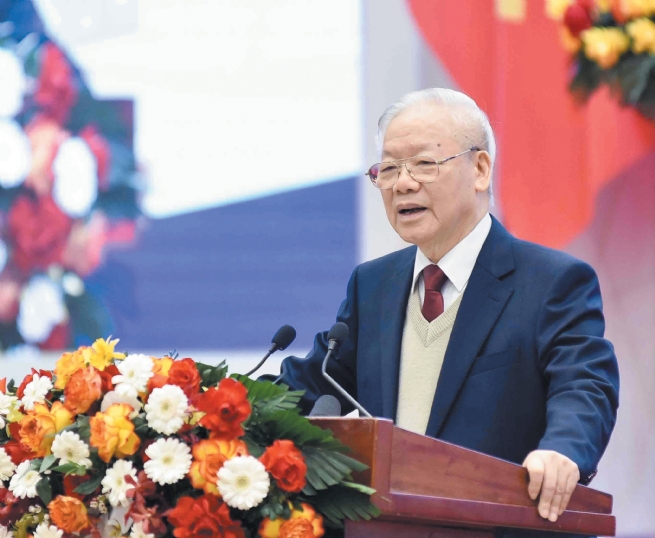 General Secretary Nguyen Phu Trong addresses the 32nd National Diplomatic Conference |
The 32nd Diplomatic Conference "Promoting the pioneering role, building a comprehensive, modern, strong diplomacy, successfully implementing the resolution of the 13th National Party Congress," transpired in a hybrid offline and online format. General Secretary Nguyen Phu Trong participated in the conference and delivered a directive speech.
Foreign Minister Bui Thanh Son, in his opening address, remarked that since the 13th Party Congress and the National Foreign Affairs Conference, the global and regional landscape has undergone significant transformations, entering a juncture marked by a new multi-polar, multi-center, multi-level paradigm.
In this context, he stressed the alignment of external and diplomatic endeavors with the foreign policy established by the 13th National Party Congress, adhering to the guidance of the Politburo, the Secretariat, Party and State leaders, particularly emphasizing the direction set by the General Secretary during the National Foreign Affairs Conference. The resolute promotion of "Vietnamese bamboo diplomacy" has been a focal point.
After the National Foreign Affairs Conference, the diplomatic service, across all levels and branches, successfully coordinated 45 visits by senior leaders to neighboring countries, key partners, and longstanding friends, alongside nearly 50 visits by foreign leaders to Vietnam. Noteworthy among these engagements are the historic visit to China by General Secretary Nguyen Phu Trong and visits to Vietnam by Chinese General Secretary and President Xi Jinping, as well as U.S. President Joe Biden. These important events have ushered in a new era of qualitative development in the nation's foreign affairs and international integration.
Relationships with many important partners have attained unprecedented heights, political trust with various countries has been fortified, and substantive and effective cooperation has seen substantial expansion.
At the multilateral level, Vietnam's international standing and prestige continue to witness augmentation. The nation has assumed substantial international responsibilities, amplifying its role across important multilateral bodies and forums, including ASEAN, the United Nations, the Mekong subregion, APEC, AIPA, IPU, UNESCO, United Nations Conference on Climate Change (COP), and Belt and Road Summit.
The realm of foreign and diplomatic affairs has accentuated its pioneering role in mobilizing external resources, notably contributing to the effective management of the COVID-19 pandemic and facilitating socioeconomic recovery and development. Vietnam's economic diplomacy has undergone extensive and profound expansion with numerous partners, playing a crucial part in upholding macroeconomic stability, fostering economic growth, managing import and export dynamics, attracting new resources such as Foreign Direct Investment (FDI), Official Development Assistance (ODA), and advancements in science and technology. These efforts have positioned Vietnam among the top 40 global economies and the leading 20 economies in terms of trade and foreign investment inflows.
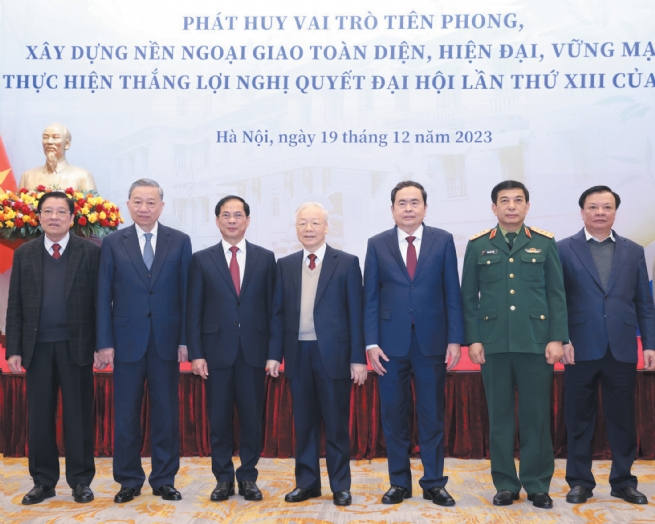
General Secretary Nguyen Phu Trong and other Party and State leaders converge at the 32nd National Diplomatic Conference
Foreign Minister Son said, "Such remarkable outcomes underscored the diplomatic approach rooted in the identity of 'Vietnamese bamboo,' grounded in Marxism-Leninism, Ho Chi Minh's ideology, cultural distinctiveness, and a traditional, peace-oriented yet resilient diplomacy that aligns seamlessly with Vietnam's conditions and circumstances, meeting the demands of national development and defense in the contemporary landscape."
In his directive address to the conference, General Secretary Nguyen Phu Trong emphasized the distinctive and unparalleled nature of Vietnam's diplomatic tradition, deeply ingrained with the essence of "Vietnamese bamboo."
He underscored that over the past three years, particularly since the first National Foreign Affairs Conference held in accordance with the aforementioned principles, the nation's diplomatic sector has garnered significant and historic achievements, standing out conspicuously among the country's notable successes in recent times. The key accomplishments are outlined as follows:
First, a comprehensive understanding and effective implementation of the foreign policy laid out by the 13th National Party Congress.
Second, the diplomatic service has advanced new positions and harnessed emerging forces, leveraging the collective strength of the entire nation to fortify open and favorable foreign relations conducive to national development and defense in the contemporary era.
Third, integration of foreign affairs with national defense and security, with all diplomatic levels and branches assuming a pioneering role in sustaining a peaceful and stable environment, thereby safeguarding the interests of the Party, the Fatherland, and the People.
Fourth, the diplomatic sector has spearheaded the mobilization of external resources, making important contributions to the execution of socioeconomic development tasks, notably the expansion and enhancement of economic diplomacy.
Fifth, proactive pursuit of more comprehensive and profound international integration, resulting in an elevated stature and reputation for the country on the global stage.
Sixth, synchronous and close implementation of Party diplomacy, state diplomacy, and people's diplomacy, yielding substantial and noteworthy results.
General Secretary Nguyen Phu Trong remarked that in the forthcoming period, global and regional dynamics are anticipated to be intricate and unpredictable. While the prevailing trends of peace, cooperation and development persist, they encounter new complexities and challenges. In a multipolar, multicentered world, the intensification of strategic competition among major nations is inevitable, with heightened risks of conflict and confrontation, presenting substantial challenges for developing countries.
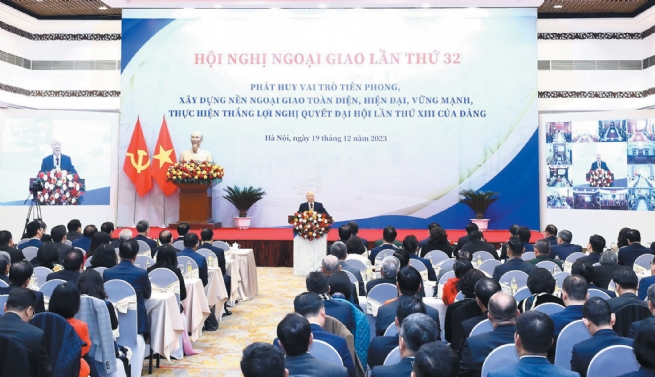
Overview of the 32nd National Diplomatic Conference
Moreover, the rapid advancement of science and technology is catalyzing transformations across all facets of social existence. Both traditional and non-traditional security concerns, notably natural disasters, epidemics, climate change, food security, energy and cyber threats, are posing formidable challenges for nations. The regions of Asia-Pacific, Indian Ocean and Southeast Asia are experiencing dynamic growth but are concurrently becoming focal points for intensified competition among major countries.
In alignment with the orientations, tasks, and solutions presented in the report by the Ministry of Foreign Affairs, General Secretary Nguyen Phu Trong Trong underscored several additional considerations.
First, it is imperative to steadfastly adhere to the resolutions and foreign policy outlined by the 13th National Party Congress, directives of the Central Party Committee, and the guidance provided by the Politburo, the Secretariat, as well as the action programs of the Government and the Ministry of Foreign Affairs. This involves consistently capturing, analyzing, and forecasting situations, promptly advising necessary adjustments and addressing emerging trends and issues. The concretization, development, and implementation of specific programs and plans by each agency should be approached in a serious, methodical, scientific and unified manner, requiring the utmost determination, collective effort and the unity of the political system.
Second, a nuanced balance must be maintained between harnessing the nation's strength and aligning with the prevailing international dynamics. General Secretary Trong emphasized the need to skillfully manage the interplay between national interests and international obligations, ensuring that “our current national interests align seamlessly with fostering a favorable international environment for development”. This convergence is in harmony with the global pursuit of peace, national independence, democracy and social progress.
Third, diplomacy should uphold principles while exhibiting flexibility in strategies. Embracing national independence and socialism as guiding principles, the strategies should be adaptive and flexible, aligning with the core tenets of "Firm in objectives, flexible in strategies and tactics," "Make more friends, fewer foes," and "ready to be friends with all democratic countries and be no enemy to anyone," as espoused by Uncle Ho. Vietnam remains open to fostering friendly, reliable, and responsible partnerships with all nations in the international community.
Fourth, a concerted effort should be directed toward building unity and consensus within the entire Party, the entire army, and the entire populace.
Fifth, particular attention should be given to enhancing the organizational structure and cultivating a cadre of diplomats characterized by bravery, quality, ethics, intelligence, modern working methodologies, professional demeanor, and proficiency in business and foreign languages.
President Ho Chi Minh repeatedly emphasized that "Personnel are the root of all work" and that "Every success or failure depends on good or bad officials". At the Third Diplomatic Conference in January 1964, he further imparted invaluable advice, stating that diplomatic officers should cultivate revolutionary ethics, uphold confidentiality, demonstrate fiscal responsibility, prioritize internal solidarity, and adeptly comprehend the host country's situation and the international landscape.
General Secretary Trong affirmed that these teachings provide a consistent direction for diplomatic officers to enhance their efforts and effectiveness. He expressed confidence that, building on the achievements of the current term, particularly in 2023, diplomatic officers will continue to exemplify intelligence, bravery, ethics, and the character inherent in the diplomacy of the Ho Chi Minh era. Despite encountering new difficulties and challenges, they will persist in reforming, constructing, and cultivating a modern, inclusive, and robust Vietnamese diplomacy, steeped in the identity of "Vietnamese bamboo." Their role will extend to leading the nation in its pursuits of construction and defense, aligning with the resolution of the 13th National Party Congress.
Source: Vietnam Business Forum
 April 24–25, 2026
 Kinh Bac Cultural Center, Bac Ninh Province


 Vietnamese





