

9:01:51 AM | 5/14/2025

According to the World Bank's East Asia and Pacific Economic Update, Vietnam's economy, due to its high level of openness, is particularly vulnerable to global trade shocks, especially amid growing risks from external economic uncertainties. To sustain long-term growth, the country needs to increase public investment, pursue structural reforms and strengthen financial resilience.
Vietnam should diversify markets, leverage FTAs, and tap new markets to boost trade growth
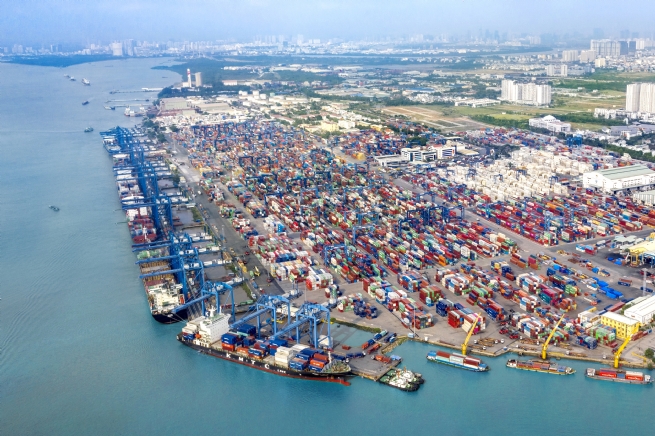
As an open economy with a trade ratio (imports plus exports) of almost 170% of GDP, Vietnam is particularly exposed to ongoing shifts in global trade policies. The United States remains the largest export destination of Vietnam, accounting for 30% of total exports, compared to China (15%), the EU (13%) and ASEAN (8%), while China accounts for 38% of its imports. Uncertainty may impact exports, investment and growth while likely to further weaken consumer confidence and spending which has lagged GDP growth in recent years.
According to the release, while the government has fiscal space to support demand, effective implementation may be hampered by chronically slow disbursement in public investment. Real estate is expected to recover in 2025-2026 although transactions have remained limited. Headline inflation is set to remain within the target of 4.5-5% as oil and commodity prices are projected to continue easing. Economic growth is hoped to help poverty reduction efforts in Vietnam. Nevertheless, external economic uncertainties pose risks that may lead to job losses among unskilled workers and might reverse some recent gains in poverty reduction.
This outlook is subject to increasing downside risks, particularly due to external factors like adverse trade policy shifts, slower-than-expected global growth and global policy uncertainty. Given the country’s exposure to the global environment, strong shocks in trade policy could adversely impact exports, private investment, including FDI, and growth.
To address these challenges, policy measures should focus on expanding public investment, mitigating fiscal sector risks and structural reforms, said the World Bank. While room for monetary policy intervention remains restrained, fiscal policy could still support growth especially through investment to close emerging infrastructure gaps.
Besides, based on recent reforms (such as the revision of the Law on Credit Institutions), further steps to mitigate financial sector risks and vulnerabilities remain crucial to promote financial sector resilience and stability. At the same time, accelerating structural reforms to strengthen the regulatory environment in critical backbone services (like information technology, electricity and transport), green the economy, build human capital and improve the business environment is vital to sustain long-term growth.
According to the WB, East Asia and Pacific (EAP) outpaced most regions in economic growth in 2024. To sustain this momentum and generate jobs, EAP countries must navigate global uncertainty and tackle long-term challenges tied to shifting global integration, climate change and demographic trends.
Notably, growing global uncertainty is having an impact on business and consumer confidence, inhibiting investment and consumption. Trade restrictions are expected to impact EAP’s exports while slower global growth is likely to further reduce external demand.
“While navigating global uncertainty, EAP countries have the opportunity to strengthen their economic prospects by embracing and investing in new technologies, opening up business opportunities through bold reforms and deepening international cooperation,” said Madam Manuela V. Ferro, Vice President of the World Bank for East Asia and Pacific.
By Quynh Chi, Vietnam Business Forum





 Vietnamese





