

10:56:02 AM | 5/23/2025

The Vietnam Business Forum is honored to present the article: "New Driving Forces for Economic Development" by General Secretary To Lam.
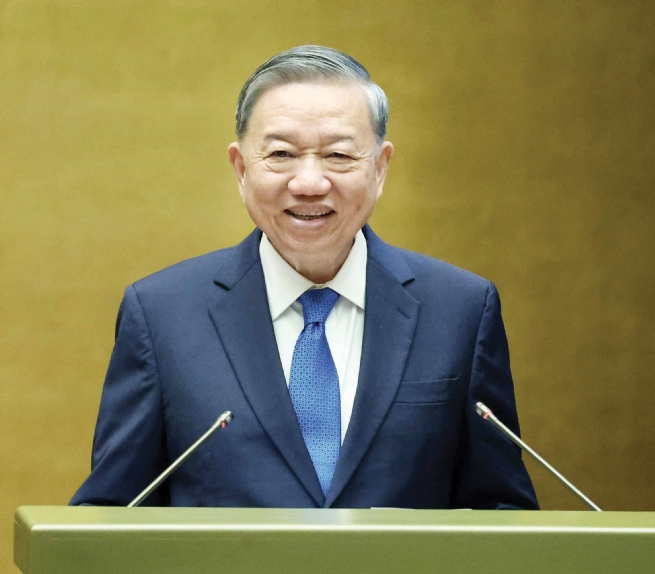 Party General Secretary To Lam addresses the national conference on the dissemination and implementation of Resolutions 66 and 68 in Hanoi on May 18, 2025 |
1. The resolute pursuit of national independence linked to socialism has been the wise and correct choice of the Communist Party of Vietnam since its inception and throughout its leadership of the revolutionary process. This is the fundamental reason for all victories in the struggle for national liberation and reunification in the past, as well as the current construction and defense of the Fatherland. The socialism we are building, as President Ho Chi Minh once emphasized, aims to “make the people prosperous and the nation powerful,” characterized by “a wealthy people, a mighty nation, democracy, justice and civilization where the people are the true masters; have a highly developed economy based on modern productive forces and progressive, appropriate production relations; and have an advanced culture deeply imbued with national identity; have the people enjoy a prosperous, free and happy life and have opportunities for comprehensive development; have all ethnic groups in the Vietnamese community equal, united, respectful and supportive of one another in development; have a socialist rule-of-law state of the people, by the people and for the people under the leadership of the Communist Party; and have friendly and cooperative relations with countries around the world.”

Party and State leaders and other delegates at the conference
The Marxist-Leninist theory of socioeconomic formations demonstrates that the material production of humankind is the foundation, origin and decisive factor in social transformation. Production is the fundamental activity that generates and develops human social relations and fosters cooperation and competition, lifting production to new heights while offering the basis for forming, transforming and developing human society. According to Marxism, social change is fundamentally and primarily the transformation of material production, which is the central and most critical factor determining social change. In the social evolution process, changes in economic structures lead to changes in social structures and changes in societal values and norms. Stemming from the “obvious truth… that man must first have food, drink, shelter and clothing, meaning they must work before engaging in struggles for dominance and before pursuing politics, religion and philosophy.” Marxism points out that, to survive, exist and develop, man must inevitably produce material wealth for society. At the same time, “Different economic eras are distinguished not by what they produce, but by how they produce it and with what means of labor in use.”
Additionally, according to V.I. Lenin, high labor productivity reflects the inherent superiority of socialism over capitalism and is the most critical and primary criterion for the triumph of socialism. Ultimately, labor productivity is the most important and decisive factor for the victory of the new regime. Capitalism produced unprecedented labor productivity compared to feudalism. Capitalism can and will be definitively defeated because socialism creates far higher labor productivity.”
Thus, to successfully build socialism with the characteristics outlined in the Party’s Political Platform for National Development during the Transition to Socialism (supplemented and developed in 2011), human material production is of decisive importance, with high labor productivity as the key factor. Through material production, we construct the material and technical foundation of socialism, create positive social transformations, thoroughly address limitations and shortcomings, and develop new socialist people who enjoy prosperous, free and happy lives with conditions for comprehensive development. This process completes the transitional period toward socialism, paving the way for entry into the higher stage of the communist socioeconomic formation as envisioned by Marx in Critique of the Gotha Program: “After the productive forces have also increased with the all-around development of the individual, and all the springs of cooperative wealth flow more abundantly - only then can the narrow horizon of bourgeois right be crossed in its entirety and society inscribe on its banners: From each according to his ability, to each according to his needs.”

Delegates at the conference
2. The practical experience of economic development, particularly the development of the private sector in China and Russia as well as in Vietnam after 40 years of Doi Moi (renovation), has offered invaluable lessons. In Russia, even during the period of centrally planned economic development, Lenin’s New Economic Policy, which encouraged the development of various economic components including the private economy from 1921 to 1991, enabled the Russian economy to achieve remarkable growth. During this period, Russia, along with many underdeveloped republics within the Soviet Union, emerged as a major power that reached advanced levels in various fields such as energy, industry and space exploration. In China, starting with the “Reform and Opening Up” policy in 1978, constitutional amendments in 1988 toward increased protection of private businesses’ legitimate rights and interests, and the recognition of the private economy as a vital component of the socialist market economy at the 15th National Congress of the Communist Party of China in 1997 and its commitments to safeguarding the rights and interests of individual and private economies, the private economy experienced explosive growth, with the emergence of giant conglomerates that not only dominated domestic markets but also expanded into the world market, and played a significant role in technology, telecommunications and e-commerce. A myriad of private businesses now account for the majority share in various industries, including manufacturing, services and especially high technology, contributing over 60% of GDP, creating 80% of urban employment, and generating more than 70% of inventions and patents in China's economy.
In Vietnam, the official recognition of a multi-sector economy in the documents of 6th Party Congress; the encouragement and facilitation of private economic development ascertained at the 7th Congress, underlined continuations at the 8th Congress, and further advancements at the 9th Congress where the Party affirmed the long-term importance of the private capitalist economy in the socialist-oriented market economy and issued a thematic resolution on continued reforms of mechanisms and policies to promote private economic development for the first time; the important role of the private economy as a driving force of the economy emphasized and regulations on Party members’ participation in the private economy economic at the 10th Congress; and the role of the private economy strongly and decisively affirmed as a key economic driver at the 12th and 13th Congresses, the private economy has made remarkable progress. From a state of mere survival under the centrally planned, bureaucratic subsidy system where it faced discrimination in both societal perceptions and state policies, the private economy has thrived during the Doi Moi period, significantly contributed to State Budget, created jobs for society, leveraged local and national potential and advantages and contributed to boosting socioeconomic development, reinforcing national defense and security, and asserting its importance in international integration.
It is evident that, with visionary and correct policies, developing the private sector within a socialist-oriented market economy is a critical choice to foster material production, drive social transformation, create breakthroughs in technological advancement and vocational training, enhance capital absorption, boost labor productivity, and build the material and technical foundation for socialism. The most critical and central task in private economic development is to further improve the institutional framework of the socialist-oriented market economy, with transformative changes in mindset, awareness and action. This forms the fundamental characteristic of a socialist-oriented market economy managed by the state under the Party’s leadership, distinct from earlier models of state-managed socialist-oriented market economies.
3.On May 4, 2025, the Politburo issued Resolution 68-NQ/TW on private economic development, outlining unprecedented goals, perspectives, tasks, and breakthrough solutions. This resolution shapes the Party’s new stance on fostering the private sector within a socialist-oriented market economy managed by the state under the Party’s leadership and fostering the private economy as a new driving force for economic development in the coming period. To successfully implement Resolution 68, the following urgent tasks must be prioritized:
First, decisively and effectively implement measures to quickly bring the Party’s resolution into real-life practice. At the upcoming 9th session of the 15th National Assembly, the legislature will discuss and adopt a resolution on private economic development with specific, feasible and effective preferential mechanisms and policies. A National Steering Committee for the implementation of Resolution 68 will be established, led by the Prime Minister. The committee will regularly, on a monthly basis, review and supervise the implementation progress across ministries, sectors and localities, and absolutely prevent fragmented or inconsistent application that could weaken central policies. Implementation results will be publicly disclosed on a regular basis and used as one of the criteria for measuring performance and accountability, especially for leaders. It is important to foster a strong shift in administrative mindset from control to facilitation, view businesses as entities to be "served" rather than "managed," ensure the principle of "words go with actions" is consistently upheld throughout the political system. The government will promptly issue a directive requiring all ministries, sectors and localities to shift administrative procedures to a post-audit model, except for certain special sectors (like national defense and security). There should also be clear guidance on the public service responsibilities of Party leaders and administrative authorities at all levels in supporting businesses, linked to emulation and commendation activities. The entire investment licensing process should be standardized into an electronic model, with shortened timelines for announcing results.
Second, urgently institutionalize the Party’s viewpoints into law and ensure strict enforcement across the political system, the business community and the people. The Law on Private Economic Development will be researched and developed and related legal provisions will be amended to fully institutionalize the guidelines of Resolution 68. This includes establishing a fair competition system, clearly identifying actions that negatively impact market access or discriminate against the private economy. Mechanisms to promote investment and financial support will be created, requiring financial institutions to develop credit evaluation financial support systems suitable for the private economy. Science and technology development will be encouraged, with private businesses taking the lead in major national projects and establishing national innovation research infrastructure. A system to protect the rights and interests of market participants will be established. It is necessary to clearly distinguish economic disputes from criminal offenses and strictly prohibit the abuse of legal authority in market management. Measures to support administrative procedures and policies for the private economy will be introduced while relevant processes will be standardized. The Criminal Code will be amended to clearly separate fraudulent or profiteering acts from ordinary administrative errors.
Third, pay special attention to supporting small and micro businesses and fostering the development of a society with an entrepreneurial mindset and ambition, particularly in innovation. A preferential credit package tailored for small and medium-sized enterprises (SMEs) will be immediately introduced through a government-backed credit guarantee fund. 5-10% of land in high-tech parks will be reserved for startups at preferential rates. A legal sandbox model will be expanded nationwide, enabling real-world testing in fintech, AI and digital agriculture within a clear legal protection framework. Free or subsidized legal consultation centers for SMEs will be set up across localities.
Fourth, build a force of entrepreneurs who truly become "warriors" on the economic front, practically participating in policy formulation. It is important to protect, support, encourage and honor entrepreneurs with patriotism, national pride, law-abiding consciousness, ambition to make money for their own and contribute to national prosperity, with knowledge and capabilities in business management within a market economy, and with responsibility to their employees and society. Favorable conditions will be created for entrepreneurs to engage in policy critique and contribute to the formulation and implementation of development strategies. Ministries and sectors must thoroughly listen to opinions from citizens and businesses, especially experienced entrepreneurs when they draft laws and decrees. Budget and expertise support will be provided to build strong, independent trade associations capable of giving policy critique. The establishment of a National Private Entrepreneurs’ Council will be encouraged to directly advise the Government on long-term economic and industrial strategies.
Vietnam has a resilient tradition, fervent patriotism, close and comprehensive theoretical-practical foundations and political-legal foundations, coupled with the aspiration, willpower and unified determination of the political system, enterprises, entrepreneurs and all people to realize the goal of "achieving stability, high-quality development, and improving all aspects of life for people." We will undoubtedly successfully implement this resolution, thus soon empowering the private economy to develop to its full potential, become the most important driving force and pillar to ensure the robust development of the national economy, and realize the aspiration of building a socialist Vietnam with a wealthy people, a powerful nation, and a democratic, just civilization.
Source: Vietnam Business Forum





 Vietnamese





