

2:48:45 PM | 7/2/2025

Over the past 30 years since Vietnam and the United States officially established diplomatic relations, the Vietnam-U.S. partnership has experienced substantial and substantive growth, deepened across many areas, and made positive contributions to security, peace, cooperation, and development in the region and the world.
Solid foundation
Since 1986, when the Party adopted the Doi Moi (Renovation) policy with an independent, self-reliant, peaceful, cooperative, and development-oriented foreign policy, aimed at diversifying and multilateralizing international relations, Vietnam-U.S. cooperation has steadily developed. This laid the groundwork for increased mutual trust and expanded cooperation in many fields. On July 11, 1995, Prime Minister Vo Van Kiet and U.S. President Bill Clinton officially announced the normalization of diplomatic relations, marking a new chapter in bilateral ties. This event opened up a new phase of cooperation based on the spirit of “putting the past behind, overcoming differences, promoting similarities, and looking toward the future.” The Vietnam-U.S. Comprehensive Strategic Partnership is the culmination of decades of relentless efforts to heal and build trust between the two sides, starting with the normalization of diplomatic relations in 1995. This development clearly proves the positive transformation in bilateral relations, from former foes to friends and partners.
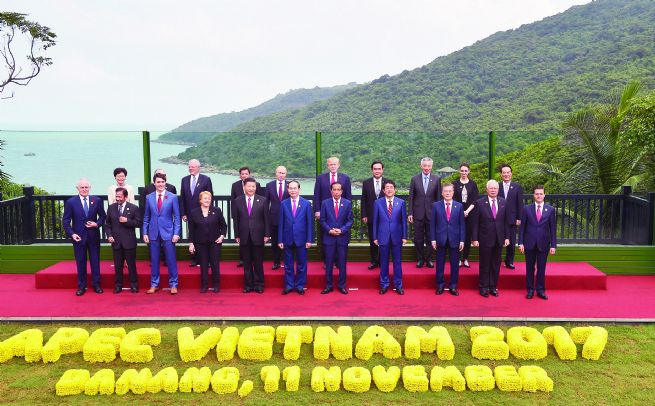
U.S. President Donald Trump joins other leaders of APEC member economies at the APEC Economic Leaders’ Week 2017 in Da Nang, Vietnam
The period from 1995 to 2013 witnessed rapid and comprehensive progress in Vietnam-U.S. relations. The announcement of the Vietnam-U.S. Comprehensive Partnership concluded in 2013 laid a framework for the two countries’ ties, confirmed the inevitable development trend of their bilateral ties and built a solid foundation for the development of their relations in the years to come. The two nations pledged comprehensive cooperation across nine key areas, including politics - diplomacy, trade - economics, science - technology, education - training, environment, health, war legacy settlement, defense - security, human rights protection and advancement, and culture - sports - tourism. Both parties emphasized principles of their comprehensive partnership based on respect for international law and the United Nations Charter, as well as mutual respect for each other’s independence, sovereignty, territorial integrity and political systems. This was the first time the U.S. officially affirmed its respect to Vietnam's political system.
An important progress in the Vietnam-U.S. Comprehensive Partnership was recognized in 2015 when the strategic confidence between the two countries was bolstered by the historic visit by General Secretary Nguyen Phu Trong to the U.S., which marked the 20th anniversary of normalized diplomatic relations. The visit held significant meaning for bilateral relations, marking the conclusion of a chapter in which the two countries fully normalized their relations under the spirit of “comprehensive cooperation,” while also ushering in a new era of Vietnam-U.S. relations. It also served as a prime example of the growth and overall strength of Vietnam’s comprehensive and modern diplomacy, built on three key pillars: Party diplomacy, state diplomacy, and people’s diplomacy.
Substantive and effective cooperation
With this strong foundation, the Vietnam-U.S. Comprehensive Partnership has further deepened and become more effective and substantive across all fields, at bilateral, regional and global levels.

On August 5, 1995, in Hanoi, U.S. Secretary of State Warren Christopher and Vietnamese Foreign Minister Nguyen Manh Cam sign a protocol to formally establish diplomatic relations between the two countries
In politics and diplomacy, mutual understanding and respect have significantly increased through regular high-level exchanges and contacts. Exchanges at all levels, particularly at the high level, have been strengthened, thereby reinforcing and deepening the vision, objectives, approach, principles and directions for cooperation while addressing most issues in a balanced, harmonious and effective manner. The two sides have actively implemented dialogue and consultation mechanisms, gradually moved into more substantive content and established some new mechanisms for dialogue and consultation.
Vietnam-U.S. regional and international cooperation has made significant strides. Both sides have actively coordinated in organizing important international and regional events and activities and effectively implemented initiatives and mechanisms within the frameworks of the United Nations (UN) and the Association of Southeast Asian Nations (ASEAN). The U.S. supports Vietnam’s position and has increasingly pursued actions and core policies aligned with Vietnam’s interests on such key issues as the East Sea, the Mekong subregion and climate change response. The U.S. also places high importance on cooperation with Vietnam across other significant regional matters.
Thirty years of diplomatic ties, 25 years of the Vietnam-U.S. Bilateral Trade Agreement (BTA), more than 10 years of the Comprehensive Partnership and two years of the Comprehensive Strategic Partnership, the bilateral relationship has kept growing steadier and more positive in all sectors, with economic, trade and investment pillars serving as the central driving force behind overall bilateral cooperation.
In 2024, the total trade value between the two countries reached nearly US$150 billion, representing a 20.5% growth compared to the previous year. Vietnam became the U.S.’s 8th largest trading partner and 4th largest export market in ASEAN. Conversely, the U.S. is Vietnam’s second-largest trading partner and top export market for electronics, apparel, footwear and agricultural products.
By the end of 2024, U.S.’s direct investment in Vietnam reached approximately US$11.94 billion, with more than 1,400 projects. Most of major U.S. corporations have already established a strong presence and had productive investment and business in Vietnam while many Vietnamese companies have also invested in the U.S. market. Vietnam currently has 252 investment projects in the U.S., with a total investment capital of over US$1.36 billion, ranking 6th out of 83 outbound investment destinations. Vietnam is increasingly attracting high-tech investments from the U.S., particularly in microchips and semiconductors, to keep pace with the global science and technology era. Vietnam also plays a vital role in the U.S.’s global supply chains while U.S. businesses have made significant contributions to Vietnam’s economic transformation and development.
Toward deeper and more effective cooperation
According to General Secretary To Lam, the Vietnam-U.S. relationship is an exceptional process and an exemplary model in international relations for post-war reconciliation and partnership building. Although initial interactions between the two nations date back more than two centuries, they had to undergo numerous challenges and ups and downs, from former adversaries to friends and eventually becoming comprehensive partners in 2013.
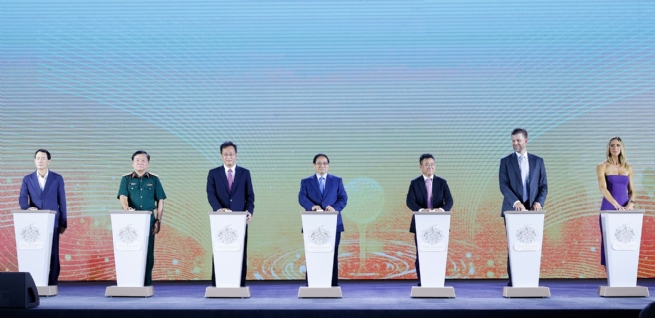
Prime Minister Pham Minh Chinh (middle) and delegates launch the Trump International Hung Yen project, May 2025
After more than 10 years of implementing the Comprehensive Partnership, Vietnam and the U.S. have made important progress in reinforcing trust and bolstering mutual understanding, hence paving the solid base for the two countries to upgrade its relationship to the Comprehensive Strategic Partnership in 2023 and realizing the vision of President Ho Chi Minh.
"This achievement is the fruition of relentless efforts by generations of leaders, governments, legislatures and people of both countries in the past three decades to reconcile and build trust," General Secretary To Lam emphasized.
According to U.S. Ambassador to Vietnam Marc E. Knapper, in the past three decades, Vietnam-U.S. relations have grown robustly, especially in economics, security, diplomacy, healthcare and education. He underscored mutual respect for each other’s independence, sovereignty and political regimes as the foundation of the partnership.
He also stressed that despite many proud achievements, the bilateral relationship still needs to grow deeper and broader, especially in high-tech and innovation sectors.
“On the 30th anniversary of diplomatic relations, we look toward deeper and more effective cooperation. While we have achieved many proud milestones, we must not rest on our laurels, but we need to continue striving for a brighter and more prosperous future for the people of both countries. The U.S. is committed to supporting a strong, prosperous, independent and resilient Vietnam,” Ambassador Knapper stated.
With the comprehensive and concrete substance of the new partnership framework, both sides still have ample room to further deepen and advance the bilateral relationship in a stable and substantive manner, bringing greater benefits to the people of both nations and contributing to peace, stability and prosperity in the region and the world. More importantly, this will help both sides build trust, a crucial foundation so that “We can work together to build a bright vision for our bilateral relations so that our two nations and our future generations will always remain friends and good partners as General Secretary Nguyen Phu Trong remarked during his historic visit to the U.S. in 2015.
Anh Mai (Vietnam Business Forum)
 April 24–25, 2026
 Kinh Bac Cultural Center, Bac Ninh Province


 Vietnamese





