

9:45:31 AM | 6/25/2025

Huong Son land (Huong Son commune, My Duc district, Hanoi city) is famous for the famous Huong Pagoda "Nam Thien De Nhat Dong". Coming here, visitors are not only impressed by the poetic Yen stream that attracts visitors from afar and the majestic natural landscape, but also enjoy many natural specialties such as rau sang, cu yam and it would be a mistake not to mention apricots, a fruit that creates many delicious and healthy drinks, and is also an ingredient for the unique Huong Tich apricot wine.
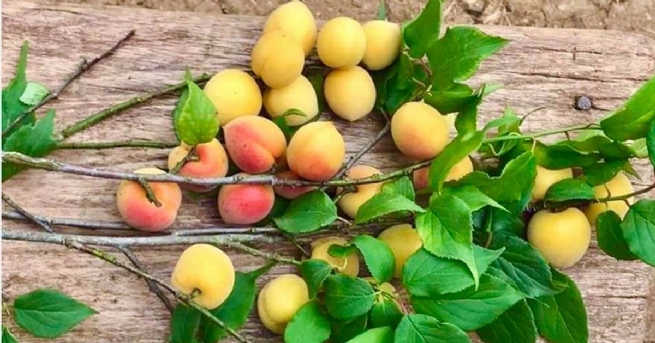
From apricots harvested on the mountain and fermented in sticky rice wine for at least 4 years with the dedication of the craftsmen, "Huong Tich apricot wine" is truly the quintessence of the Buddha land - Huong Pagoda.
In Huong Son, there are many types of apricots, but the most famous and delicious is still the red-spotted apricot or also known as double-deciduous apricot. Only in Huong Son land can there be such a delicious type, because it is suitable for the soil and climate here. Because of its delicious quality, Huong Tich apricots have been included in the "List of some genetic resources of Hanoi's specialty crops". Since 2011, the Hanoi People's Committee has assigned the Hanoi Department of Agriculture and Rural Development to coordinate with the Hanoi Protective Forest Management Board and local authorities to implement the project "Restoring, improving and developing some rare specialty trees in Huong Son special-use forest", including apricot trees. Implementing the project, the authorities have supported people in building infrastructure systems, transportation, tree varieties, fertilizers, etc. to develop apricot trees.
However, the support is not enough, and there need to be many comprehensive solutions to help apricot trees affirm their specialty status, the effectiveness is not commensurate with their potential. Apricots contain many vitamins and nutrients. A glass of apricot juice soaked in sugar is a great summer thirst quencher. The slightly sour apricot juice is balanced by sugar, the irresistible aroma, the faint scent of the forest, difficult to locate in words. For a long time, monks at Huong Pagoda have known how to exploit apricots around the pagoda area to brew wine to treat visitors. Later, people in Huong Son commune also went into the forest to pick apricots and bring them back to brew wine. From the best apricots, carefully selected, soaked with the best wine in the region, combined with experience and traditional wine brewing secrets, Huong Pagoda apricot wine products have become especially delicious. Through many ups and downs and changes in society, the quintessence in the characteristic flavor of Huong Pagoda apricots has been passed down to generations. Huong Pagoda apricot wine has become a specialty of Huong Son mountains and forests that nature has bestowed upon this place.
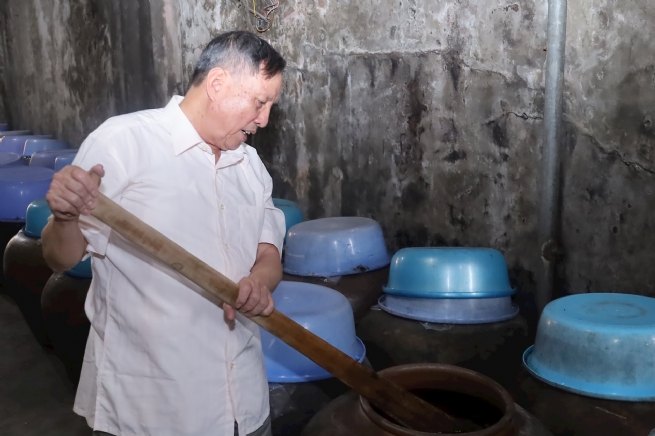
Mr. Trinh Tien Dung, a famous apricot wine maker, owner of Huong Tich apricot wine production facility, former Party Secretary of Huong Son commune, My Duc district, Hanoi shared: the profession of making apricot wine is unlike any other craft, because it requires "playing with time". “A good batch of plum wine cannot be made in a hurry. From the time the fruit is picked until it is poured into bottles for sale, it takes at least 4 years.” The special thing about Huong Tich plum wine is that the ingredients are carefully selected from this land. The plums must be grown in the Huong Son mountain valleys with thick, fragrant, and mildly sour flesh. Choosing each ripe, yellow fruit with no signs of worms eating or making nests, Mr. Dung washes it with clean water, then with warm, boiled water to remove the larvae. To drain the fruit, Mr. Dung marinates the plums with sugar at a ratio of 5-7 ounces of sugar per kilogram of fruit. “The maker must taste each batch of plums and each jar of wine to adjust the sourness and sweetness to the right level. If the fruit is unripe, the wine will be pungent and bitter. If the fruit is too sour, it will be difficult to drink. Only the plums that have “slept” for two years in sugar will produce delicious essence,” Mr. Dung informed.
The wine used for soaking is made by Mr. Dung from yellow sticky rice. "I do not use probiotics but use Chinese herbal yeast, which is both fragrant and enhances the flavor of the apricots, which is good for health," he emphasized. On average, each year, Mr. Dung's family uses 5-6 tons of sticky rice to make wine and soak apricots. The distilled wine used to soak apricots must have an alcohol concentration of 40 degrees or higher. After 4 years of soaking in earthenware jars and apricots, the wine will naturally lower its alcohol concentration to about 30 degrees. If aged for 10 years or more, Huong Tich apricot wine can reach its peak - the drinker will only feel excited as if they had never drunk alcohol.
The secret to making Mr. Dung's apricot wine popular with customers is its clear, deep aroma, light sweet aftertaste, no headaches, no thirst after drinking. "It's all thanks to the apricot ingredients, standard sticky rice wine, and long soaking time," Mr. Dung shared.
Mr. Dung's family's Huong Tich plum wine products are packaged in ceramic jars, which are not only convenient for giving as gifts, but also used to decorate ancestral altars and Vietnamese people's meals. Every year, Mr. Dung's family supplies the market with about 3,000-4,000 liters of Huong Tich plum wine. At the end of the year and during festivals, the product is often sold out.
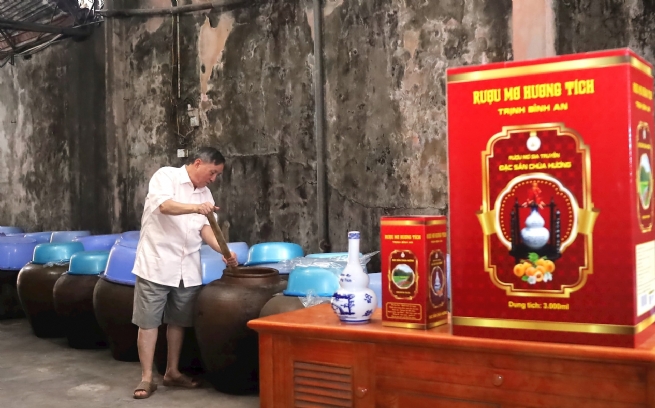
Mr. Dung added that he has twice brought Huong Tich plum wine products to participate in the OCOP evaluation and ranking. The first time was in 2018 and the second time, re-evaluated in 2023 and achieved 3 stars. He participated in the OCOP program because in addition to quality, he also had to pay attention to packaging, labels, codes, barcodes, and brands to be recognized. Since being recognized as OCOP, my products have become more known to many people, which is also a way to maintain the drink left by our ancestors.
Vice Chairman of My Duc District People's Committee Le Van Trang commented: “Huong Tich plum wine of Mr. Trinh Tien Dung's family is one of the typical products of the locality, harmoniously combining traditional elements and safe production standards. The fact that the product has been recognized with 3 consecutive OCOP stars is proof of its quality and development potential. We are supporting Mr. Dung to complete the documents and designs to aim for 4-star classification in the near future...”.
“OCOP is not just a certificate, but a motivation for me to do things more accurately and systematically. I have to number each jar, monitor the aging time, and record in detail. Wine that is not at least 4 years old is not for sale...”, Mr. Dung said. Currently, plum trees in Huong Son commune are no longer planted as much as before. The area is only about 15-20 hectares, with a crop yield of less than 10 tons. This makes the plum wine soaking profession even more valuable, requiring persistent investment.
By Minh Ngoc, Vietnam Business Forum
|
This special section is supported by Hanoi Coordination Office of the New Rural Development Program |
 April 24–25, 2026
 Kinh Bac Cultural Center, Bac Ninh Province


 Vietnamese





