

10:00:06 AM | 9/22/2025

Over the past 80 years of development, Vietnam’s tax sector has steadily expanded, reinforcing its central role in mobilizing resources for the state budget, serving as the “lifeblood” of national finance, supporting socio-economic stability, and promoting renewal and integration.
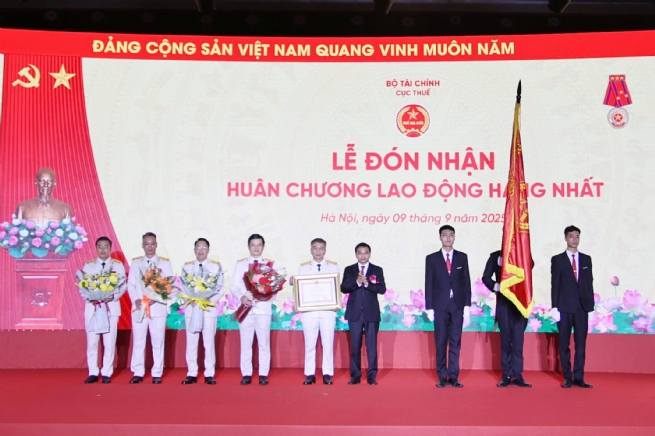
The Department of Taxation is honored with the First-Class Labor Order
Outstanding achievements
Steadfast as the pillar of the national budget: Whether during wartime in defense of the nation or in peacetime today, the tax sector has consistently fulfilled its political mandate assigned by the Party, the State, and the People, ensuring sustainable budget revenue, maintaining fiscal balance, contributing to macroeconomic stability, and safeguarding social welfare.
State budget revenue under the tax sector’s management has increased impressively, from VND5.2 trillion in 1990 to more than VND1.7 quadrillion today, and is projected to surpass VND2 quadrillion by 2025, an increase of 380 times compared to 1990. The revenue structure has shifted positively, with a rising share of domestic collection, reflecting sustainable growth driven by the economy’s internal strengths. Notably, in times of economic hardship, the tax sector has proactively advised, enacted, and effectively implemented timely tax exemption, reduction, and deferral policies, helping citizens and businesses recover and expand production and business activities, thereby fulfilling the “dual mandate” set by the Government and the Ministry of Finance.
Improving institutions and creating a favorable business environment: Vietnam’s tax policies and laws have become increasingly comprehensive, consistent, modern, and aligned with international practices, expanding the tax base to include nearly all revenue sources and economic sectors. In international tax cooperation, the sector has advised the Government and the Ministry of Finance to sign double taxation agreements with more than 75 countries and to join multilateral tax cooperation mechanisms such as the Multilateral Tax Reform Convention, the Convention on Mutual Administrative Assistance in Tax Matters (MAAC), and the Inclusive Framework on BEPS. These efforts have created a transparent investment environment, promoted business activities, safeguarded national interests, and enhanced Vietnam’s role and responsibility on the global stage.
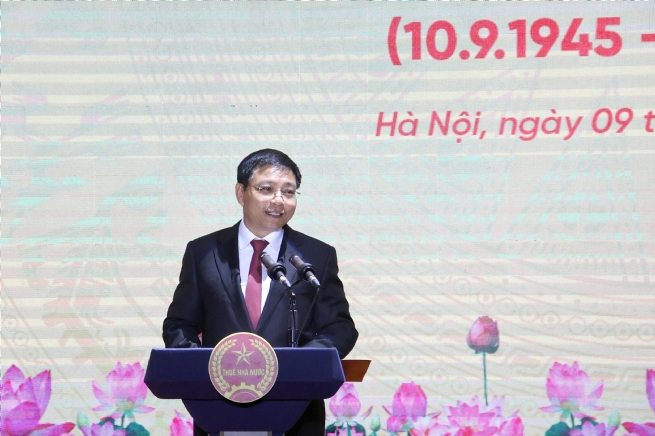
Minister of Finance Nguyen Van Thang acknowledges the tax sector’s role as a key force supporting national development and people’s livelihoods
Pioneering modernization and digital transformation: Today, over 99% of enterprises use e-tax filing and payment services; 100% of enterprises use e-invoices; and nearly 7 million individuals use the e-tax mobile application.
The tax sector has taken the lead in linking with national data systems under Project 06, using digital IDs to clean and authenticate taxpayer data. Over 30 million taxpayers have so far accessed the system with digital identification accounts.
In 2025, the sector continues exchanging data with the national data center to optimize shared national datasets, simplify administrative procedures - especially those requiring interconnected data such as land, motor vehicles, and financial reporting - and improve tax management and policy implementation.
A milestone was the Politburo’s issuance of Resolution 68 on May 4, 2025, which mandates the complete abolition of presumptive taxation on household businesses from January 1, 2026, shifting entirely to a self-declaration and self-payment mechanism. This marks a profound transformation for the tax sector on its modernization path, creating a fairer business environment and contributing significantly to state revenue.
In parallel with Resolutions 57 and 68, the tax sector is working daily to deliver better services to citizens and businesses. On August 1, 2025, the Department of Taxation officially launched a tax information portal for entrepreneurs and released a set of three electronic tax handbooks for business owners, chief accountants, and household or individual businesses. The handbooks are integrated with AI-enabled smart Q&A functions, allowing quick and convenient access to tax policies and procedures. This tangible achievement reflects the sector’s innovative spirit in implementing the Politburo’s core Resolutions.
Consistently guided by the principle of “putting taxpayers at the center of service,” taxpayer satisfaction is the key measure of performance and reflects the sector’s firm transition toward modernization and professionalism in the new development stage.
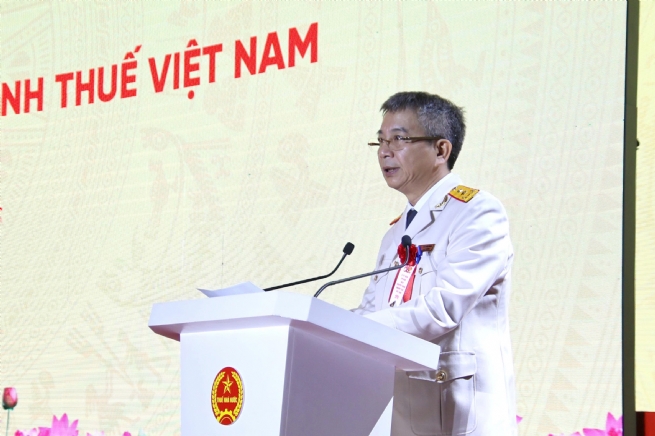
Director General of Taxation Mai Xuan Thanh commits that the tax sector will continue striving to excellently fulfill its assigned tasks
Key tasks for the tax sector
In the new context, the tax sector faces pressing demands, and Minister of Finance Nguyen Van Thang called on the sector to focus on several key tasks: Completing tax institutions and policies not only to mobilize resources effectively for the budget but also to create a favorable business environment, encourage innovation, and resolve existing institutional bottlenecks.
Strengthening revenue management and combating tax evasion, particularly in e-commerce, the digital economy, and cross-border activities, while resolutely handling violations and preventing invoice fraud and tax refund fraud to ensure fairness and equality in tax obligations and maintain stable budget revenues. Promoting administrative reform and improving taxpayer services by determinedly cutting and simplifying tax procedures so that all processes are clear, accessible, and easy to comply with, striving for 100% of tax procedures to be conducted online, interconnected, and fully digital, with the goal of reducing compliance time and costs for businesses and citizens while enhancing satisfaction, trust, and social consensus toward tax authorities.
Accelerating comprehensive digital transformation in tax management and building centralized databases as a core, continuous task, requiring the urgent design and implementation of a nationwide IT system overhaul to ensure a modern, integrated infrastructure with accurate, complete, clean, and live data, alongside developing a centralized, intelligent tax management system that leverages artificial intelligence (AI), big data, cloud computing, and real-time analytics to improve administration, manage risks effectively, and expand diverse digital tax services that promote fast, transparent, secure, and convenient taxpayer transactions, making digital transformation a driver of improved management capacity and the best support for businesses and citizens.
Enhancing training and discipline to build a clean, transparent, and integrity-driven tax administration that serves the people through continuous professional development and strict discipline within the workforce.
“These are strategic, decisive, and enduring tasks - foundations for the tax sector to continue affirming its core and pioneering role in securing budget revenues, contributing to the development of a stable, transparent, and modern national financial system, and playing a vital part in the country’s sustainable and prosperous development,” Minister of Finance Nguyen Van Thang emphasized.
By Huong Hau, Vietnam Business Forum


 Vietnamese





