

11:17:49 AM | 10/13/2025

Sharing the view that the two countries still have great potential and room to further enhance cooperation, especially in the fields of economy, trade, and investment, Mr. Michele D’Ercole – Chairman of the Italian Chamber of Commerce in Vietnam (ICHAM) – shared with Vietnam Business Forum his insights on trade sectors and business relations between Vietnam and Italy.
 |
Vietnam–Italy Strategic Partnership builds on over five decades of cooperation and is expanding across multiple domains. Science, technology and innovation are both the “bridge” and the “engine” of bilateral ties. From your perspective, which sectors and technologies in Vietnam are currently drawing the strongest interest from Italian companies (e.g., biomedical devices, automation & robotics, advanced materials, smart agriculture, clean energy, etc.)?
Over the last decades, the Vietnam–Italy Strategic Partnership has not only grown stronger but has also become increasingly diversified, with science, technology, and innovation serving both as a bridge and as a true engine of cooperation. Italy and Vietnam are actively advancing academic, institutional, and business collaboration, with particular attention to the key challenges of our times: sustainable growth, digital transformation, and the green transition. A concrete example is our joint work within the Just Energy Transition Partnership (JETP), where Italy has been contributing ideas and expertise to support Vietnam’s ambitious net-zero target by 2050.
Scientific and technological cooperation is progressing steadily, as demonstrated by the Italy–Vietnam workshop on semiconductors, co-organised with Vietnam’s National Innovation Centre. This initiative highlighted the enormous potential for joint innovation in a sector of global strategic relevance, one that sits at the heart of the digital economy and future industrial competitiveness. Similar formats are being considered in other areas such as green building, circular economy, and biomedical innovation, where Italian universities, research centers, and enterprises can bring significant value. Looking ahead, several areas appear particularly promising for Italian companies to bring their recognized expertise. These include mechanics and industrial machinery, where Italy has long been a global leader, as well as renewable energy and clean technologies, which are crucial to Vietnam’s green transition. Smart agriculture and sustainable design also represent important opportunities, especially as Vietnam modernizes its agri-food sector. At the same time, advanced manufacturing, automation, and Industry 4.0 solutions are becoming increasingly relevant to enhance competitiveness and efficiency. Finally, digitalization and smart city development stand out as key fields where Italian know-how can significantly contribute to Vietnam’s transformation into a high-value, future-oriented economy. Italy is widely regarded as a reliable partner, synonymous with quality, creativity, and innovation. As Vietnam strives to become a regional hub for high-value manufacturing, digital transformation, and sustainable development, Italian know-how and technologies can make a real difference. What makes this partnership unique is not only the complementarity of our economies but also the shared vision of building long-term, resilient, and future-oriented cooperation for the benefit of both nations.
Vietnam is advancing semiconductors, AI, IoT, quantum technologies and green hydrogen to drive the green and digital transitions. Where do you see the most promising avenues for Vietnam–Italy cooperation (technology transfer, startup incubation, co-developing supply chains)? What policies and practical mechanisms should governments and businesses prioritize (regulatory sandboxes, co-funded research programs, expert exchanges & training, joint innovation hubs) to turn potential into results?
The most promising avenues for Vietnam–Italy cooperation in emerging fields such as semiconductors, artificial intelligence, the Internet of Things, quantum technologies, and green hydrogen are manifold and depend on the specific stage of each technology. They range from technology transfer and startup incubation to the co-development of supply chains. In this regard, ICHAM has recently signed an MoU with the Institute of Information Technology for Business, an affiliated unit of the Vietnam Chamber of Commerce and Industry (VCCI), to establish a cooperative framework aimed at supporting, developing, and promoting promising startups in both Vietnam and Italy. This kind of initiative represents a practical step to connect innovative ecosystems and foster long-term collaboration. At the same time, cooperation in co-developing supply chains will be crucial, ensuring that innovation is matched by industrial capacity and market access. From the perspective of a business association, we believe that governments and enterprises should prioritize policies and mechanisms that can translate potential into tangible results. These include co-funded research programs to share both risk and reward, expert exchanges and joint training programs to build human capital, and joint innovation hubs that serve as platforms for collaborative R&D and commercialization. Regulatory sandboxes could also play an important role in allowing companies to test new technologies in a controlled environment, thus accelerating adoption while managing risks. Training and capacity-building stand out as particularly vital. Without the right skills, even the best technologies cannot achieve their full impact. Therefore, equipping young professionals, researchers, and entrepreneurs with the necessary expertise will be key to achieving results within a reasonable timeframe. By combining Italy’s strong traditions of innovation and design with Vietnam’s dynamism and growth trajectory, we can together create a framework where advanced technologies not only drive the green and digital transitions but also open new horizons for sustainable and inclusive development.
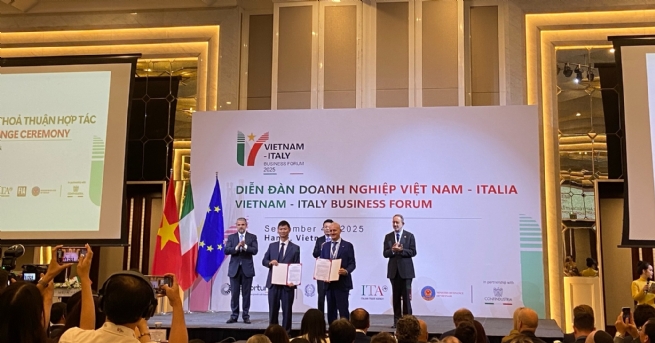
ICHAM SIGNED (MoU) with VCCI-ITB (the Institute of Information Technology for Business under the Vietnam Chamber of Commerce and Industry)
How do you assess the current status and growth potential of Vietnam’s supporting industries (electronics components, precision engineering, tooling & molds, materials, industrial logistics, etc.)? For Italian firms, what are the key advantages and challenges when engaging with Vietnam’s investment policies, incentives and procedures today? What recommendations would you make to upgrade industrial infrastructure, clusters, tier-2/3 suppliers and compliance with international standards (ESG, traceability, EU norms)?
In recent years, the status and growth potential of Vietnam’s supporting industries have improved significantly, reflecting the country’s efforts to move up the value chain. However, important gaps remain in areas such as electronics components, precision engineering, tooling and molds, advanced materials, and industrial logistics. Many local companies still rely on imported components and intermediate products that are not yet produced domestically, which limits the competitiveness and resilience of supply chains. For Italian firms, one of the key challenges is navigating Vietnam’s investment policies, incentives, and procedures. While the government has introduced a number of favorable measures, some aspects are still not fully clear or consistent, occasionally creating misunderstandings for foreign investors. Simplifying procedures, ensuring transparency, and accelerating administrative digital transformation would go a long way toward attracting more Italian investment into Vietnam. At the same time, there are strong advantages that make Vietnam an attractive destination: a dynamic and resilient economy with positive growth forecasts, political stability, and a strategic geographical location at the heart of ASEAN, offering access to both regional and global markets. These factors, combined with Vietnam’s ongoing integration into major free trade agreements such as the EVFTA, provide a solid foundation for stronger industrial partnerships. Looking ahead, upgrading infrastructure is essential. Improving mobility—through better roads, bridges, ports, and logistics facilities—will directly enhance the competitiveness of industrial clusters and supply chains. The presence of foreign investors, including Italian companies, can also play a catalytic role in upgrading local tier-2 and tier-3 suppliers, helping them to meet international standards such as ESG compliance, product traceability, and EU norms. From Vietnam’s side, it will be crucial to facilitate local procedures and create a clearer regulatory framework that encourages firms to adopt these standards. By doing so, Vietnam can not only strengthen its supporting industries but also position itself as a reliable hub for sustainable and globally integrated manufacturing, where Italian technology and expertise can make a decisive contribution.
Source: Vietnam Business Forum




 Vietnamese





